
Empire State Realty Trust Balances Iconic Asset Growth with Rising Debt and Observatory Challenges
ESRT leverages its prized NYC portfolio for steady leasing gains while navigating debt maturities and subdued observatory visitation.
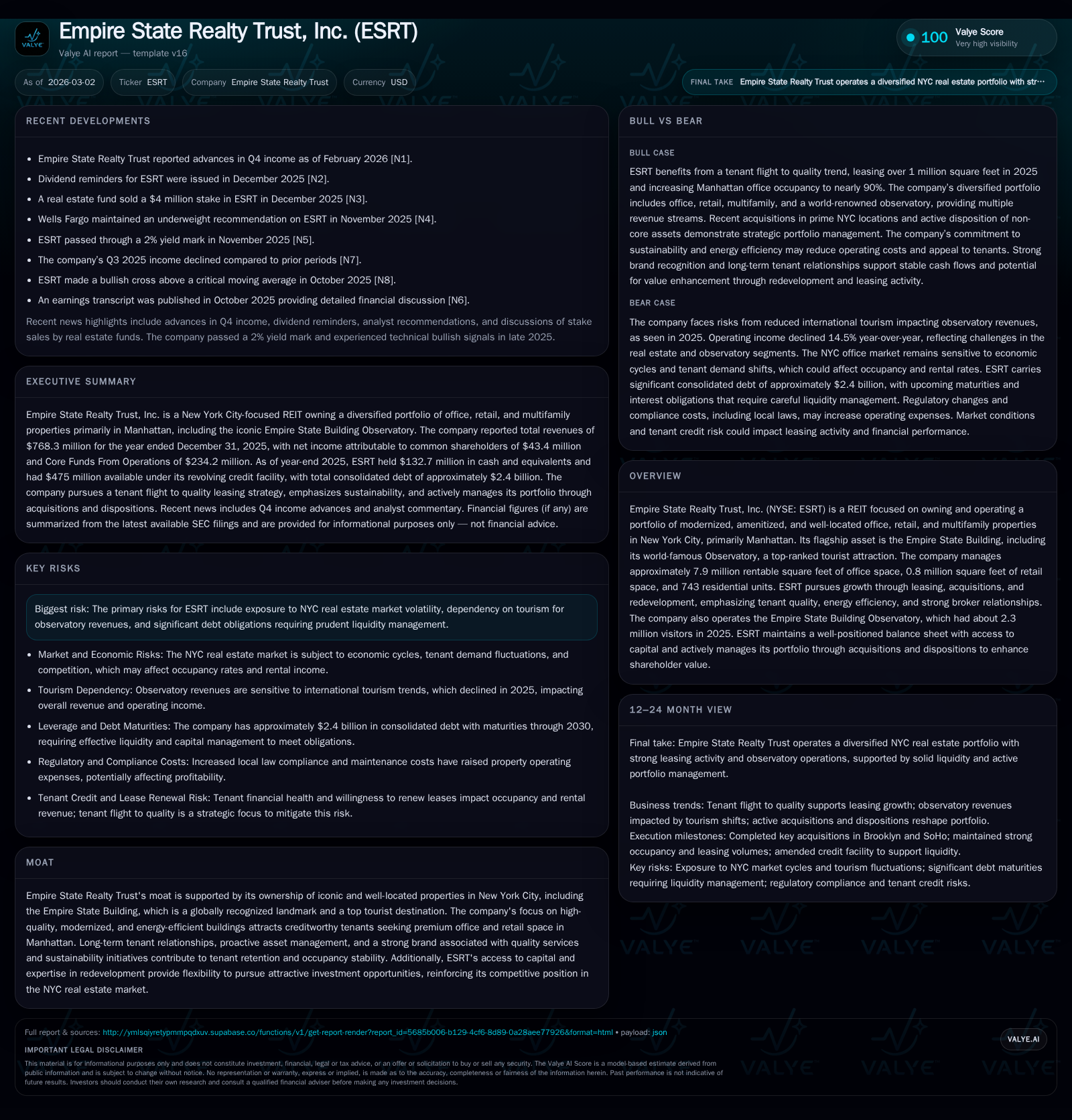
Empire State Realty Trust, Inc. operates a premier portfolio anchored by the Empire State Building, generating modest revenue growth through focused leasing and strategic acquisitions in NYC’s office, retail, and multifamily markets. In 2025, rental revenues ticked up by nearly 2%, driven by tenant expansions and new leases, even as observatory revenue declined amid weakened international tourism. The company secured over one million square feet in new and renewed leases, raising Manhattan office occupancy and benefiting from tenant flight-to-quality trends. However, operating income fell 14.5% year-over-year due to softer observatory results and increased expenses. ESRT's capital structure includes approximately $2.4 billion in consolidated debt with a weighted average maturity of 4.8 years, supported by access to a $475 million revolving credit facility and $132.7 million in cash at year-end 2025. The firm continues active portfolio management including recent acquisitions in SoHo and Williamsburg while maintaining shareholder returns through buybacks authorized up to $500 million over two years. Balancing landmark asset leverage and evolving market risks will shape ESRT's near-term trajectory.
Company Overview
Empire State Realty Trust, Inc. (NYSE: ESRT) owns and operates a high-quality portfolio of office, retail, and multifamily properties centered on New York City’s prime submarkets. At the portfolio core stands the iconic Empire State Building and its flagship Observatory, which remains a leading tourist draw despite recent visitation headwinds [S1][S14]. ESRT’s asset base encompasses approximately 7.9 million rentable square feet of office space spread across ten Manhattan properties, nearly 0.8 million square feet of retail properties, and 743 residential units predominantly in Manhattan [S1][S14].
Historical Performance Drivers
From an operational standpoint, ESRT has benefited from macro tenant trends favoring well-located, modernized buildings equipped with superior amenities and energy-efficient infrastructure — traits that align well with the broad "flight-to-quality" movement evident in NYC's office market [S12]. This tenant preference underpinned the company’s ability to lease over one million rentable square feet in new or renewed contracts during 2025 while pushing Manhattan office occupancy to nearly 90%, excluding redevelopment-affected assets [S1][S12].
Financially, these operational improvements contributed to rental revenue rising by about 1.9% to $626 million in FY2025 from FY2024 levels [F1][S13]. This increase was primarily propelled by higher base rents from new leases as well as uplift from tenant reimbursement income; however, lease termination fees dropped significantly year-over-year [S1]. Meanwhile, net revenues from the Empire State Building Observatory declined roughly 5.9%, driven largely by a reduction in international visitors despite modest gains in domestic attendance and revenue per visitor enhancements [S22]. Visitor counts totaled approximately 2.3 million in calendar year 2025 compared to about 2.6 million the prior year [S22].
Historical performance (annual)
| FY | Rev ($mm) | CFO ($mm) | OpInc ($mm) | Capex ($mm) | Rev YoY |
|---|---|---|---|---|---|
| 2025 | 768 | 249 | 136 | +0.0% | |
| 2024 | 768 | 261 | 159 | +3.8% | |
| 2023 | 740 | 232 | 147 | 169 | +1.7% |
| 2022 | 727 | 211 | 127 | 86 |
Source: SEC companyfacts cache [F1].
Capital returns and efficiency (annual)
| FY | Buybacks ($mm) | FCF ($mm) |
|---|---|---|
| 2025 | 8 | |
| 2024 | 0 | |
| 2023 | 13 | 63 |
| 2022 | 90 | 125 |
Source: SEC companyfacts cache [F1].
Operating expenses rose moderately due to higher property-related payroll costs (notably cleaning due to greater building utilization), utility expenses, repairs, maintenance linked to local law compliance mandates, as well as marketing and maintenance expenses associated with Observatory operations [S13][S22]. Total operating expenses increased nearly four percent year-over-year [S1]. This resulted in operating income contracting by approximately 14.5%, from around $159 million in FY2024 to nearly $136 million for FY2025 [F1][S13].
Growth Prospects
Looking ahead, ESRT is positioned to capitalize on tenant flight-to-quality preferences through leases signed well ahead of term (“Early Renewals”), which support occupancy stabilization or growth even amid broader economy-driven uncertainties [S12]. The firm’s proactive leasing strategy yields accretive absorption even amid partially redeveloped assets.
Acquisition activity also figures prominently: notable closings include retail properties on North Sixth Street in Williamsburg acquired mid-2025 for $31 million and the December acquisition of a high-quality mixed-use property at SoHo’s Mercer Street for $386 million [S1]. These complement prior multifamily purchases enhancing diversification within New York’s attractive submarkets.
However, limitations exist around potential overreliance on tourism-dependent Observatory revenues given international visitation softness evident since mid-2024 impacting top-line performance despite domestic recovery efforts [S22]; ongoing pandemic-era behavioral shifts may constrain return patterns longer term.
The balance sheet maturity profile requires attention over the medium term—with about $54 million maturing principal plus amortization obligations due in calendar year 2026 alone—though the presence of long-dated maturities well into the next decade provides capital flexibility subject to refinancing execution risk [S4][S25].
Capital Allocation & Returns
Capital discipline remains emphasized alongside growth investments; operating cash flow generation stood near $249 million for FY2025 versus approximately $169 million invested into capital expenditures focused heavily on redevelopment projects that sustain competitive positioning [F1][S13]. The resultant free cash flow approximates $80 million annually—supportive of dividends alongside balance sheet servicing needs.
The Board reauthorized a share repurchase program totaling up to $500 million through end-2027 replacing prior authorizations—reflecting management confidence in equity valuation dynamics amidst stable cash flow generation despite sector cyclicality risks [S7]. Actual repurchases reached about $8 million during FY2025 with zero buybacks conducted prior year [F1], evidencing measured deployment aligned with liquidity preservation.
Financial Structure & Liquidity
ESRT maintained cash balances around $133 million at fiscal year-end with an undrawn revolving credit line offering further liquidity of approximately $475 million—important buffers given total consolidated indebtedness near $2.4 billion weighted at ~4.48% interest rate averaging close to five years duration reflecting balanced funding costs amid rising rates environment [F1][S4][S25]. Given scheduled amortization/maturity terms concentrated mostly post-2026 yet material several upcoming years out, prudent refinancing strategies will be critical.
The company also benefits from established industry relationships supporting mortgage financings alongside equity issuances as needed while monitoring financial covenants embedded within credit agreements ensuring capital structure flexibility under various scenarios [S6][S9][S11].
Risks & Moat Considerations
ESRT’s moat stems strongly from controlling world-renowned real estate assets coupled with best-in-class building modernization standards emphasizing energy efficiency—elements increasingly coveted across commercial tenant spectrums seeking sustainability-aligned real estate solutions along with superior tenant experience delivered via active management practices fostering strong retention rates.
Conversely risks persist related principally to the cyclical nature of New York City’s commercial real estate market vulnerable to economic downturns or shifts towards hybrid work models potentially limiting demand elasticity; likewise heavy debt maturities necessitate careful liquidity oversight especially if cap markets tighten or refinancing cost premiums expand unexpectedly [S16]. Dependence on travel volumes for Observatory revenues introduces external variability linked notably to global tourism trends outside ESRT's direct control.
Conclusion & What To Watch (Analysis)
Monitoring upcoming leasing velocity trends will be key given their role sustaining occupancy above submarket averages amid evolving office usage patterns citywide; similarly tracking observatory visitor mix recovery versus travel macro conditions remains vital for bottom-line impact assessment.
Refinancing execution against growing maturities alongside capital expenditure efficiencies comprise additional strategic touchpoints influencing future earnings stability.
Lastly, incremental support or deterrents stemming from NYC regulatory changes affecting operating costs or capital improvements could materially influence profitability margins going forward.
This analysis summarizes data compiled from Empire State Realty Trust’s most recent SEC filings and public disclosures as of March 2, 2026 ([F1], [S#], [N#]). It does not constitute investment advice or recommendations but aims to provide a detailed company profile grounded exclusively on available reported information.
Disclaimer: This is research-only, informational analysis and not investment advice. It may include AI-generated interpretation and general industry context. Always verify important details using primary sources.

Comments