
Grayscale Ethereum Staking Mini ETF’s 2025 Losses Expose Custody and Regulatory Risks
The Trust’s passive structure, reliance on Coinbase custody, and Ether’s uncertain security status contribute to steep net losses and liquidity challenges in 2025.
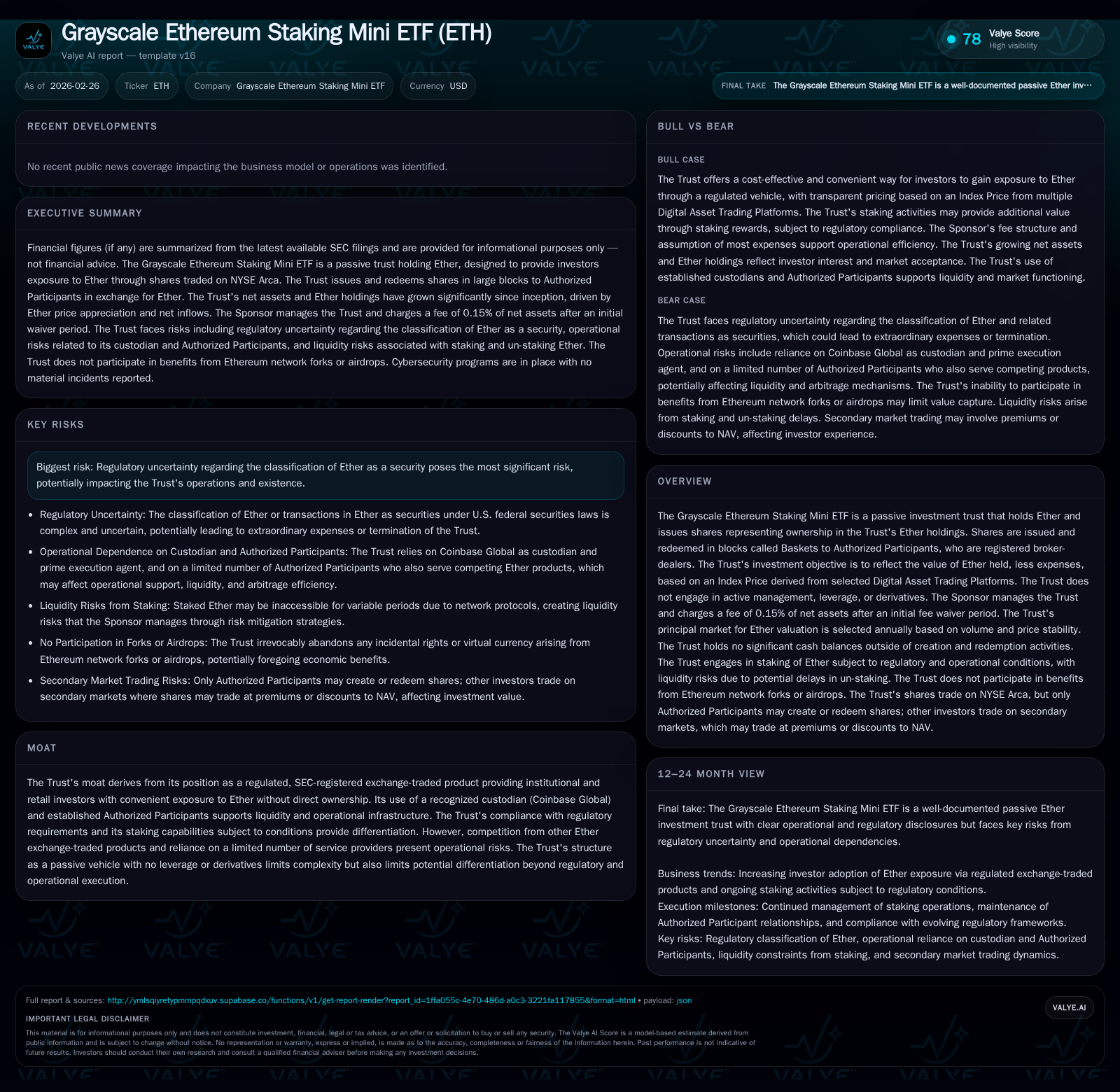
The Grayscale Ethereum Staking Mini ETF recorded a substantial increase in net losses and negative operating cash flows in FY2025, highlighting financial strain despite the growing digital asset market. The Trust’s passive structure, dependent on Coinbase Global custody and a limited group of Authorized Participants, introduces concentration and liquidity risks. Regulatory ambiguity over Ether’s classification as a security poses significant threats to the Trust’s operation and valuation. While staking offers yield potential, regulatory and liquidity constraints temper near-term growth prospects.
Financial Performance: Sharp Deterioration in Income and Cash Flow
The Grayscale Ethereum Staking Mini ETF (ETH) experienced significant financial headwinds in FY2025. Net income declined drastically from a loss of $32.8 million in FY2024 to a loss of $317.7 million in FY2025, representing an 868% year-over-year worsening [F1]. Operating cash flow also deepened its negative trend, with an outflow of $928.4 million compared to $591.3 million the prior year, a 57% decline [F1]. These figures underscore considerable challenges driven by market volatility impacting Ether valuations and increased extraordinary expenses related to regulatory compliance and trust operations detailed in filings [S1][S4].
Historical performance (annual)
| FY | Net ($mm) | CFO ($mm) | Net YoY |
|---|---|---|---|
| 2025 | -318 | -928 | -868.1% |
| 2024 | -33 | -591 |
Source: SEC companyfacts cache [F1].
Figures represent thousands of U.S. dollars for fiscal years ended December 31.
Structural Overview: Passive Trust Model and Market Dependencies
ETH functions as a passive investment trust that holds Ether directly without employing leverage or derivatives [S2][S5]. Shares represent fractional interests in the underlying Ether assets held by the Trust. Issuance and redemption occur only through Authorized Participants exchanging blocks of Shares called Baskets (10,000 Shares each) under specific agreements [S2].
This structure emphasizes cost-effective exposure but limits active management flexibility. Custodial services rely heavily on Coinbase Global, which also supports competing Ether exchange-traded products. This concentration raises risks related to resource allocation conflicts that could affect the Trust's operations and liquidity [S5]. Moreover, the limited pool of Authorized Participants serving multiple competing products may prioritize differently across trusts, potentially disrupting arbitrage activities essential for keeping Share prices aligned with NAV per Share [S5][S19].
Regulatory Landscape: Security Classification Risks and Compliance Burdens
A critical uncertainty involves whether Ether will be classified as a "security" under U.S. federal law—a determination with profound implications including possible Trust termination or restructuring due to compliance obligations [S4][S6][S10][S14].
Legal precedents show inconsistent judicial views on digital assets' status as securities, adding complexity to this risk [S16]. A security classification would disrupt current trading frameworks incompatible with securities regulations, likely impairing liquidity and valuation [S14].
Additionally, evolving anti-money laundering (AML) and know-your-customer (KYC) regulations applicable to custodians and Authorized Participants impose operational burdens that increase expenses and reduce funds available for investors [S9][S10][S23].
Operational Considerations: Custodian Role and Authorized Participant Dynamics
Authorized Participants facilitate creation/redemption processes and maintain arbitrage mechanisms aligning Share prices with NAV per Share [S5][S19]. However, their overlapping responsibilities across competing ETFs may lead to capacity constraints or conflicts affecting ETH’s liquidity.
Coinbase Global’s dominant position as custodian introduces concentration risk; any operational shortcomings or preferential treatment toward other products could impair ETH’s service quality and investor confidence [S5][S19].
Limitations or suspensions of cash or in-kind orders can widen bid/ask spreads during volatile periods common in digital asset markets, negatively impacting trading liquidity [S17][S19].
Growth Prospects: Staking Opportunities Amid Constraints
The Trust integrates Ethereum staking — locking Ether tokens for blockchain validation — which generates periodic staking rewards distributed as additional shares within regulatory limits [S20]. This feature positions ETH favorably amid institutional demand for yield-generating digital asset instruments.
However, staking involves token lockup periods varying by network protocol that introduce liquidity risk; withdrawals may take extended timeframes potentially constraining redemption capabilities [S20]. Regulatory oversight of staking remains fluid; future rules may limit staking capacity or require further compliance efforts restricting operational efficiency.
While staking adds incremental revenue potential beyond spot holdings exposure, its expansion depends heavily on regulatory clarity and effective liquidity management.
Capital Allocation: Fee Structure and Shareholder Value Implications
The Sponsor charges a management fee of 0.15% annually after an initial waiver period aimed at incentivizing early adoption; this fee level is competitive relative to traditional asset management while addressing digital asset custody costs [F1][S17].
No dividends or share repurchases occur due to the pass-through trust format where returns primarily derive from Ether price appreciation minus expenses rather than distributable earnings. Consequently, shareholders bear tax liabilities arising from sales of Ether used for expense payments without corresponding distributions, which can adversely affect after-tax returns [S1].
Given persistent losses combined with rising compliance-related costs absorbing capital resources, scope for shareholder capital return initiatives is minimal currently beyond managing expenses efficiently.
Outlook: Key Factors for Investors to Monitor
Though no explicit forward guidance is provided in filings, investors should closely watch:
- Regulatory rulings clarifying whether Ether is deemed a security under U.S. law.
- Enhancements in Authorized Participants’ ability to facilitate in-kind creations/redemptions improving liquidity.
- Continuity of custodial services provided by Coinbase Global ensuring operational stability.
- Mitigation strategies addressing staking-related liquidity risks as staking forms a core product differentiator.
- Overall digital asset market volatility influencing NAV alignment and investment appeal.
Quarterly updates should be reviewed for developments on these fronts alongside broader regulatory dialogues impacting digital asset frameworks.
This analysis is based solely on publicly available data without investment advice. Financial figures reflect exact reported values without implied forecasts. Regulatory uncertainties remain significant factors shaping performance over time.
Disclaimer: This is research-only, informational analysis and not investment advice. It may include AI-generated interpretation and general industry context. Always verify important details using primary sources.

Comments