
Grayscale Ethereum Staking ETF’s 2025 Loss Highlights Liquidity and Regulatory Pressures
ETHE’s shift to a $1.23 billion loss reflects Ether volatility, cash-only share mechanics, and evolving regulatory challenges impacting liquidity and capital strategy.
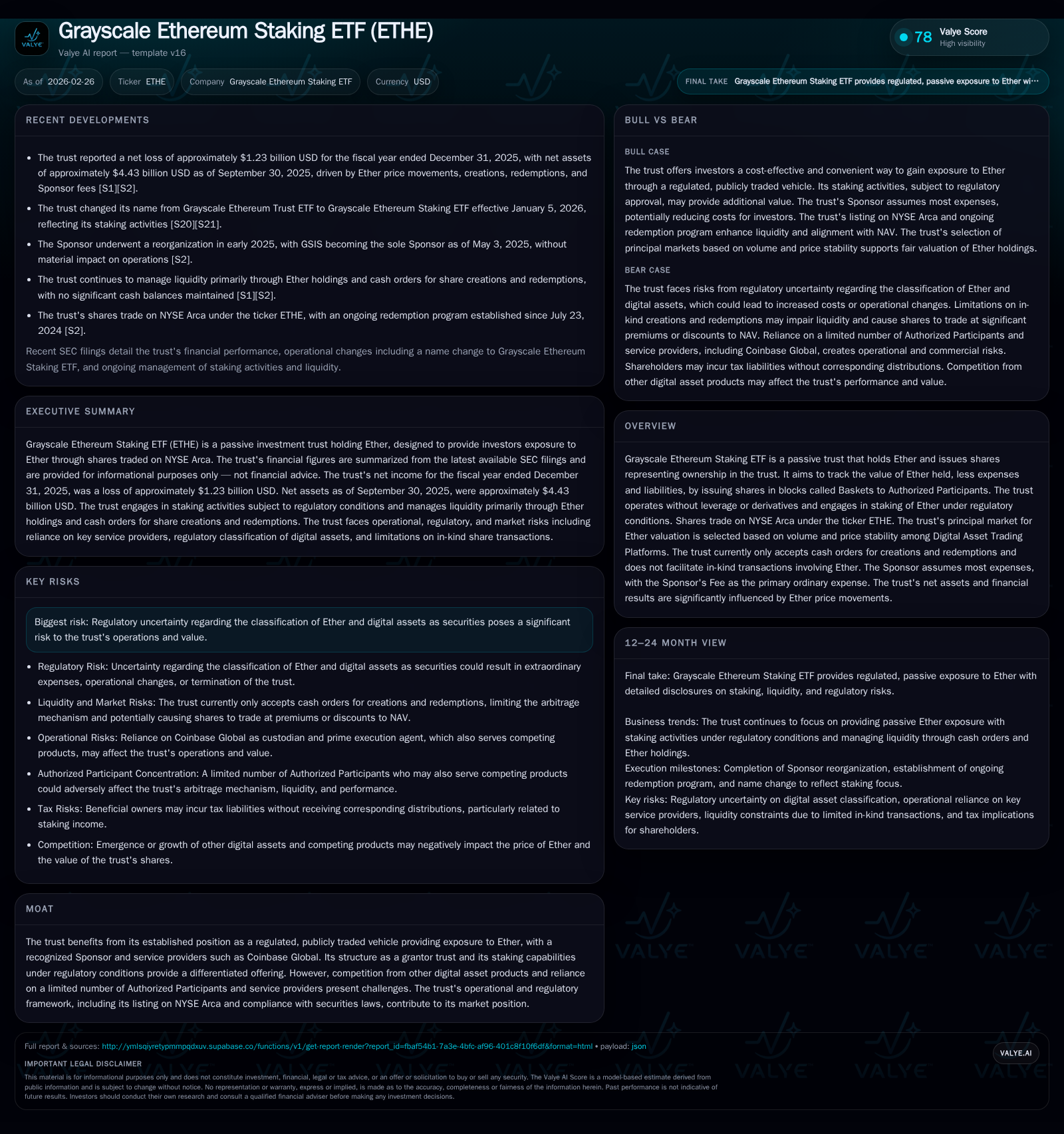
The Grayscale Ethereum Staking ETF (ETHE) experienced a significant financial reversal in 2025 following a profitable 2024, driven by Ether price volatility and structural expenses. Operating as a grantor trust with passive management, ETHE issues shares tied to its Ether holdings but currently limits transactions to cash-only creations and redemptions. Regulatory uncertainties around Ether’s security classification and money transmitter regulations pose ongoing risks. The trust’s staking approach introduces liquidity constraints that affect share pricing and market dynamics. Despite losses, substantial share repurchases funded by the Sponsor demonstrate active capital allocation aimed at supporting market confidence. Future developments in regulation and market participant behavior will be critical for ETHE’s sustainability.
Financial Performance: Significant Earnings Reversal
The Grayscale Ethereum Staking ETF (ETHE) reported a marked earnings reversal between fiscal years 2024 and 2025. Net income fell from approximately $1.14 billion in 2024 to a loss of $1.23 billion in 2025—a decline exceeding 200% year-over-year [F1]. This movement largely reflects the underlying volatility of Ether prices impacting the Trust's asset base alongside fixed expense obligations including Sponsor fees. Operating cash flow similarly contracted from $3.63 billion in 2024 to $1.41 billion in 2025 (a decline of over 60%), aligned with reduced transactional activity and realized losses [F1]. Share repurchases decreased but remained substantial at about $2.16 billion in FY25 compared to $3.65 billion in FY24 [F1]. ETHE’s passive structure excludes leverage or derivatives, limiting downside protection against price swings.
Historical performance (annual)
| FY | Net ($mm) | CFO ($bn) | Net YoY |
|---|---|---|---|
| 2025 | -1226 | 1.4 | -207.3% |
| 2024 | 1143 | 3.6 |
Source: SEC companyfacts cache [F1].
Capital returns and efficiency (annual)
| FY | Buybacks ($bn) |
|---|---|
| 2025 | 2.2 |
| 2024 | 3.6 |
Source: SEC companyfacts cache [F1].
Table: Key financial metrics highlight material earnings volatility linked to Ether price fluctuations and fixed cost structures [F1].
Operational Framework: Passive Grantor Trust Model
ETHE operates as a grantor trust managed passively without officers or employees [S2]. It issues shares in blocks called "Creation Baskets" (10,000 shares each), which Authorized Participants may create or redeem exclusively via cash transactions rather than in-kind exchanges of Ether itself [S2]. This cash-only mechanism differentiates ETHE from traditional ETFs that typically use in-kind redemptions to minimize premium/discount fluctuations.
The Trust's Net Asset Value per share is based on Ether prices aggregated across selected Digital Asset Trading Platforms weighted for volume and price stability [S20]. The Sponsor covers most operational expenses through fees deducted from the Trust assets; however, these fee-related sales of Ether can trigger tax liabilities for shareholders without corresponding distributions [S2].
Regulatory Risks: Evolving Landscape Impacting Valuation and Operations
ETHE faces significant regulatory uncertainty regarding Ether's classification as a security or commodity—an outcome that could impose compliance costs or force termination of the Trust [S1, S4, S9]. Additional regulatory burdens may arise if the Trust or its Authorized Participants are designated as money services businesses or money transmitters subject to FinCEN regulations and state licensing requirements [S5, S14]. Such developments could increase expenses materially and reduce liquidity if APs disengage.
Foreign jurisdictions have imposed various restrictions affecting digital asset operations that may adversely impact the Trust’s value globally [S7]. Moreover, tax treatment complexities related to transactions involving Ether held by the Trust may cause shareholders to incur unexpected liabilities without cash distributions [S5].
Staking Strategy: Yield Opportunities Coupled with Liquidity Constraints
ETHE stakes its Ether holdings under prevailing network protocols to earn blockchain validation rewards [S18]. However, staked Ether remains inaccessible during unstaking periods ranging from hours to weeks depending on network conditions—introducing liquidity risk that the Sponsor manages through various risk mitigation approaches [S18].
Staking execution depends on third-party custodians such as Coinbase Global; any disruptions or suspension of withdrawals could impair Trust operations or reduce staking-related returns [S19].
Market Dynamics: Premiums, Discounts and Liquidity Challenges
Shares trade on NYSE Arca where trading hours do not fully align with digital asset platforms setting Ether prices; this timing mismatch fosters premiums or discounts relative to NAV per share [S24]. The lack of in-kind redemption capability exacerbates pricing inefficiencies since creations/redemptions occur solely via cash settlements incurring conversion costs [S10].
The limited pool of Authorized Participants servicing ETHE increases vulnerability to liquidity shocks if participants reduce engagement amid competitive pressures or regulatory compliance challenges [S10, S24]. Effective arbitrage activity remains essential but challenged under current mechanisms.
Capital Allocation: Active Repurchase Program Amid Volatility
Despite reporting operating losses for FY25, ETHE executed share repurchases totaling over $2 billion—a strategic move reflecting Sponsor confidence during volatile market conditions [F1][S17][S27]. The Sponsor assumes most ordinary expenses covered by fees charged against Trust assets rather than direct shareholder charges [S23].
This juxtaposition of declining profitability alongside robust buybacks illustrates deliberate capital deployment aimed at enhancing shareholder value perceptions.
Outlook: Regulatory Developments and Market Structure Evolution
Going forward, key factors include U.S. Congressional actions on digital asset classifications potentially triggering new registration requirements for the Trust or Sponsor entities under securities or commodities laws [S21]. European regulations such as MiCA also bear cross-border trading implications.
Potential SEC approvals enabling in-kind creations/redemptions could reduce premium/discount volatility if broker-dealers adapt accordingly—a development that would improve NAV alignment and liquidity dynamics [S10]. Monitoring Authorized Participant engagement will provide insight into liquidity stability.
Ether price trends remain central given ETHE’s direct exposure; sustained declines will pressure NAV values and operating cash flows.
Legal Proceedings and Competitive Environment
While the Trust itself is not party to ongoing litigation involving affiliates such as bankruptcy claims against former co-sponsors (Genesis v DCG), related disputes merit monitoring due to corporate interconnections [S6].
Competition from other exchange-traded products offering exposure to Ether—with features like lower fees or in-kind redemptions—may influence investor preference away from ETHE over time [S19]. Conflicts of interest could arise given overlapping service providers catering to multiple products including Coinbase Global.
Disclaimer: This analysis is based on publicly available SEC filings as of February 26, 2026. It does not constitute investment advice but provides an informed overview of Grayscale Ethereum Staking ETF's financial performance, operational design, regulatory context, and associated risks.
Disclaimer: This is research-only, informational analysis and not investment advice. It may include AI-generated interpretation and general industry context. Always verify important details using primary sources.

Comments