Eureka Acquisition Corp’s Strategic Venture into Autonomous Maritime Tech via Marine Thinking Merger
A deep-dive into Eureka’s SPAC origins, financial posture, and its pivotal move targeting autonomous shipping tech amid SPAC risks.
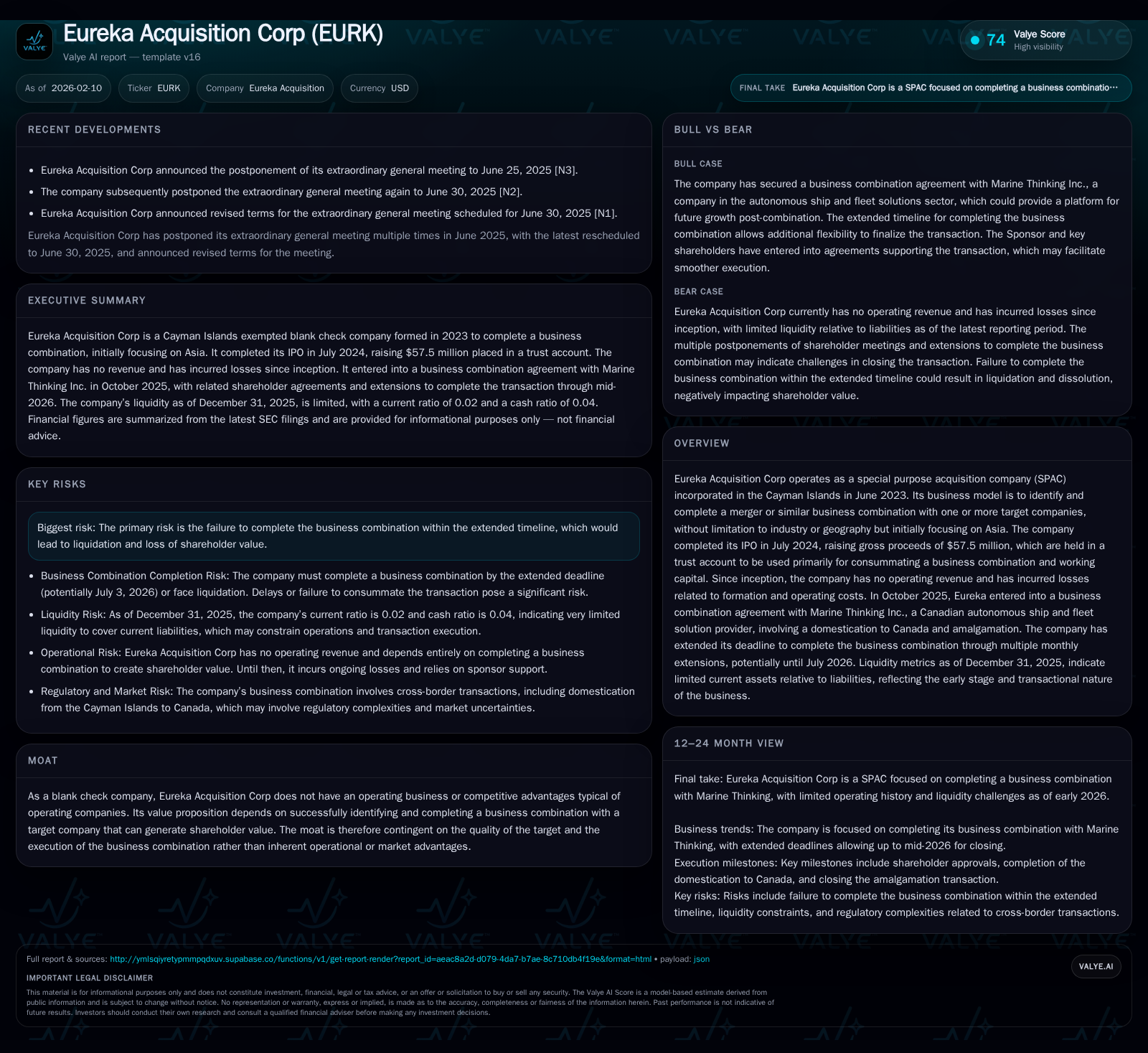
Founded as a Cayman Islands-incorporated blank check company with an initial Asia focus, Eureka Acquisition Corp (EURK) raised $57.5 million in its July 2024 IPO to pursue acquisitions. Its pivot toward a business combination with Canadian autonomous ship solution provider Marine Thinking Inc. marks a strategic expansion beyond Asia into cutting-edge maritime technology. While financials reflect typical pre-revenue SPAC characteristics and notable cash reserves held in trust, completion deadlines and liquidation risk loom large. The sponsor Hercules Capital Management holds aligned incentives that will shape the successful execution of this deal. Eureka’s fundamental value is thus tied less to intrinsic operations than to the quality and execution of this transformative transaction.
From Blank Check to Business Vision: Eureka’s Corporate Origin
Eureka Acquisition Corp was incorporated on June 13, 2023, in the Cayman Islands as a special purpose acquisition company (SPAC), or blank check company. This legal domicile offers potential tax efficiencies and lighter regulatory encumbrances relative to U.S.-based entities, though it can complicate investor protections and disclosure rigor. Eureka's founding mission diverges little from classic SPAC constructs—namely, to raise capital through an initial public offering (IPO) with no operating business, intending to identify one or more target companies for merger or acquisition within a predetermined timeframe.
The company's initial strategic intent was articulated as focusing on acquisition candidates primarily in Asia but without fixed industry or geographic limitation. This latitude signals a pragmatic opportunism common among newer SPACs, permitting management flexibility amid shifting deal landscapes [S1]. Notably, the choice of Asia as an initial focus aligns with the region’s rapid economic growth and dynamic innovation ecosystems but remains non-exclusive.
The startup phase has predictably been devoid of operating revenue, with the company incurring routine formation and administrative costs.
Building Trust: IPO Mechanics and Financial Armor
On July 3, 2024, Eureka consummated its IPO by issuing 5 million units priced at $10 each, aggregating gross proceeds of $50 million. Each unit consisted of one Class A ordinary share plus one right entitling holders to fractional shares upon business combination completion. Concurrently, Eureka completed a private placement selling approximately 216,750 units at the same price point to its sponsor, Hercules Capital Management Corp., generating an additional $2.17 million [S1].
Shortly thereafter on July 8, Maxim Group LLC exercised its full overallotment option, subscribing for an extra 750,000 units at $10 each for $7.5 million gross proceeds. Simultaneously, sponsors acquired approximately another 11,250 private units totaling $112,500. Collectively these transactions brought total gross capital raised at IPO closure to about $57.5 million.
The entire sum was placed into a trust account managed by Continental Stock Transfer & Trust Company strictly for the benefit of public shareholders and underwriters—a standard safeguard ensuring that funds will be directed toward consummating a qualifying business acquisition or refunded if no deal materializes [S1]. While management enjoys broad discretion regarding out-of-trust funds usage (working capital etc.), most proceeds remain sequestered pending the merger's closing.
This layered financing structure—with public units split into shares plus fractional warrants paired with sponsor private unit purchases—reflects common SPAC underwriting frameworks balancing capital assurance with sponsor incentives [S1].
Asia to Arctic Waters: Targeting an Autonomous Maritime Future
By October 29, 2025, Eureka pivoted from its initial Asian-centric pursuit by entering into a definitive business combination agreement with Marine Thinking Inc., a Canadian-based provider specializing in autonomous ship and fleet solutions [S1]. Though seemingly geographically divergent from Eureka’s early positioning, this move aligns naturally with evolving technological frontiers—autonomous maritime applications promise substantial disruption akin to automotive autonomous vehicles but within global shipping logistics.
Marine Thinking operates at the nexus of maritime technology innovation and sustainable shipping solutions—fields benefiting from intense regulatory focus on reducing emissions alongside digital transformation imperatives across shipping industries worldwide (analysis). In this context, Eureka’s leap represents not merely geographic flexibility but a bet on high-growth emerging technology spaces.
The decision underscores the adaptability required by SPACs navigating fluctuating pipeline realities while pursuing technologically sophisticated targets that may offer cleaner narratives for brand positioning post-merger.
Behind the Headlines: Dissecting the Marine Thinking Deal
The business combination involves more than a simple merger; it contemplates Marine Thinking’s domestication through amalgamation into a Canadian entity controlled by Eureka post-transaction [S1]. Domestication refers to relocating corporate registration jurisdictions typically intended to optimize regulatory compliance or tax advantages.
This structural reshaping implicates multiple layers—from cross-border legal adaptations to complexities integrating operations under new governance frameworks. The agreement ratified in late October also coincides with management extending deadlines for deal closure—reflecting continued negotiation dynamics or due diligence thoroughness customary in large transformative SPAC deals.
Eureka retains significant cash reserves in its trust account supporting this transaction’s financing mechanics while absorbing operational expenses until closing [S1]. Such timelines impose pressure on all parties as expiry dates near—a fundamental risk element inherent across all blank check companies.
Financial Snapshot: The Thin Ledger of a Pre-Revenue SPAC
Like most blank check structures prior to acquisition completion, Eureka’s financial footprint is sparse yet telling. Operating revenue is nonexistent given it is purely an acquisition shell; however, operating expenses related to formation costs produce modest net losses—in the latest reported quarter ending December 31, 2025, net income stood at negative $118 thousand [F1].
Available liquidity paints a picture dominated by highly restricted cash balances locked in trust accounts—approximately $57.9 million reported mid-2024 [F1]. Outside this segregated pool lie scant current assets (~$32 thousand) versus current liabilities exceeding $1.5 million at year-end 2025—a heavily skewed balance sheet yielding an ultra-low current ratio around ~0.02 signaling traditional SPAC operational burn without substantive free working capital outside trust protections [F1].
Such figures underscore operational fragility prior to business combination finalization; survival depends almost exclusively on sponsor funding or successful deal consummation unlocking true enterprise value.
The Clock is Ticking: Deadlines, Extensions, and Liquidation Risks
Eureka Acquisition Corp benefits from the typical SPAC structure whereby failure to consummate a qualifying business combination within prescribed timeframes triggers mandatory liquidation—with return of remaining trust funds less expenses back to shareholders, effectively ending the company's run [valye_report_excerpt][S1].
This existential deadline was extended following marine thinking deal announcement indicating complexities requiring additional time for final negotiations or regulatory approvals [valye_report_excerpt]. However, prolonged timelines increase investor uncertainty—each extension compounds dilution risk and elevates liquidation probability should hurdles persist.
Moreover, management discretion over how non-trust funds are applied (working capital vs other uses) adds nuanced risk layers where resource allocation decisions materially affect execution feasibility.
Investors must weigh these ticking clock considerations alongside deal quality—a perennial tightrope walk faced by all SPAC investors.
Sponsor Dynamics: Hercules Capital Management’s Role and Incentives
Hercules Capital Management Corp., serving as Eureka's sponsor since inception, plays multifaceted roles including capital contributor via private unit purchases at IPO pricing ($10/unit) and orchestrator behind target pursuit strategy [S1].
Sponsor-held private units incentivize aligned interests toward driving deal completion since sponsors typically realize disproportionate equity stakes upon transaction closure—the so-called "promote" mechanism ubiquitous among SPACs (analysis). Nevertheless, this construct also introduces potential tensions: sponsors may prioritize closing deals expediently over maximizing valuation given their equity leverage.
Balancing these dynamics requires transparent governance frameworks; absent robust oversight sponsors could unduly influence timing or target selection optimizing personal returns over public shareholder interests.
For Eureka specifically, Hercules' sustained commitment evidenced through supplemental private placements post-IPO signals confidence—but also cements critical influence over trajectory.
Decoding the Moat: Where Eureka’s Real Value Lies
As a blank check entity without operations or proprietary intellectual property pre-business combination completion, Eureka intrinsically lacks "moat" qualities traditionally associated with sustainable competitive advantages such as brand equity or cost leadership [valye_report_excerpt].
Value derivation rests squarely on two pillars:
- Quality and potential growth trajectory of Marine Thinking post-merger,
- Execution discipline managing transaction completion including integration risks.
This dependence places premium importance on thorough due diligence outcomes examining Marine Thinking’s technology differentiation within autonomous maritime markets—a sector projected for expansion amid environmental mandates globally (analysis).
Ultimately, the "moat" is contingent rather than inherent—anchored more in transactional success than ongoing operational dominance.
Regulatory & Structural Nuances of a Cayman Islands SPAC
Cayman incorporation offers several structural advantages such as flexible corporate laws tailored for investor-friendly arrangements and beneficial tax treatments absent direct income taxes onsite [S1]. However, it also introduces complexity around investor protections derived principally from U.S. federal securities regulation interplay versus state-specific corporate law nuances impacting governance rights.
Reporting requirements remain rigorous given Nasdaq listing obligations yet some investors exhibit caution regarding offshore domiciles due to perceived added difficulty exercising minority shareholder rights or litigation recourse (analysis).
For Eureka, the Cayman domicile emphasizes leveraging global structuring efficiencies while navigating heightened demand for transparency amidst heightened global regulatory scrutiny post-SPAC proliferation fervor.
Outlook & Investor Takeaways: Balancing Potential and Perils
Eureka Acquisition Corp embodies classic SPAC paradoxes—a blank canvas vehicle whose value only emerges upon successfully marrying capital market access with visionary acquisition execution. Its shift from an Asian market focus toward acquiring cutting-edge Canadian autonomous shipping technology reflects agility responding both strategically and tactically within volatile deal environments.
Financial metrics illustrate typical pre-combination constraints: limited liquid resources outside trust funds coupled with ongoing operating losses necessitating efficient capital deployment synonymous with sponsor stewardship degrees of freedom.
Meanwhile, sponsor Hercules Capital Management holds substantial sway both financially and strategically underpinning transaction feasibility through private investments incentivized by potential upside linked disproportionately to deal closure rather than long-term operations alone.
Investors tracking Eureka should prioritize monitoring:
- Progress against extended business combination deadlines,
- Transparency surrounding integration planning for Marine Thinking,
- Sponsor engagement dynamics amid evolving investment environment,
- Regulatory developments impacting offshore domiciled SPACs post-merger governance protocols.
This nuanced interplay illustrates broader lessons applicable across evolving special purpose acquisition company ecosystems where value creation hinges simultaneously on visionary target identification balanced with impeccable execution rigor in inherently risky landscape contexts.
This analysis is based solely on filed SEC materials up through February 10th, 2026 and does not constitute investment advice.
Disclaimer: This is research-only, informational analysis and not investment advice. It may include AI-generated interpretation and general industry context. Always verify important details using primary sources.

Comments