
Extra Space Storage’s Scale and Capital Intensity Drive Growth with Debt Leverage Tradeoffs
EXR leverages its dominant U.S. footprint and integrated operations model to deliver steady revenue growth while managing elevated leverage and capital demands.
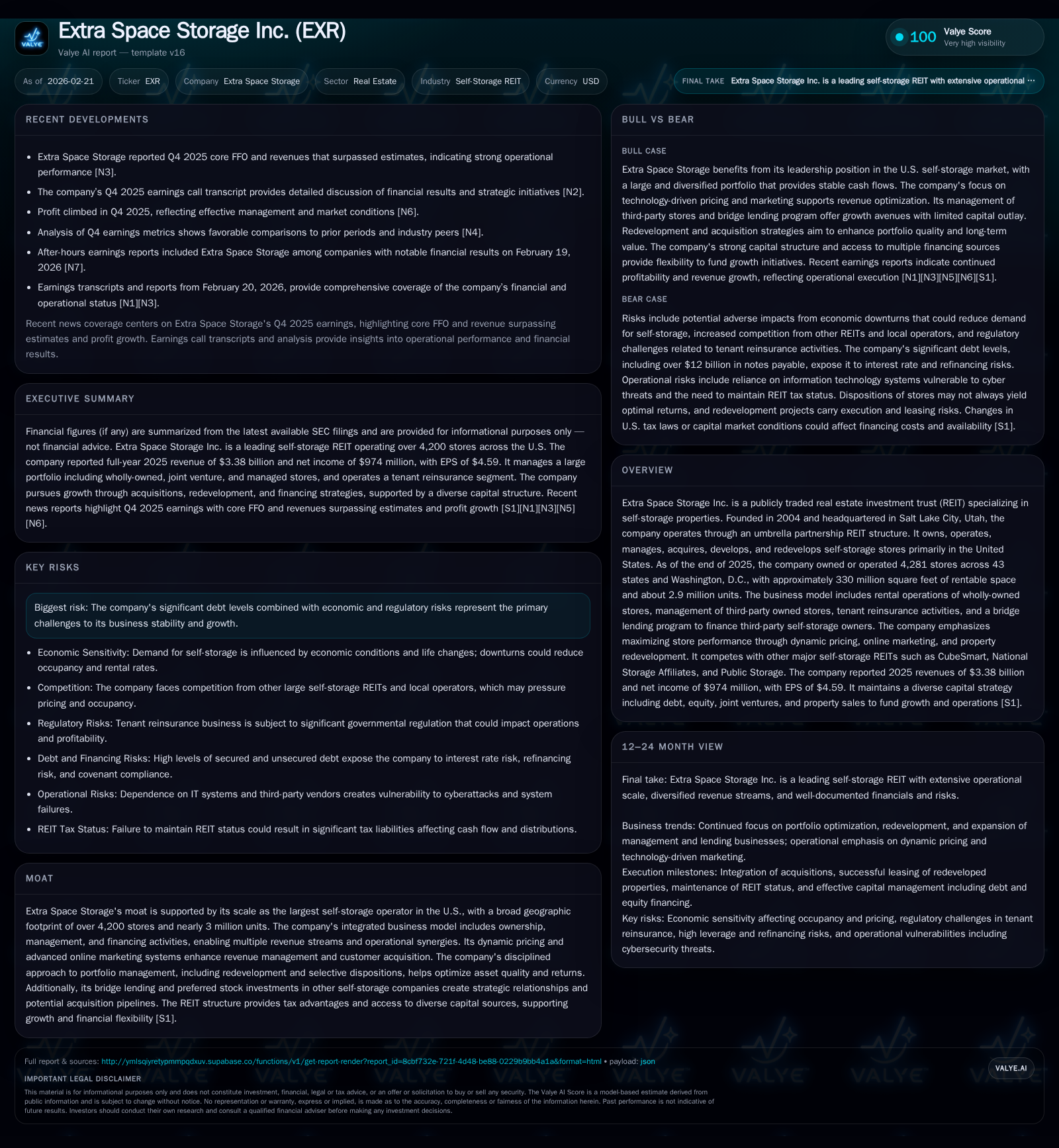
Extra Space Storage Inc. (EXR) is the largest self-storage REIT in the U.S., with over 4,200 stores and nearly 3 million units as of end-2025. Its historical growth has been fueled by acquisitions, developments, and optimized store management using dynamic pricing and online marketing. In 2025, revenues reached $3.38 billion (+3.7% YoY) with net income of $974 million (+14%), supported by disciplined portfolio management and technology investments. However, the company faces capital allocation challenges given its significant debt load (~$12.3 billion in notes payable plus bridge loans) alongside sizeable capex for redevelopment and new store openings. Future growth hinges on continued acquisitive expansion, redevelopment projects, and leveraging its third-party management and lending platforms to build acquisition pipelines. The REIT maintains a robust dividend policy but has limited buybacks, reflecting prioritization of growth investment amid evolving regulatory and economic risks.
Company Overview
Extra Space Storage Inc. (EXR) stands as the largest owner-operator within the U.S. self-storage industry, a sector characterized by fragmented ownership among many small local operators but consolidating toward scale players benefiting from capital access and operational sophistication [S24]. Founded in 2004 and headquartered in Salt Lake City, EXR maintains an umbrella partnership REIT (UPREIT) structure that provides both tax efficiencies and flexibility in deal-making through common and preferred operating partnership units issuance [S24],[S4].
As of December 31, 2025, EXR owned or operated approximately 4,281 self-storage stores spread across 43 states plus Washington D.C., amounting to about 330 million square feet of rentable space comprising roughly 2.9 million storage units [S24],[F1]. This scale supports multiple revenue streams: rental income from wholly owned stores; third-party management fees from nearly 1,860 managed stores; tenant insurance reinsurance fees; and bridge loans financing third-party owners [S9],[S24].
The company prioritizes maximizing store performance through active management leveraging advanced dynamic pricing models that adjust rates in near real-time and one of the industry's most advanced online marketing platforms aimed at customer acquisition efficiency [S8]. Redevelopment initiatives further enhance asset quality by adding units or improving unit mix aligned with local demand while extending asset life cycle [S8].
Historical Performance
Extra Space Storage demonstrated consistent revenue growth between fiscal years 2022–2025 as follows:
Historical performance (annual)
| FY | Rev ($bn) | Net ($mm) | CFO ($mm) | OpInc ($mm) | Rev YoY | Net YoY |
|---|---|---|---|---|---|---|
| 2025 | 3.4 | 974 | 1850 | 1413 | +3.7% | +14.0% |
| 2024 | 3.3 | 855 | 1887 | 1323 | +27.2% | +6.4% |
| 2023 | 2.6 | 803 | 1402 | 1170 | +33.1% | -6.7% |
| 2022 | 1.9 | 861 | 1238 | 1050 |
Note: Omitted columns lack sufficient annual XBRL coverage in the provided tags (need ≥2 annual points): Capex. Source: SEC companyfacts cache [F1].
Capital returns and efficiency (annual)
| FY | Div ($mm) | Buybacks ($mm) | FCF ($mm) |
|---|---|---|---|
| 2025 | 1374 | 150 | 1288 |
| 2024 | 1375 | 0 | 1408 |
| 2023 | 1046 | 0 | 1267 |
| 2022 | 805 | 63 |
Source: SEC companyfacts cache [F1].
Note: Capex prior to FY2023 not disclosed explicitly; data shown from available filings.
Revenues rose sharply particularly between FY2022 to FY2024 as EXR integrated substantial acquisitions including Life Storage assets completed mid-2023 [S11],[F1]. Growth moderated somewhat in FY2025 reflecting a mature platform but still achieved positive YoY expansion supported by higher same-store rental rates aided by pricing technology.
Operating income compounded at approximately a 6–7% annual rate over this period despite inflationary pressures likely impacting operating expenses [F1]. Net income was more volatile due to acquisition-related non-cash items but notably recovered strongly in FY2025 (+14%) after a dip in FY2023 [F1].
Operating cash flows reached nearly $1.85 billion in FY2025 but were slightly lower than the prior year (-2%) due to timing on working capital changes [F1]. Capital expenditures increased meaningfully from below $140 million in FY2023 to over $560 million by FY2025 as EXR accelerated redevelopment and development of newly built Certificate of Occupancy stores which typically carry upfront lease-up dilution but promise solid long-term returns [S8],[F1].
Dividend payments have grown substantially consistent with REIT requirements to distribute at least 90% of taxable income annually: approximately $1.37 billion paid both in FY2024 and FY2025 [F1]. Buybacks are modest relative to dividends but resumed modestly to about $150 million in FY2025 after a pause [F1], reflecting capital reinvestment priorities.
Business Model & Operational Nuances
EXR’s competitive moat is anchored by its integrated self-storage business model combining ownership/operations with third-party management fees and tenant reinsurance activities . The firm deploys scalable technology for dynamic pricing that captures rent increases opportunistically even on densely occupied stores without eroding occupancy—a critical margin driver given industry typical occupancies near 90% [S21],. Online marketing drives lead generation cost efficiencies complementary to physical store locations predominantly sited near high-density population centers.
The redevelop-and-reallocate strategy includes physical enhancements for security improvements—as customer perception highly values safety—and unit mix modifications addressing local client demand shifts such as more climate-controlled units or varied sizes [S8], an important differentiation factor.
Third-party management contracts cover close to half of all stores managed under EXR's brand umbrella (about 1,856 stores), generating fee revenue with low capital requirements while feeding potential acquisition targets through strong partner relationships [S9],[F1]. Bridge lending extends this ecosystem by providing financing solutions to select operators under management—totaling about $1.5 billion outstanding—embedding EXR deeper into the segment's capital markets fabric beyond pure storage operations [S9,S4]. This financing activity additionally yields interest income diversifying revenue streams.
Capital Structure & Liquidity Positioning
As of end-2025 EXR carries approximately $11.2 billion unsecured notes payable plus about $1.1 billion secured notes payable related partly to Life Storage transaction liabilities included post-merger [S4,S12],[F1]. The company maintains revolving credit lines with available capacity aggregate exceeding $3 billion—only ~$500 million drawn—backed by investment-grade credit ratings supporting liquidity buffer for acquisitions or redevelopment capital needs [S6,S10,S16]. Commercial paper programs provide short-term bridge financing options amounting up to $1 billion capacity with ~70% availability currently unused [S4].
The accounting for debt-to-assets covenants mandates maintaining total indebtedness below 60–65% depending on recent acquisition timing along with EBITDA-to-interest charge coverage minimums (>1.5x), constraining aggressive leverage escalation [S10,N3]. These covenants influence capital allocation amongst dividends (stable payout policy), reinvestment spend on redevelopment/certificate-of-occupancy builds ($560M capex annually), selective buybacks ($150M in FY25), opportunistic acquisitions likely financed via combination of debt/equity/joint ventures [S8,S11,S22].
Joint ventures remain material with EXR holding interests in ~400 properties where partners primarily contribute equity capital while EXR controls management operations—a risk mitigating structure that enhances return on invested capital without full balance sheet exposure [S9,S22].
Industry Context & Competitive Dynamics
The U.S. self-storage sector exhibits mature demand fundamentals underpinned by life transitions (downsizing homes, relocations), urban densification trends limiting residential storage space availability externally driving unit leasing activity . This market exhibits pronounced seasonality—peak revenue months May to September coincide broadly with moving seasons—but sustained portfolio occupancy remains resilient year-round (~93.7% average same-store occupancy reported for EXR pool in FY25) demonstrating strong underlying client retention dynamics typical for month-to-month rental models with extended lease durations often over multiple years due to inertia or convenience premium .
Fragmentation marks ownership structures historically; however increasing capital scarcity amongst local operators versus access advantages held by large REITs like EXR supports ongoing consolidation trends unlocking operating scale economies spanning centralized marketing call centers through procurement savings as well as pricing power capabilities afforded by data-driven rental rate optimization tools . Competitors include CubeSmart, National Storage Affiliates and Public Storage—each also public REITs pursuing similar scalable growth strategies emphasizing portfolio enhancement via acquisitions alongside managed store expansion efforts [N7,N11,N12].
Growth Drivers & Constraints
Primary avenues for future growth stem from:
- Continued acquisitive activity targeting multi-store portfolios or certificate-of-occupancy new-build purchases offering favorable returns relative to stabilized assets albeit requiring gradual lease-up periods dilutive short term earnings impact [S11,S22];
- Intensified store redevelopment programs to increase unit counts or enhance mix tailored for price premium capture;
- Expansion of the third-party management platform enabling fee revenue diversification while seeding acquisition pipeline opportunities;
- Strategic deployment of bridge lending that deepens operational partnerships with independent owners potentially unlocking volume scale advantages.
Constraints include macroeconomic sensitivity of rental demand as slowdowns reduce discretionary move activity depressing occupancy/rate growth; regulatory risks relating especially to tenant insurance reinsurance frameworks which are subject to evolving governmental oversight increasing compliance burdens; cyber risk concerns heightened by growing dependence on tech infrastructure including AI tools posing potential operational disruption if inadequately managed; leverage levels require cautious balance between funding growth initiatives against covenant thresholds limiting aggressive financial engineering; competitive intensity among national consolidators may push acquisition prices upward leaving fewer accretive bolt-on targets at attractive returns compared with earlier cycles [S15,S20,S26].
Moreover, rising construction costs challenge new development economics necessitating refined underwriting rigor on certificate-of-occupancy deals especially where lease-up timelines extend longer than expected amid cyclical headwinds [N8,N9,S8]. AI-enabled operational advancements also represent a double-edged sword: crucial for maintaining competitive edge against peers who invest heavily yet also necessitating substantial R&D expenditure alongside robust cybersecurity defenses against more sophisticated automated threats impinging confidentiality/integrity goals [S26,S20].
Financial Returns & Capital Allocation Summary
EXR generated net income of approximately $974 million in fiscal year ended December 31, 2025 representing a +14% increase year-over-year while delivering operating income margin expansion driven by improved rental economics offsetting development investing costs [F1,N10,N13]. Its operating cash flow remained robust just below prior-year peak at ~$1.85 billion; subtracting substantial capex ($562 million mainly focused on asset enhancement/certificates-of-occupancy projects) yields estimated free cash flow near $1.29 billion supporting sustained dividend distributions totaling ~$1.37 billion consistent with REIT payout policies emphasizing shareholder income stability plus modest share buyback resumption marking a balanced approach toward capital deployment priorities despite debt service commitments totaling majority fixed-rate notes payable alongside floating-rate bridge loan portfolios currently managed within covenant parameters [F1].[N9]
Return on equity measured approximately at ~7.3%, influenced by elevated total equity base inflating post-LIfe Storage merger as well as reinvestment into high-growth certificates-of-occupancy limiting short-term earnings uplift but supporting longer-term value creation potential given strong market demand durability combined with digital-first marketing strategies facilitating pricing power gains [F1],.
Management continues emphasizing disciplined underwriting tied closely to strategic geographic concentration favoring dense metropolitan clusters alleviating inherent portfolio volatility risks inherent across more dispersed markets while preserving flexibility through joint ventures lowering balance sheet concentration risk exposures partially offsetting elevated leverage concerns especially if economic cycles shift negatively impairing occupancy or rate escalation ability going forward [S21,S23].[N6,N12]
Key Milestones & What To Watch
Although explicit detailed guidance beyond full-year results was not issued recently per available filings/transcripts through Q4 earnings calls late February ’26 [N2,N3], key milestones would include:
- Success metrics on lease-up velocity & yield delivery for newly acquired certificate-of-occupancy stores targeting return enhancement versus core portfolio assets;
- Expansion velocity / margin contribution from third-party management transitioning pipeline into full consolidation/M&A deals;
- Changes/updates on tenant insurance regulatory environment potentially impacting underwriting profitability or leading into structural adjustments;
- Refinancing moves impacting cost of capital amid evolving interest rate environments including term loan tranche maturities within next three years requiring strategic proactive liquidity planning;
- Innovations integrating AI-driven analytics into pricing/demand forecasting potentially unlocking incremental occupancies or rental rate uplift without incurring prohibitive expense. Monitoring these will offer insights into how effectively management navigates balancing near-term earnings pressures versus long-term franchise value capture.
Risks Summary
Major risks highlighted include rising debt loads interacting unfavorably with adverse macroeconomic conditions pressuring occupancies/rental rates lowering cash flow stability; intensifying regulatory scrutiny especially around tenant reinsurance lines potentially increasing compliance costs or liability exposures; cybersecurity vulnerabilities heightened from expanded IT system footprints requiring continuous mitigation investments; competitive pressures mandating ongoing tech adoption particularly AI-based optimizations demanding incremental expense alongside reputational risks from data breaches or ethical AI governance challenges[S15,S20,S26]; reliance on external construction supply chains impacting cost/timing execution accuracy further complicating redevelopment program profitability forecasts[S8]; potential inability to consummate attractive acquisition opportunities hampers inorganic growth ambitions restricting overall strategic trajectory[S26]; market saturation risk eventually tempering rent escalation opportunity windows standard across matured metro submarkets[S21],.[N6,N12]
Conclusion
Extra Space Storage’s standing as the dominant U.S.-wide self-storage operator positions it well within an increasingly consolidated industry benefiting from economies of scale enabled through advanced online marketing platforms combined with dynamic rate-setting exploiting localized demand patterns effectively. This integrated model buttressed by diversified revenue streams spanning owned stores plus third-party management fees along with affiliated entity lending provides multiple levers fueling steady top-line progression.
However its operational model necessitates heavy capital deployment evidenced by rising capex particularly toward property redevelopment/new build certificates-of-occupancy which although promising stronger returns entail absorption risks during lease-up periods constraining near-term free cash flow generation while large fixed-rate unsecured debt balances alongside leveraged bridge loan positions impose financial covenants forcing prudence around leverage trajectory.
Going forward investors/industry watchers should monitor how effectively EXR manages this balancing act maintaining high store occupancy & rental yield advancement amidst evolving macroeconomic/regulatory landscapes alongside measured capital allocation navigating dividend stability versus opportunistic incremental buybacks/deal-sourced reinvestments providing growth runway sustainable over ensuing cycles.
Disclaimer: This report is for informational purposes only and does not constitute investment advice or recommendations regarding buying or selling securities. Readers should perform their own due diligence before making any investment decisions.
Disclaimer: This is research-only, informational analysis and not investment advice. It may include AI-generated interpretation and general industry context. Always verify important details using primary sources.

Comments