
Reliance Global Group: Insurance Platform Growth Meets the Uncertainty of Diversification into Tech and Life Sciences
Reliance Global Group is leveraging momentum in its core insurance brokerage and InsurTech business while aggressively expanding into technology and life sciences. This diversification brings new revenue opportunities but amplifies execution and integration risks, especially given early setbacks in its tech investments and the regulatory challenges inherent to healthcare.
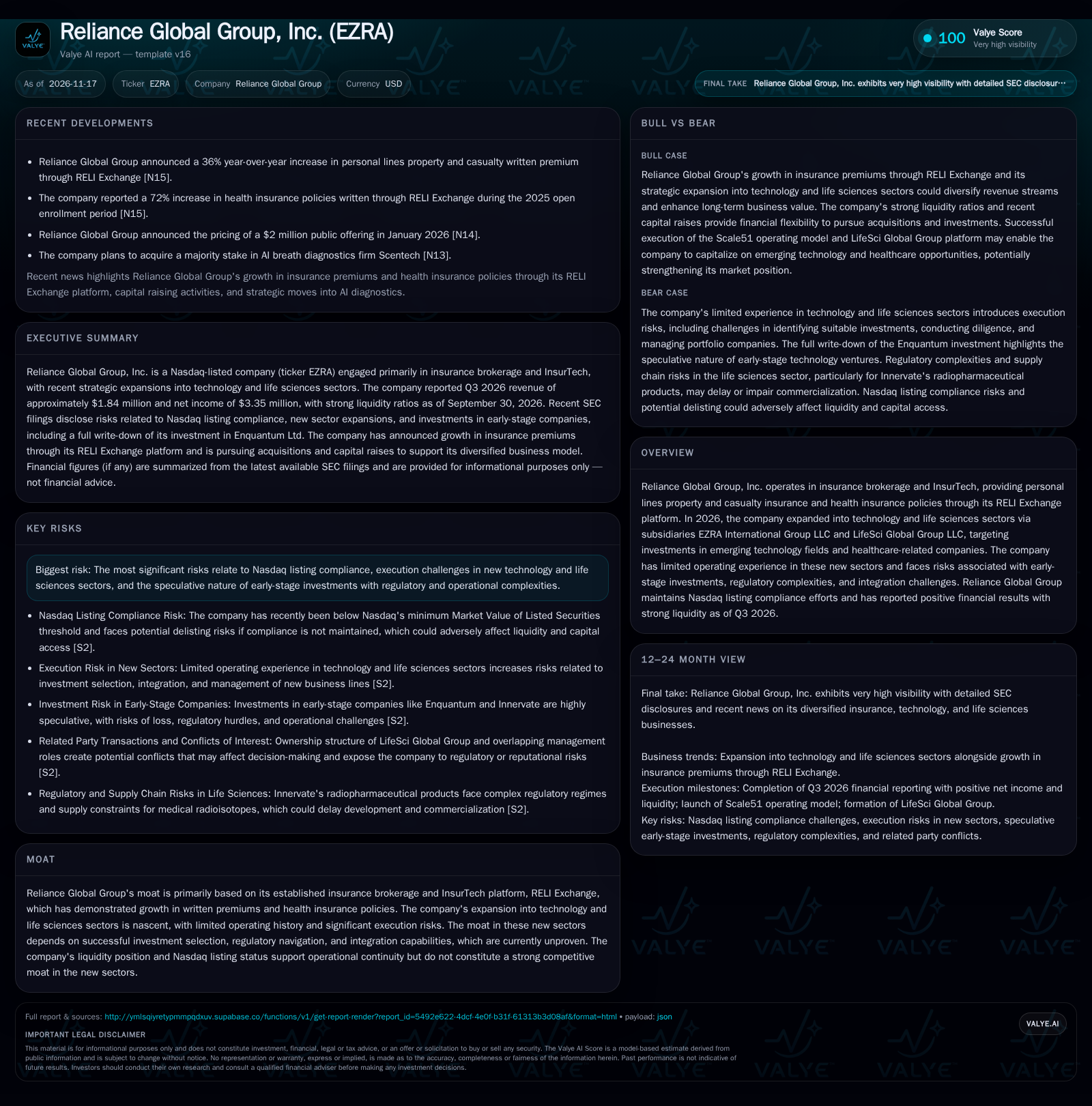
Reliance Global Group (Nasdaq: EZRA) is growing its RELI Exchange insurance platform, reporting significant increases in written premiums and health policies. However, its push into technology and life sciences through subsidiaries like EZRA International Group and LifeSci Global Group introduces substantial execution, regulatory, and investment risks, as highlighted by a recent write-down in an early-stage tech investment and complex partnership structures. Financially, the company posted positive Q3 2026 results and maintains reported liquidity position, but continued Nasdaq listing compliance and successful integration of new business lines will be pivotal for its long-term trajectory. [S2]
Reliance Global Group is at a crossroads: its traditional insurance brokerage and InsurTech platform, RELI Exchange, is delivering strong year-over-year growth in premiums and health policy sales. However, the company’s rapid diversification into technology and life sciences—fields where it has little operating history—brings both the promise of new value creation and the reality of significant execution and regulatory risks. Early stumbles, such as the full write-down of its Enquantum investment, underscore the challenges of moving beyond its core. The next phases will test whether Reliance can translate its insurance momentum into successful, sustainable diversification.
Insurance Gains and Diversification Drive Current Narrative
Reliance Global Group’s Q3 2026 results show $1.84 million in revenue and $3.35 million in net income, with basic EPS at $2.39 and a reported cash balance of $10 million, supporting strong current and cash ratios. [S2] These metrics reflect a period of operational stability and liquidity. Core insurance operations are showing robust momentum: RELI Exchange posted a 36% year-over-year increase in personal lines property and casualty written premiums, and a 72% increase in health insurance policies written during the 2025 open enrollment.
Strategically, the company has launched EZRA International Group and LifeSci Global Group, targeting investments in technology (including post-quantum cryptography, cybersecurity, and AI) and life sciences (notably radiopharmaceuticals). [S2] However, the abrupt failure of Enquantum Ltd., leading to a total investment write-down, and the complexity of LifeSci Global Group’s ownership and regulatory context, highlight the risks in these new ventures. Continued Nasdaq listing compliance remains a critical operational and reputational watchpoint. [S2]
How Reliance Could Monetize Insurance, Tech, and Healthcare Bets
The company’s insurance brokerage and InsurTech operations remain the primary revenue engine, where the economics are typically driven by commission-based models, platform fees, and incremental margin on policy growth. The RELI Exchange platform likely benefits from digital distribution efficiencies, and recent growth in written premiums and health policies suggests operating leverage is achievable if customer acquisition costs are controlled and retention remains high.
In contrast, the economics of the new technology and life sciences initiatives are far less certain. Early-stage tech investments and AI ventures can be capital-intensive and may not generate near-term revenue, with outcomes often binary (e.g., the complete write-down of Enquantum). Life sciences projects, such as Innervate’s radiopharmaceuticals, face high up-front R&D and regulatory costs, long timelines, and complex supply chains. The majority/minority structure of LifeSci Global Group may also impact how profits or losses are allocated and create friction in decision-making.
Overall, Reliance is attempting to blend stable, cash-generative insurance operations with high-variance, long-horizon bets in technology and healthcare. This introduces the possibility of future operating leverage if new bets succeed, but also increases the risk of dilution, capital calls, or further write-downs if integration and execution falter.
Established in Insurance, Unproven in New Frontiers
Within insurance brokerage and InsurTech, Reliance’s RELI Exchange platform is showing competitive momentum, as evidenced by the reported growth in written premiums and health policy sales. This suggests some traction against traditional agencies and digital-first InsurTech peers, with possible advantages in digital onboarding and cross-sell. However, the insurance space is highly competitive, with low switching costs and persistent pressure from both legacy players and upstart digital platforms.
In technology and life sciences, Reliance is entering highly specialized and competitive sectors where established incumbents, deep domain expertise, and regulatory experience are critical. The company’s limited operating history in these fields means it must compete not only for deals and talent but also for credibility with customers, partners, and regulators. The early failure of its Enquantum investment highlights the steep learning curve and the risk of adverse selection in deal flow.
Unless Reliance can demonstrate repeatable success in sourcing, integrating, and scaling technology or healthcare assets, it may be at a structural disadvantage relative to sector specialists and established venture investors.
If Insurance Momentum Funds Breakout Success in New Sectors
Success would likely require at least one of its new ventures (e.g., Innervate in radiopharmaceuticals or a future AI asset) to achieve meaningful commercialization, regulatory approval, or strategic exit.
Confirmation of this scenario would come from: (1) sustained double-digit growth in RELI Exchange premiums and policy volumes, (2) evidence of revenue or valuation uplift from new tech or healthcare subsidiaries, (3) successful navigation of regulatory hurdles in life sciences, and (4) minimal dilution or incremental capital raises to support new investments.
Falsification could occur if insurance growth stalls, if new investments continue to result in write-downs or capital drains, or if Nasdaq listing compliance is again threatened by market value or bid-price issues.
Blending Insurance Stability with High-Risk Venture Outcomes
The most plausible outcome is that Reliance continues to generate modest growth and cash flow from its insurance platform while experiencing a mixed record in its technology and life sciences bets. The insurance business may provide a stable base, but early-stage investments will likely be a drag on near-term profitability due to high R&D expenses, failed ventures, or dilution from capital needs.
This scenario would be confirmed by ongoing growth in insurance KPIs and stable cash flow, offset by further write-downs, slow progress, or regulatory delays in new sectors. If the company can avoid major governance or compliance lapses and maintain liquidity, it may have the optionality to pivot or scale back non-core ventures if results disappoint.
Evidence against this scenario would include a dramatic acceleration in new venture success (suggesting the upside case) or a significant deterioration in insurance fundamentals, liquidity, or listing status (suggesting the downside).
When Diversification Drains Value and Threatens Core Stability
In a negative scenario, Reliance’s diversification strategy fails to deliver, with repeated losses on early-stage investments, regulatory setbacks in life sciences, and unresolved conflicts of interest or governance issues in new subsidiaries. If these distractions erode management focus or drain capital from core insurance operations, the company’s financial position could deteriorate rapidly.
A loss of Nasdaq listing—whether from market value, bid-price, or compliance issues—could further restrict access to capital and undermine partner and customer confidence. Such an outcome would be confirmed by further write-downs, negative operating cash flow, or evidence of capital-raising under duress. Repeated regulatory or supply chain failures in the life sciences business, or public governance disputes, would also support this scenario.
Falsification would require either a stabilization of new venture losses, a clear return to insurance-driven profitability, or a successful divestiture or wind-down of underperforming non-core assets.
Benchmarks for Testing Reliance’s Diversification and Core Momentum
Year-over-year growth in RELI Exchange written premiums and health policy volumes; continued double-digit increases would support core momentum.
Revenue contribution, milestone achievements, or valuation marks from EZRA International Group and LifeSci Global Group investments, if disclosed, to gauge progress in new sectors.
Regulatory milestones and supply chain reliability for Innervate’s radiopharmaceutical pipeline; delays or disruptions would indicate execution risk.
Frequency and materiality of investment write-downs or impairments in technology and life sciences subsidiaries.
Nasdaq listing compliance status, particularly market value of listed securities and minimum bid price requirements.
Operating cash flow trends and capital-raising activity—net cash generation from insurance operations versus cash consumption by new ventures.
Incidence and disclosure of related party transactions or governance conflicts within LifeSci Global Group, which could affect decision-making and investor perception.
Disclaimer: This is research-only, informational analysis and not investment advice. It may include AI-generated interpretation and general industry context. Always verify important details using primary sources.

Comments