
FB Financial Corp Expands Southeast Footprint Post-Southern States Merger with Steady Profitability and Elevated Credit Costs
FB Financial Corp leverages regional banking strengths and mortgage services while managing credit risk from recent acquisitions.
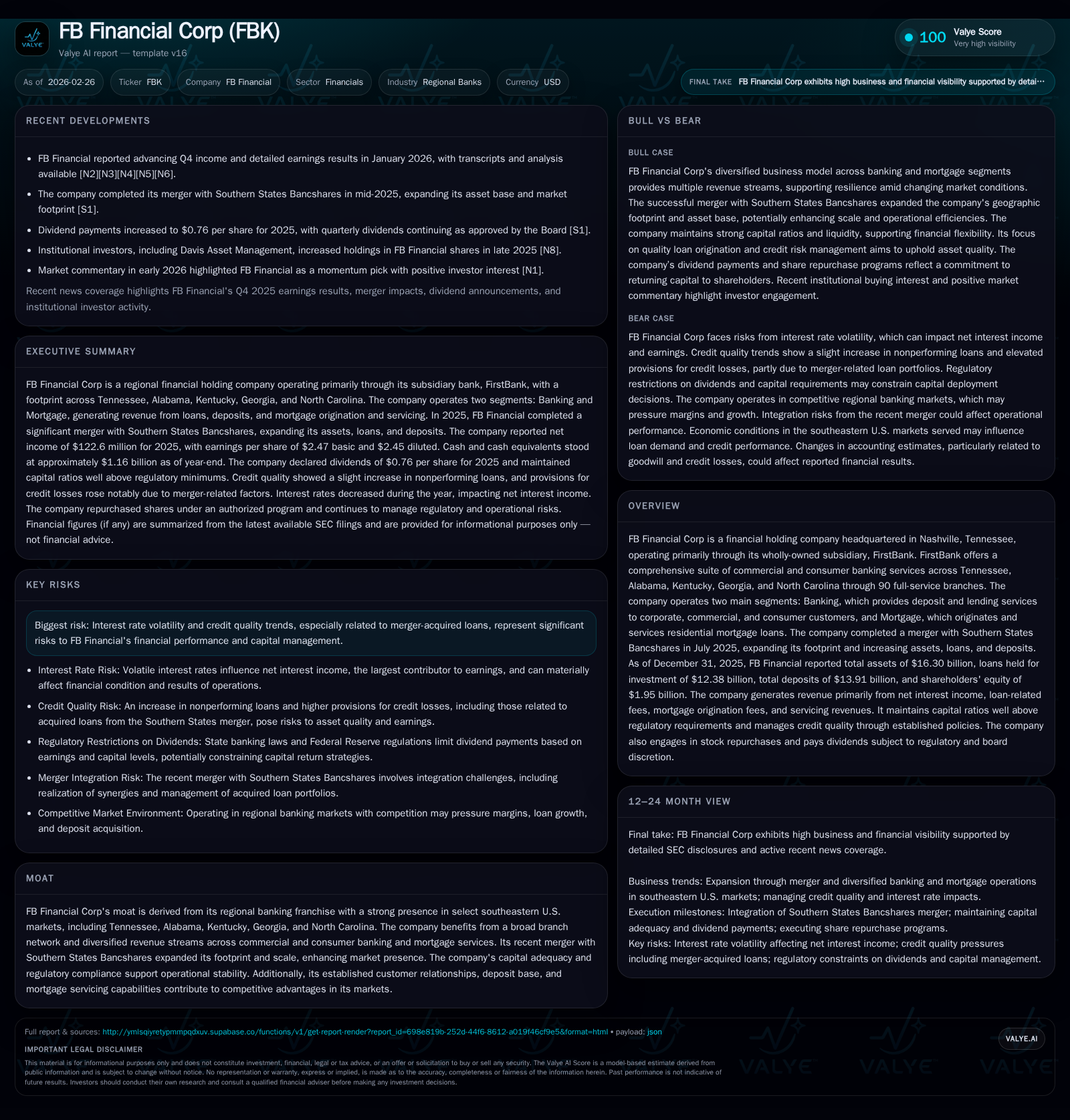
FB Financial Corp, through its wholly-owned FirstBank subsidiary, operates a broad regional banking franchise across five southeastern states. The company's 2025 merger with Southern States Bancshares materially increased assets, equity, and market presence. While net income modestly improved supported by merger-related scale, credit costs rose notably due to acquired loan portfolios. Capital ratios remain solid, supporting ongoing dividend payments and sizable share repurchases. Key risks include interest rate fluctuations and credit quality trends linked to the merger. Investors should watch future integration outcomes and credit quality trends closely.
Company Profile and Market Footprint
FB Financial Corp (NYSE: FBK), headquartered in Nashville, Tennessee, operates primarily through its wholly-owned subsidiary FirstBank. The bank provides comprehensive commercial and consumer banking products across Tennessee, Alabama, Kentucky, Georgia, and North Carolina through a network of 90 full-service branches. Alongside traditional banking services, FBK owns a Mortgage segment focused on originating and servicing residential mortgage loans across its footprint.
The company’s recent merger with Southern States Bancshares in July 2025 notably expanded its regional presence and financial scale, adding to FirstBank's existing established markets and allowing leverage on broader geographic diversification [S1][S26].
Historical Performance Overview
FBK’s financial performance over recent years reveals steady growth in net income and equity alongside increasing loan volumes driven both organically and through M&A.
Historical performance (annual)
| FY | Net ($mm) | CFO ($mm) | Capex ($mm) | Net YoY |
|---|---|---|---|---|
| 2025 | 123 | 156 | 9 | +5.7% |
| 2024 | 116 | 139 | 7 | -3.5% |
| 2023 | 120 | 211 | 20 | -3.5% |
| 2022 | 125 | 789 | 11 |
Source: SEC companyfacts cache [F1].
Capital returns and efficiency (annual)
| FY | Buybacks ($mm) | FCF ($mm) | ROE% |
|---|---|---|---|
| 2025 | 156 | 147 | 6.3 |
| 2024 | 13 | 132 | 7.4 |
| 2023 | 5 | 191 | 8.3 |
| 2022 | 40 | 779 | 9.4 |
Source: SEC companyfacts cache [F1].
Net income increased moderately by nearly 6% in fiscal year 2025 despite a challenging credit environment partially due to costs associated with the Southern States acquired loan portfolio provisions [F1][S15][S1]. Operating cash flow also grew by over 12%, underpinning dividend payouts and aggressive share repurchase programs.
The company has shown disciplined capital allocation by steadily increasing dividends annually ($0.68 per share in 2024 to $0.76 per share in 2025) while conducting large-scale share buybacks totaling approximately $156 million in the most recent fiscal year [F1][S16][S23][S4].
Balance Sheet Expansion via Merger and Organic Growth
Post-merger total assets swelled to roughly $16.3 billion as of December 31, 2025 from a smaller base prior year. Key balance sheet highlights include:
- Loans held for investment rose by nearly $2.78 billion or ~29%, reaching $12.38 billion as of YE25.
- Total deposits totaled approximately $13.91 billion.
- Shareholders' equity expanded materially to nearly $1.95 billion, boosted by $368 million common stock issued for the merger plus net earnings retention [S1][F1][S26].
This balance sheet growth aligns with the company’s expansion strategy targeting scale efficiencies across its southeast regional markets while diversifying commercial real estate, construction, residential mortgage, consumer lending portfolios [S12][S26].
Business Segments: Banking & Mortgage
FB Financial’s operations report through two segments:
- Banking Segment: Commercial & consumer loans focusing on deposit gathering and lending products including construction loans, owner/non-owner occupied CRE loans, C&I loans.
- Mortgage Segment: Residential mortgage loan origination and servicing with income derived from mortgage fees and secondary market sales.
In FY25:
- The Banking segment generated net interest income after provision approximating $468 million after absorbing a $37 million provision for credit losses mostly from acquired loans.
- The Mortgage segment contributed $52 million in mortgage banking income [S12].
The corporate management utilizes transfer pricing strategies internally assigning funding credits/charges across segments optimizing balance sheet risk measurement [S12].
Credit Quality Trends: Elevated Provisions Reflect Integration Challenges
Credit cost pressures escalated during FY25 ramping up provision expense to $43 million versus only $12 million the year prior [S15]. This increase was mainly tied to the acquired loan portfolio from Southern States Bancshares representing an initial provision of roughly $28 million related to these acquisition assets [S15].
Nonperforming loans ratio tightened somewhat but reflected slight increases in nonaccruing assets reaching near 0.97% of total loans at year-end.
Loan underwriting standards reportedly remained robust with enhanced evaluation methodologies adopted midyear using discounted cash flow approaches under CECL accounting standards [S21][S17]. However, elevated credit risk remains a key watch point given economic uncertainties impacting commercial real estate markets regionally that comprise a significant portion of FBK’s loan book [S15].
Capital Adequacy & Regulatory Compliance
FB Financial maintains capital well above regulatory minimums mandated by federal regulators:
- Total risk-based capital ratio at approximately 13.2%
- Tier-1 capital ratio around 11.4%
- Tier-1 leverage ratio exceeding twice the minimum required level at roughly 10.3% These metrics classify FirstBank as "well-capitalized," underscoring strong capitalization post-merger [S1].
The company redeemed certain subordinated debt obligations during early FY25 but assumed fixed-to-floating rate subordinated notes totaling $92 million from the Southern States acquisition thereby maintaining Tier-2 capital eligibility albeit with phased amortization schedules [S6][S7].
Liquidity is managed prudently with available Federal Home Loan Bank lines exceeding $2 billion at YE25 providing additional contingency funding capacity absent any outstanding advances then [S5][S9].
Returns & Capital Allocation Priorities
Return on equity currently approximates a moderate ~6.3%, reflecting earnings dilution from integration costs and incremental provisions offsetting core operational growth [F1].
Free cash flow (operating cash flow minus capex) remains solid near $147 million for FY25 supporting disciplined shareholder returns.
Dividend policy is conservative yet progressive with a payout reflecting underlying bank earnings subject to state banking restrictions limiting dividend capacity relative to three-year retained earnings cumulative [S1][S16].
Strong buyback execution throughout late FY24 into FY25 demonstrates commitment toward capital return enhancement while balancing capital conservation for future organic growth and potential M&A activity [S4][S16].
Future Growth Prospects & Milestones to Watch
Key growth drivers for FB Financial encompass:
- Deepening penetration in its core southeastern markets benefiting from expanded branch network post-merger.
- Continued loan portfolio expansion especially within owner/non-owner occupied CRE, construction lending sectors driven by localized economic activity.
- Growing contributions from mortgage operations amid sustained housing demand elevating fee-based revenues.
- Cost synergies realization through merger integration improving operating margins over time.
Potential growth constraints or risks include:
- Volatility in interest rates which could compress net interest margins or impact demand for loans/deposits.
- Ongoing credit quality pressure particularly related to recently acquired portfolios necessitating vigilant risk management.
- Regulatory changes impacting capital or liquidity requirements imposing operational flexibility constraints.
- Competitive pressures within regional banking market requiring continued technology investment for customer retention.
Investors should observe FBK’s upcoming quarterly results for updates on loan loss provision trends including specific performance of Southern States legacy loans, progress on branch integration efficiency gains, deposit growth dynamics, and continued deployment of buyback authorization expiring January 31, 2027 [N1][N3][S4].
Conclusion: Regional Strength Paired With Integration Execution Challenge
FB Financial stands as a growing regional financial institution leveraging its multi-state footprint strengthened by its July ’25 acquisition of Southern States Bancshares that augmented scale and market position in key southeastern jurisdictions. Despite commendable top-line growth and solid capital buffers sustaining shareholder dividends plus significant buybacks, the firm faces short-term headwinds from elevated credit costs tied to portfolio integrations. Their prudent approach toward credit risk modeling upgrades combined with strong regulatory compliance frameworks underpins operational resilience. Future performance will hinge significantly on how effectively FBK manages asset quality amid market cycle shifts while extracting merger synergies toward enhanced profitability metrics over subsequent periods.
This analysis is based solely on publicly available information including company SEC filings as of February 26, 2026 ([F1], [S#]) and recent news transcripts ([N#]). It does not constitute investment advice or recommendations.
Disclaimer: This is research-only, informational analysis and not investment advice. It may include AI-generated interpretation and general industry context. Always verify important details using primary sources.

Comments