
Franklin BSP Realty Trust’s Dual-Focused Model Drives Revenue Growth Amid Margin and Leverage Constraints
FBRT’s combination of commercial real estate debt financing and agency mortgage servicing is fueling top-line expansion while capital allocation decisions and leverage management impose strategic trade-offs.
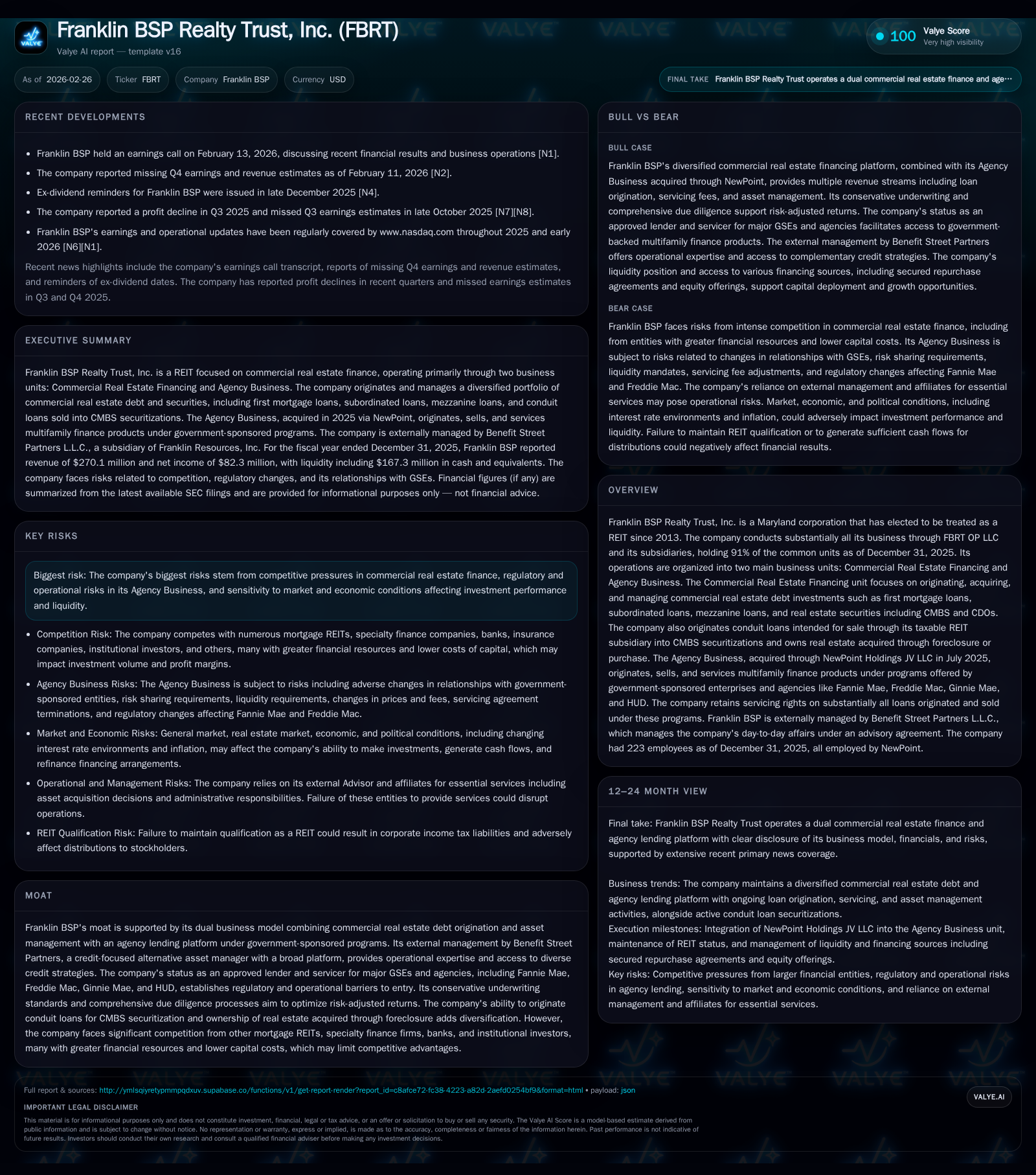
Franklin BSP Realty Trust, Inc. has developed a resilient dual business model centered on commercial real estate debt origination and agency mortgage lending acquired with NewPoint in mid-2025. The company recorded strong revenue growth of 28% in 2025, largely driven by the agency acquisition and expanded financing activities, despite net income declining by 14% year-over-year due to margin pressures and elevated costs. FBRT maintains a moderate leverage profile around 2.5x net debt-to-equity and continues disciplined capital return programs with consistent dividends and opportunistic buybacks. Going forward, growth prospects hinge on successful integration of the Agency Business, sustaining credit underwriting amid evolving market conditions, and navigating liquidity risks inherent in short-term financing strategies.
Company Overview
Franklin BSP Realty Trust, Inc. (FBRT), established as a Maryland corporation electing REIT status since 2013, operates mainly through its subsidiary FBRT OP LLC. The company's business is organized across two main units: Commercial Real Estate Financing, which includes originating and managing first mortgage loans, subordinated loans, mezzanine loans as well as investing in CMBS bonds and other real estate securities; and the Agency Business launched via acquisition of NewPoint Holdings JV LLC in July 2025. The latter unit focuses primarily on originating, selling, and servicing multifamily mortgage products backed by government-sponsored enterprises (GSEs) such as Fannie Mae, Freddie Mac, Ginnie Mae, and HUD agencies [S1].
The External Advisor Benefit Street Partners manages daily operations under an amended advisory agreement. Benefit Street brings extensive credit expertise across multiple credit funds including private debt and structured credit strategies that complement FBRT's diversified financing approach [S1].
Historical Financial Performance
The company experienced robust revenue growth of 28.3% in fiscal year (FY) 2025 to $270 million up from $210 million in FY2024. This jump was driven largely by the inclusion of NewPoint's agency-originated loan servicing operations alongside expanded origination volumes in the Commercial Real Estate Financing segment [F1]. Revenue had been somewhat volatile historically but showed improvement compared to previous years' levels ($264 million in FY2023) reflecting successful execution of strategic initiatives.
However, net income declined by approximately 14.2% year-over-year to $82 million from $96 million in FY2024. The decline relates to increased operating expenses linked to agency servicing operations plus higher interest costs from increased borrowings used for funding acquisitive growth [F1].
A striking feature is the operating cash flow surge — CFO rose over fourfold from approximately $57 million in FY2024 to nearly $292 million in FY2025 — signaling improved liquidity from loan repayments, fee income from servicing rights, and optimized working capital management during rising revenue [F1].
Historical performance (annual)
| FY | Rev ($mm) | Net ($mm) | CFO ($mm) | Rev YoY | Net YoY |
|---|---|---|---|---|---|
| 2025 | 270 | 82 | 292 | +28.3% | -14.2% |
| 2024 | 210 | 96 | 57 | -20.3% | -34.0% |
| 2023 | 264 | 145 | 197 | +30.9% | +906.3% |
| 2022 | 202 | 14 | 153 |
Source: SEC companyfacts cache [F1].
Capital returns and efficiency (annual)
| FY | Div ($mm) | Buybacks ($mm) | ROE% |
|---|---|---|---|
| 2025 | 146 | 14 | 5.7 |
| 2024 | 145 | 5 | 6.3 |
| 2023 | 144 | 13 | 9.3 |
| 2022 | 139 | 17 | 0.9 |
Source: SEC companyfacts cache [F1].
Note: Operating income (OpInc) not explicitly provided; dividends approximate total payouts per year.
Business Segment Details
Commercial Real Estate Financing
This unit targets risk-adjusted returns through originating a broad spectrum of commercial real estate debt products ranging from senior mortgages to mezzanine loans coupled with participations in conduit loan originations intended for CMBS securitization sales via its taxable REIT subsidiary structure (TRS). The portfolio also contains real estate owned through foreclosure or deed-in-lieu acquisitions that enhance diversification away from pure lending risk. Given current market dynamics characterized by rising interest rates coupled with tighter credit spreads, FBRT emphasizes conservative underwriting standards aimed at mitigating default risk while seeking accretive yields typically above its funding costs [S1][S13][S15].
Agency Business
Post-acquisition of NewPoint Holdings JV LLC in July 2025 for approximately $337 million cash plus equity issuance funded through existing cash reserves and new debt issuance, this segment originated a substantial multifamily loan portfolio backed by GSEs such as Fannie Mae and Freddie Mac plus Agencies including HUD/Ginnie Mae programs [S14]. It retains servicing rights on nearly all sold loans creating recurring fee income that enhances earnings visibility but requires adherence to complex regulatory frameworks governing GSE lender approvals plus compliance with liquidity mandates.
NewPoint's servicing portfolio stood near $48 billion at December-end compared to about $55 billion at acquisition closing date—reflecting some paydowns/principal amortization or sales post-close. Key business risks relate to regulatory changes affecting GSE pricing models or eligibility requirements which could impair origination volume or service fee margins; moreover adverse economic shifts might elevate delinquencies influencing loss-sharing arrangements under certain programs [S1][S14][S20].
Capital Allocation and Returns
FBRT maintains a dividend distribution policy aligned with REIT mandates requiring minimum payout of approximately 90% of taxable income. During FY2025 it paid roughly $146 million in dividends sustained at similar levels over prior years demonstrating commitment to shareholder returns despite profit volatility [F1][S11]. Further supporting shareholder value is an authorized share repurchase program with available capacity around $16.7 million at year-end utilized opportunistically given prevailing valuation metrics [F1][S12].
Return on equity hovered near an estimated mid-single digits (circa ~5.7%) as net income normalized notwithstanding ongoing reinvestment into growth opportunities; this modest ROE aligns with the firm's low-risk adjusted investment mandate emphasizing stable cash flows over aggressive earnings spikes [F1]. EBITDA or operating margin metrics are unavailable but given large proportions of net interest expense depicted within financial notes margins face headwinds reflective of rising short-term borrowing costs amid exposure to repurchase agreements backing their leveraged loan assets [S6][S16].
Liquidity Position and Debt Profile
As of December-end 2025, unrestricted cash totaled about $167 million supplemented by available reinvestment capacity under collateralized loan obligation vehicles totaling approximately $30 million along with financing lines availability exceeding $600 million giving aggregate near-term liquidity sources upward of $820 million [S4][S6]. These funds underpin FBRT's leverage target range set between one to three times book equity while actual net debt-to-equity stood around conservatively controlled levels at ~2.5x replicating prior year trends despite significant balance sheet changes post-acquisition [F1][S6].
Funding mix heavily depends on secured repurchase agreements on commercial mortgage loans notably accounting for over a billion dollars quarter-end outstanding balances supported by revolving credit facilities backed by high-quality collateral valued monthly along with growing collateralized loan obligation issuances structured to refinance maturing borrowings without material refinancing risk provided markets remain open [S8][S9][S10].
Management acknowledges dependency on short-term secured borrowings involves risks including collateral margin calls during adverse credit cycles necessitating potential forced asset sales or liquidity squeezes—an industry-wide pressure point gradually counterbalanced by proactive capital recycling strategies maximizing asset yield versus capital cost trade-offs [S18][S20].
Growth Prospects and Constraints
FBRT’s future growth expects to be driven principally by organic expansion within its Agency Business through leveraging its approved lender status across key GSE platforms enabling multifamily loan originations in line with current metro housing demands fueled partly by affordable housing initiatives supported federally [N1][N2]. Furthermore cross-selling opportunities exist whereby borrowers utilizing bridge loans through Commercial Real Estate Financing may refinance via Agency Business channels enhancing customer retention.
On the flip side challenges include margin compression attributed to rising funding costs outpacing achievable loan yields plus potential regulatory shifts impacting underwriting flexibility or gain recognition; credit quality remains a focus amid non-performing loan inventories increasing moderately though well-reserved based on management disclosures reflecting prudent loss provisioning policies increasing during late-cycle pressures [N2][N4][S17].
Capital markets backdrop will also constrain growth if tightening liquidity or elevated cost of reinvestment curtail ability to raise incremental debt or equity instruments necessary for scaling investments efficiently; FBRT holds an open shelf registration statement providing optional access nevertheless dilution concerns must be balanced carefully against funding needs without adversely affecting stockholder interests extensively [N2][N4][S23].
What To Watch: Key Milestones & Risks Analysis
Absent explicit forward guidance beyond corporate filings discussion points highlight watching:
- Credit loss trends particularly within recently acquired Agency portfolio segments given elevated multifamily exposures subject to macroeconomic volatility;
- Execution progress integrating NewPoint’s platform operationally while maintaining GSE compliance certifications;
- Stability of repurchase agreement pricing/collateral terms affected by broader capital markets volatility potentially triggering liquidity tightening;
- Dividend continuity reflecting underlying earnings capacity amidst capital deployment mix between organic originations versus external acquisitions/promotional investments.
Overall macroeconomic factors such as inflation persistence forcing Fed monetary policy tightening cycles could strain borrower affordability leading to lower origination volumes combined with higher provisions—a scenario common across CRE finance companies currently—necessitating close observation for decisive inflections impacting FBRT's earnings trajectory.
Conclusion
Franklin BSP Realty Trust presents a story of measured yet meaningful revenue growth through deft integration of an agency lending platform complementing its longstanding commercial real estate finance franchise enriched by Benefit Street’s advisory expertise. The firm balances expansion aspirations within a leveraged framework prudently managed via diversified funding instruments while actively stewarding shareholder returns through dividends augmented slightly by buybacks. However, squeezed earnings margins influenced by financing cost inflation alongside elevated operational complexity heighten execution demands while exposing FBRT’s financial structure sensitivity especially given reliance on short-dated secured borrowings exposed to collateral revaluation risk. Effective risk management around credit quality monitoring coupled with capital markets access will remain pivotal levers shaping whether sustained growth translates into improved profitability metrics going forward.
This report summarizes publicly available information from Franklin BSP Realty Trust filings and recent news publications without providing investment advice or stock recommendations.
Disclaimer: This is research-only, informational analysis and not investment advice. It may include AI-generated interpretation and general industry context. Always verify important details using primary sources.

Comments