
FDCTech Expands Global Brokerage Reach Following Key Acquisitions
FDCTech’s recent acquisition of Alchemy International Ltd. and other strategic moves deepen its multi-asset trading footprint and technology licensing amid regulatory and competitive pressures.
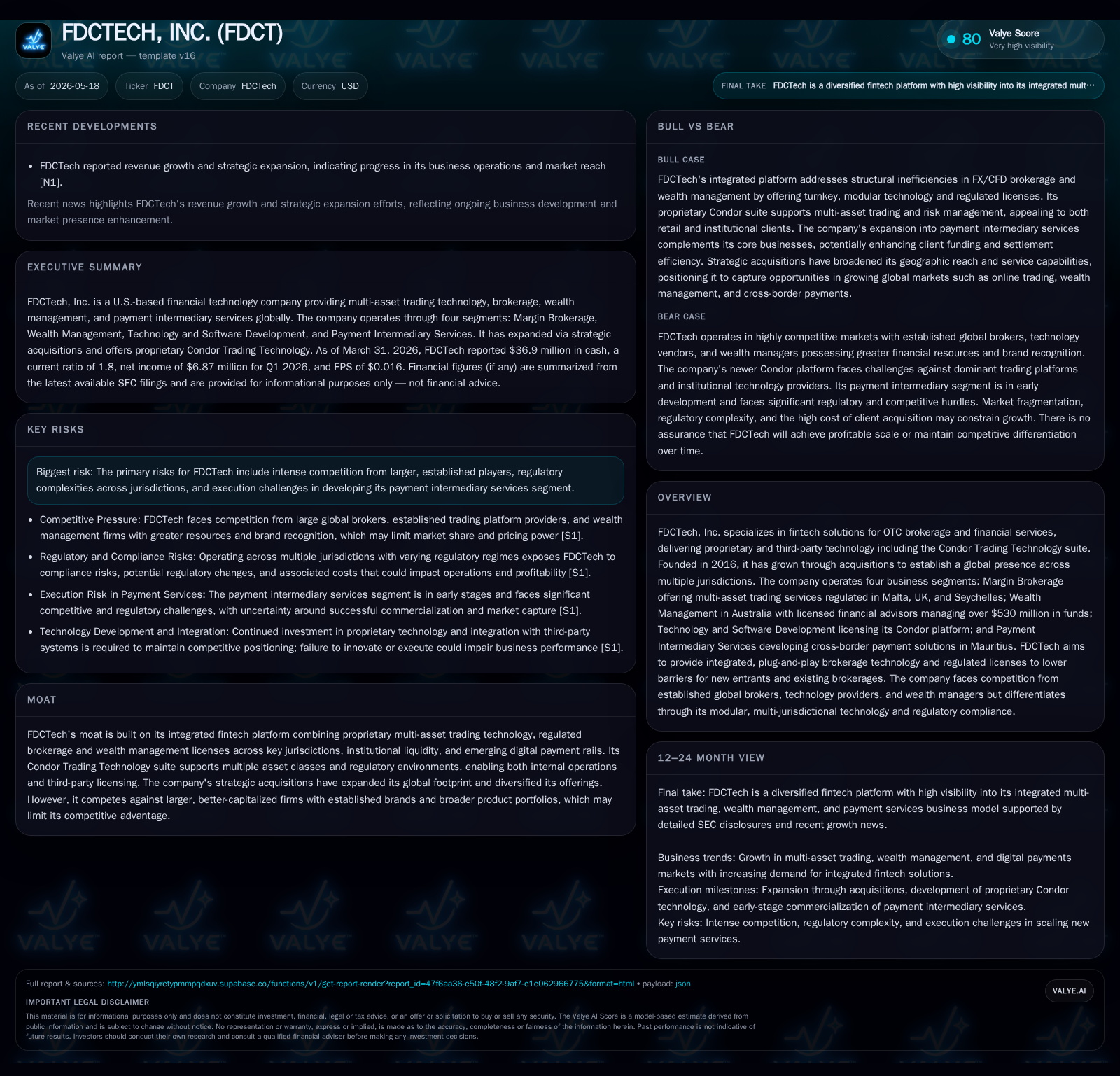
In its latest 10-Q, FDCTech reported operational progress anchored by the acquisition of Seychelles-licensed Alchemy International Ltd., expanding its margin brokerage services across Asia. The company pursues an integrated fintech model combining regulated brokerage operations, proprietary Condor technology licensing, wealth management advisory services in Australia, and emerging payment intermediary capabilities in Mauritius. While its multi-jurisdictional licenses and modular platform offer niche advantages, FDCTech faces execution risks including ongoing litigation tied to acquisition diligence, regulatory complexity, and nascent payment service scaling amid intense competition. Key growth drivers include cross-border expansion fueled by regulatory approvals and technology synergies, while financials reflect a strong liquidity buffer supporting continued strategic investments.
Recent Quarterly Update Frames Expansion Trajectory
The company’s latest quarterly filing dated May 15, 2026 [S2] confirms the operational integration of Alchemy International Ltd. (AIL), acquired in late October 2025 [S4]. This subsidiary licenses under Seychelles’ Financial Services Authority (FSA #SD136) and extends FDCTech’s margin brokerage platform into the Asia-Pacific offshore brokerage space. The transaction consideration totals $2 million due by January 29, 2026 [S4], signaling a near-term capital deployment priority.
This acquisition complements existing subsidiaries regulated in Malta (Alchemy Markets Ltd., MFSA), the United Kingdom (Alchemy Prime Ltd., FCA), and others across Europe and Australia [S1]. AIL adds a valuable licensed entity capable of servicing diverse retail and institutional clients seeking leveraged foreign exchange (FX), contracts-for-difference (CFDs), equities, commodities, and digital asset access under compliant frameworks.
However, the October 29 acquisition overlaps with ongoing legal challenges stemming from prior deals remain notable [S28]. Specifically, shareholder claims relating to alleged undisclosed anti-money laundering (AML) deficiencies at Alchemy Markets Ltd., discovered post-acquisition along with unreimbursed loans affecting net capital disclosures, remain pending with trial set for November 2026. Such litigation introduces uncertainty around acquisition-related contingencies that may impact financial leverage or future deal structuring.
Integrated Business Model Anchored in Multilateral Brokerage and Technology
FDCTech’s operating architecture comprises four key segments:
Margin Brokerage — Operating licensed entities AML (Malta), APL (UK), AIL (Seychelles) to provide multi-asset OTC trading leveraging proprietary Condor Trading Technology alongside third-party systems [S1]. These platforms enable FX/CFD/equities trading with embedded risk management and compliance reporting.
Wealth Management — Via AD Advisory Services Pty Ltd. (Australia), where licensed financial advisors manage over $530 million funds under advice across diversified portfolios regulated by ASIC [S1]. This segment generates fee-based revenues via advisory mandates leveraging an established regulatory license.
Technology & Software Development — Under subsidiary Alchemytech Ltd. (Cyprus) licenses Condor trading/risk management platforms to brokers and institutions globally. The modular infrastructure supports multi-jurisdiction compliance embedding best execution rules and margining policies [S1], appealing to new broker entrants requiring configurable turnkey solutions.
Payment Intermediary Services — Through Xoala Asia in Mauritius licensed as a Payment Intermediary Services provider since November 2025 [S10], offering payment gateway processing, merchant acquiring, cross-border remittance facilitation, card transaction clearing, aiming to reduce funding friction inherent in broker-client workflows.
Revenue mechanics derive from brokerage fees on client trade volumes (spread/commission models), licensing fees for software platforms based on client usage or subscription models, advisory fees based on assets under advice retained through licensed advisors, alongside nascent merchant/payment processing fees incubated by Xoala Asia operations. Margins likely vary by segment with technology licensing typically higher margin compared to trading operations requiring capital reserves under regulatory regimes.
Acquiring regulated brokerage entities expands FDCTech’s addressable market by providing cross-border compliant pathways for retail/institutional clients within European Economic Area frameworks as well as Asia-Pacific offshore hubs. The Condor platform serves as a critical integrator — its open API architecture facilitating rapid deployment across multiple asset classes with embedded real-time risk management essential for regulatory adherence across MFSA Malta, FCA UK, FSA Seychelles regimes.
Competitive Positioning Within Fragmented Global Fintech Landscape
Within global fintech brokerage markets dominated by major established firms possessing deep liquidity pools and extensive product suites—players such as IG Group, Saxo Bank, or CMC Markets—FDCTech occupies a niche leverage position [S1]. Its competitive edge stems from combining proprietary multi-asset trading technology closely aligned with operated regulated subsidiaries offering plug-and-play brokerage setups at lower upfront capital costs.
The company targets new entrants seeking access to leveraged FX/CFD markets without developing entirely bespoke infrastructure or separately securing costly licenses across jurisdictions. By integrating internally operated brokerages with latent technology licensing potential via Condor platform sales to third parties lacking direct regulated presence but needing front/middle/back office capabilities plus institutional-grade connectivity,[S1] FDCTech’s model lowers barriers to entry while generating recurring fee income streams.
That said, the company operates under constraints uncommon among larger tier-one brokers: limited scale versus top global peers restricts economies of scale; fragmented regulation requires complex oversight increasing operational costs; brand recognition remains muted versus competitors heavily marketing proprietary brands; finally, capital intensity per jurisdiction increases cost of growth relative to pure tech SaaS providers.[S1]
Customer switching costs are moderate—brokers tend to stick with proven platforms once integrated but new entrants weigh cost/time-to-market benefits of turnkey models like FDCTech’s Condor ecosystem versus building in-house or using third-party multi-vendor stacks.[S1] Regulatory heterogeneity between Maltese MFSA regimes versus FCA UK or FSA Seychelles affects product scope/licensing flexibility influencing competitive positioning per jurisdiction.[S1]
Key Growth Drivers Supported by Regulatory Licenses and Technology Synergies
Recent acquisitions extend FDCTech’s global footprint notably into Asia-Pacific through Seychelles-regulated AIL license allowing it to tap growing regional OTC FX/CFD volume pools alongside increasing penetration of Australian wealth management vertical via ADS managing $530M+ under advice [S1]
Simultaneously licensing gains from Condor Trading Technology are essential growth levers reflecting demand among smaller brokers for modular all-in-one solutions capable of integrating risk engines,* pricing models,* back-office compliance,* real-time margin calculations,* all tailored for region-specific regulatory constraints [N1][S1]
Xoala Asia’s Payment Intermediary Services license opens avenues to address chronic FX funding inefficiencies experienced by broker clients historically reliant on slow bank wires or expensive third-party processors.[S10][N1] While early-stage with uncertain profitability timing due to incremental expenses acquiring merchant relationships plus regulatory approvals,[S1] this payments arm offers a differentiated service layer synergistically tethered to brokerage units enhancing customer retention through improved deposit/withdrawal experiences.[S10]
Additional growth catalysts will arise when the $2 million purchase consideration payable by January 29, 2026 for Alchemy International is finalized enabling fuller integration synergy capture [S4]. Upcoming judicial rulings overseeing shareholder litigation on prior acquisitions slated for November 2026 may alter contingent liability profiles influencing future M&A appetite or deal structuring.[S28]
Overall growth depends on successful cross-selling among segments leveraging multi-jurisdictional licenses along with scaling core tech platform adoption both internally within operating brokerages plus externally via third-party licensing agreements.[N1][S2]
Risks From Regulatory Complexity and Execution Challenges on New Ventures
A principal risk relates to complex overlapping regulations spanning FCA UK stringent requirements; MFSA Malta evolving post-Brexit standards; FSA Seychelles relatively nascent but emerging standards; ASIC Australia compliance regimes governing wealth advisory operations; plus FSC Mauritius rules governing payment intermediaries.[S1][S10][S28]
Navigating this patchwork increases compliance costs potentially limiting margin enhancement from operational scaling across jurisdictions simultaneously [S1]
Legal proceedings present measurable execution risk—specifically Asher Alkoby et al. v. FDCTech concerning withheld acquisition payments due to AML deficiencies discovered at Alchemy Markets Ltd. along with unpaid loans reducing disclosed net capital—poses exposure to ~$915k repayment claimants seek correction on contractual enforceability [S28]. Trial scheduled November 2026 introduces timeline uncertainty that could affect cash flow planning or impair goodwill if adverse judgment ensues.
Payment services face typical startup headwinds: intense competition driving down spreads impacting FX remittance margins; client onboarding delays due to banking partner negotiations; evolving fraud prevention/compliance expectations increasing operational complexity that may defer profitability expectations.[S1][N1]
Finally, competitive pressure from larger firms with stronger brand equity restricts market share gains unless FDCTech differentiates meaningfully either through deeper integration or superior technological sophistication offsetting their smaller scale disadvantage.
Milestones to Watch: Regulatory Approvals, Platform Adoption, and Partnerships
Key near-term milestones include:
- Completion of full payment ($2M) for Alchemy International Ltd.’s acquisition by January 29, 2026 enabling consolidated performance contribution [S4].
- November 2026 trial date for the shareholder lawsuit related to AML compliance shortfalls affecting past acquisitions [S28].
- Updates from Mauritius FSC regarding expansion scope or additional approvals tied to Xoala Asia's PIS license which will underpin payment market penetration efficacy [S10].
- Quarterly updates tracking growth in assets under advice within the Australian wealth management segment signaling client retention/advisory mandate depth [N1].
- Announcements about new third-party broker partnerships adopting Condor trading technology pivotal for software licensing revenue trajectory [N1].
- Any public disclosures suggesting progress integrating payment rails into front-end offerings that reduce customer funding friction preserving user trust critical for repeat trading volume generation.
Monitoring these factors provides insight into whether FDCTech can maintain momentum across its multi-segment business amid external uncertainties.
Current Financial Profile Highlights Balance Sheet Strength
As per companyfacts data as of March 31, 2026, FDCTech holds approximately $36.9 million in cash and equivalents against nominal debt nearing $550 thousand last reported end-2022 resulting in near $36 million net cash position supporting ongoing liquidity needs [F1]
Current ratio stands around a healthy ~1.8 given current assets approximating $67.7 million against current liabilities near $37.6 million indicating solid short-term balance-sheet resilience capable of funding integration efforts plus R&D activities around technology development.
No signals from recent filings suggest covenant breaches or refinancing pressures—a positive backdrop enabling strategic flexibility surrounding acquisitions or incremental regulatory investments [F1][S2].
Disclaimer: This analysis is based solely on publicly available SEC filings as cited up through May 18, 2026 and does not constitute investment advice.
Disclaimer: This is research-only, informational analysis and not investment advice. It may include AI-generated interpretation and general industry context. Always verify important details using primary sources.

Comments