
Frequency Electronics: Backlog Growth, Defense Exposure, and the Economics of Precision Timing
A surge in aerospace contract awards and a record backlog highlight Frequency Electronics’ role in high-specification timing technology for satellites and defense, but government dependence and supply chain fragility shape both its opportunity and risk profile.
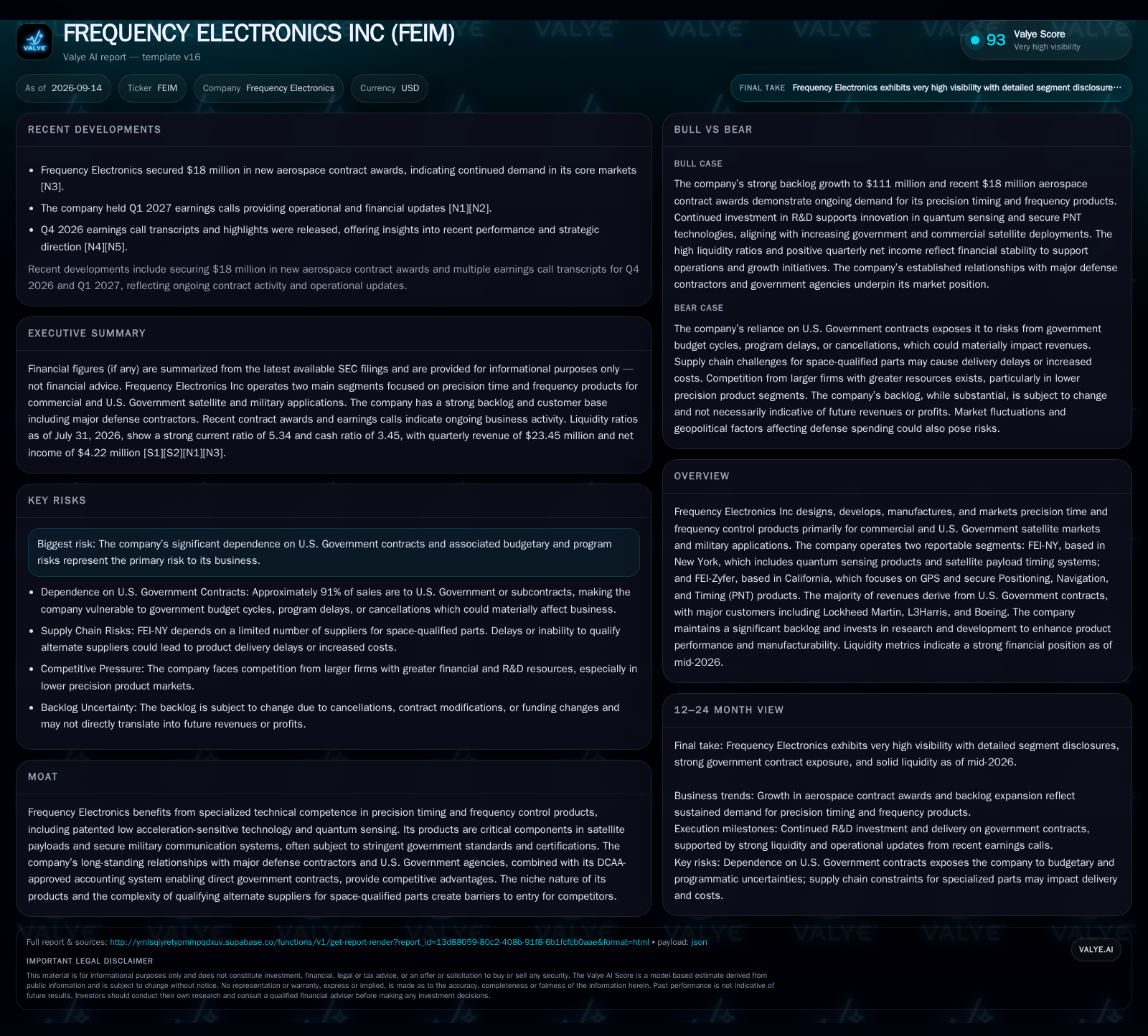
Frequency Electronics reported a consolidated backlog of $111 million as of April 2026, up sharply from the prior year, and secured $18 million in new aerospace contracts, reflecting robust demand for its precision timing products in satellite and defense markets. Over 90% of sales are tied to U.S. Government contracts or subcontracts, concentrating both opportunity and risk. The company’s future hinges on execution of its large backlog, successful delivery on new awards, and its ability to sustain technical differentiation amid evolving defense and space sector priorities. [S1] [S2] [N3]
Frequency Electronics is at a pivotal juncture: a surging backlog and fresh aerospace contract wins place the company in a position of operational strength, but also heighten its dependence on U.S. Government programs and the complexities of defense procurement cycles. As a specialist in precision timing and frequency control for satellites and military systems, FEI’s fortunes are tied to both technical execution and the broader trajectory of federal spending in space and defense. The next phase will test whether its technical edge and deep customer relationships can drive sustainable growth, or whether concentration risks and supply chain fragility will begin to erode its current momentum.
Recent Backlog Expansion and Aerospace Awards Reshape Revenue Outlook
Frequency Electronics’ consolidated backlog reached $111 million as of April 30, 2026, a steep increase from $70 million the previous year. The company expects approximately 73% of this backlog to convert into revenue during fiscal 2027, providing unusually high near-term visibility for a defense and aerospace supplier. Recent contract wins—such as $18 million in new aerospace awards—underscore ongoing demand for the company’s core timing and frequency products, especially in satellite and defense applications. These developments are material because they set up a revenue ramp and test FEI’s ability to deliver at scale while managing production and supply chain risks. [S1] [N3]
The company reported a current ratio of 5.34 for the period. [S2]
How FEI’s Segment Model Drives Margin and Capital Needs
FEI operates two primary segments: FEI-NY, focused on high-performance timing solutions for satellites and military platforms, and FEI-Zyfer, centered on secure GPS and Positioning, Navigation, and Timing (PNT) systems. The economics of the business are shaped by a mix of long-cycle, high-specification government contracts and a smaller share of commercial work. Revenue recognition is typically tied to project milestones or delivery schedules, which can create lumpiness. High engineering content and customization requirements support potential gross margin premiums, but also increase fixed costs and working capital needs.
The business model is capital intensive in R&D—$6.1 million spent in fiscal 2026—reflecting a need to maintain technical leadership amid evolving mission requirements for quantum sensing, anti-jamming, and high-reliability components. Manufacturing is likely a blend of in-house processes for core IP and outsourced fabrication for standardized parts. Operating leverage may be significant if backlog conversion accelerates, as fixed engineering and facility costs can be spread over higher volumes. However, the need for space-qualified and defense-certified parts means that supply chain disruptions or qualification delays can sharply impact margins and cash flow.
Defensible Niche or Vulnerable Link in the Defense Value Chain?
FEI’s core advantage stems from deep technical expertise in precision timing, quantum sensing, and secure PNT—categories where performance, reliability, and qualification hurdles create natural barriers to entry. Its products are embedded in mission-critical satellite payloads and military systems, and longstanding relationships with primes like Lockheed Martin and Boeing suggest that FEI is a trusted supplier for key programs. DCAA-approved accounting and proven ability to meet government contract requirements further reinforce its defensibility.
However, the company faces counterforces from larger defense electronics competitors that may have greater resources for R&D, broader product portfolios, and the ability to bundle offerings. In lower-precision or commoditized timing markets, FEI could be undercut on price or lose share to vertically integrated rivals. The risk of substitution is currently limited by qualification requirements and the complexity of replacing space-qualified suppliers, but could rise if new technologies (such as chip-scale atomic clocks or advanced photonic timing systems) reach commercial maturity.
What It Would Take for FEI to Outperform: Contract Conversion and Technical Upside
The most favorable trajectory for FEI is a rapid and efficient conversion of its record backlog into high-margin revenue, driven by flawless execution on existing aerospace and defense programs. A continued flow of new awards—especially for emerging satellite constellations, secure communications, or next-generation quantum timing—could extend the revenue runway and cement FEI’s technical leadership. If the company’s R&D yields differentiated solutions adopted in new mission profiles or defense modernization initiatives, pricing power and margin expansion could follow.
Confirmation would come from sequential revenue growth exceeding the expected conversion of backlog, disclosure of large new contract wins (especially with new government agencies or commercial satellite operators), and evidence of margin improvement tied to new product introductions or higher-value contracts. A useful falsification would be persistent delivery slippage, rising costs that erode margins despite backlog growth, or evidence that new awards are concentrated in lower-margin, lower-specification categories.
Sustained Demand, But Execution and Budget Cycles Dictate the Trajectory
The most plausible outlook is steady revenue growth as FEI works down its sizable backlog, with new awards offsetting program completions and modestly expanding the order book. Margins may remain stable, with some pressure from supply chain volatility but support from ongoing R&D investment and entrenched customer relationships. The company’s deep integration into major defense programs likely ensures baseline demand, but growth is capped by the pace of government procurement cycles and the risk of project delays.
Evidence supporting this scenario would include quarterly revenue and earnings in line with backlog conversion expectations, stable or rising bookings, and continued disclosure of R&D progress or product qualifications. Falsification would come from a sudden drop in new orders, backlog attrition (via cancellations or funding cuts), or a material deterioration in gross or operating margins due to cost overruns or supply chain failures.
When Concentration and Supply Chain Risks Materialize
A negative turn for FEI would result from a combination of U.S. Government budget tightening, program cancellations, or delays that lead to backlog contraction and revenue shortfalls. Given that over 90% of sales are tied to federal programs or subcontracts, even a modest shift in procurement priorities could have outsized impact. Supply chain bottlenecks for space-qualified parts could trigger delivery delays, cost inflation, or reputational harm, especially if alternate suppliers cannot be rapidly qualified.
Downside confirmation would come from contract modifications or cancellations disclosed in filings, a marked decline in backlog, or guidance cuts on revenue and earnings. Additional red flags would include rising inventories without corresponding revenue, persistent negative cash flow from operations, or customer concentration increasing even further—signaling reduced diversification and bargaining power.
Milestones and Metrics That Will Define FEI’s Strategic Trajectory
Sequential quarterly revenue growth relative to expected backlog conversion rates, testing both execution and demand continuity.
Gross and operating margin trends, especially in the context of rising backlog and new contract mix—if disclosed.
New contract award announcements, particularly with new government agencies or in emerging commercial satellite segments.
R&D spending levels and disclosure of technology milestones, such as quantum sensing product launches or new PNT features.
Any disclosure of supply chain disruptions, delays in qualification of alternate suppliers, or rising lead times for critical components.
Backlog attrition rates—cancellations, modifications, or funding-driven reductions.
Customer concentration metrics: monitoring whether dependency on a small number of primes increases or diversifies over time.
Cash flow from operations and changes in working capital, as indicators of underlying business health and project execution.
Disclaimer: This is research-only, informational analysis and not investment advice. It may include AI-generated interpretation and general industry context. Always verify important details using primary sources.

Comments