
FG Merger II Corp. Advances Boxabl Merger Amid Structural SPAC Execution Risks
Recent quarterly disclosures confirm FGMC’s ongoing transition from a blank check company to a public operating entity through the Boxabl Inc. business combination.
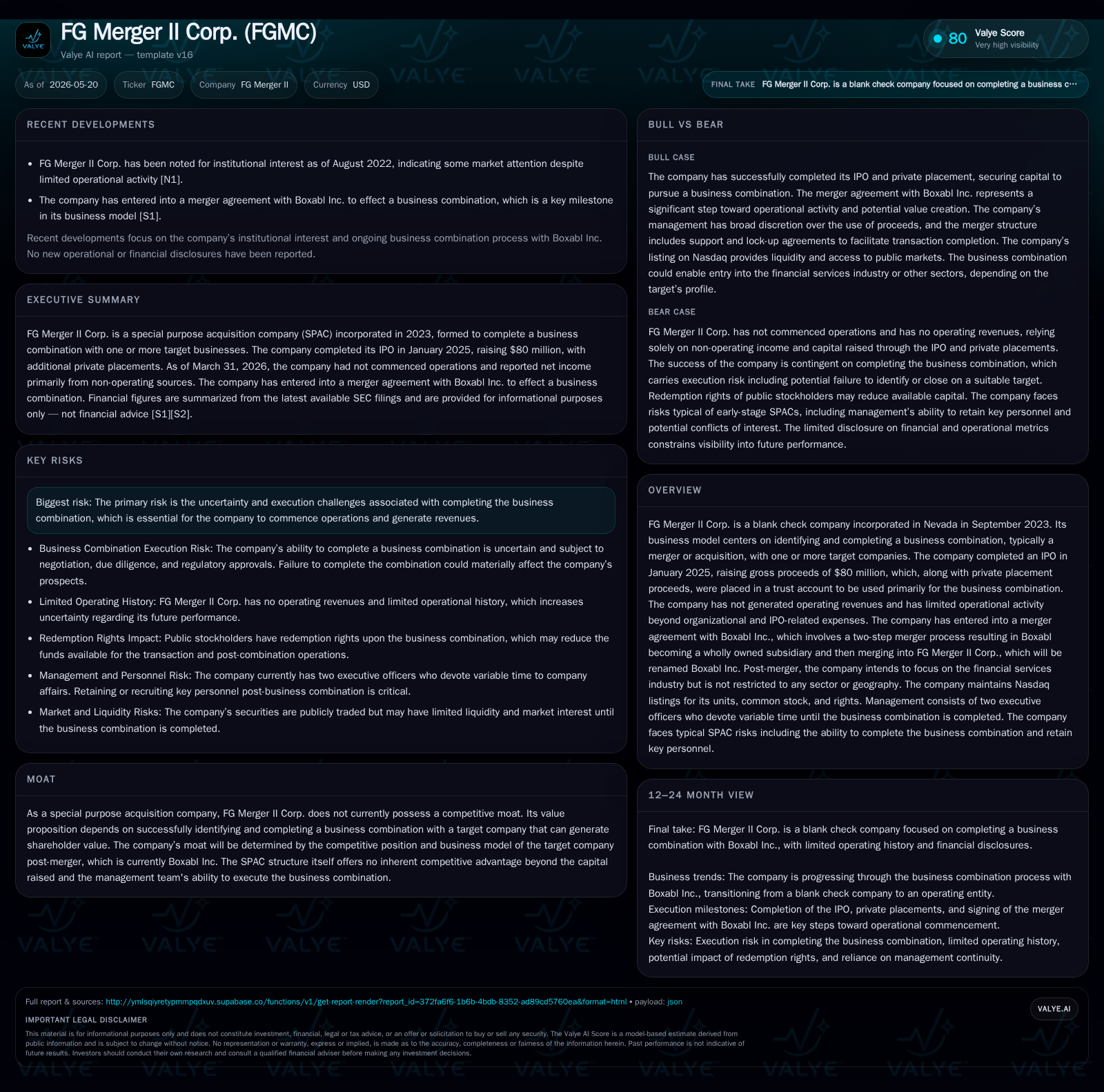
FG Merger II Corp. (FGMC) remains focused on completing its transformational merger with Boxabl Inc., following a structured two-step process approved by both parties. The latest 10-Q underscores that FGMC has no operating revenues to date, consistent with its SPAC model, and its value proposition hinges on successful transaction execution and subsequent operational growth of the combined entity. Key risks include regulatory approvals, shareholder vote outcomes, and the execution environment for Boxabl’s emerging modular housing technology amid early-stage commercialization challenges. Post-merger, FGMC will transition into an operating company in the financial services sector primarily via Boxabl’s platform.
Recent Operating Update
FG Merger II Corp. (“FGMC”) reaffirmed its position as an early-stage blank check company in its latest 10-Q filed May 14, 2026 [S2]. Consistent with prior disclosures, FGMC has not recognized any operating revenues nor engaged in substantive operational activity beyond organizational costs and IPO-related expenses. The recent filing clarifies that FGMC's primary endeavors remain tied to progressing the business combination with Boxabl Inc., a proposed target that would fundamentally transform FGMC from a shell entity into an operating public company.
On May 6, 2026, FGMC executed a third amendment to its merger agreement with Boxabl ("BOXABL"), underscoring continued commitment to a two-step transaction structure: first merging a FGMC wholly owned subsidiary into BOXABL (making BOXABL its subsidiary), then merging BOXABL back into FGMC itself—renaming the combined entity Boxabl Inc. This approach meets Nasdaq rules mandating majority control while aiming for streamlined integration post-close [S3], [S9].
Business Model
As a Special Purpose Acquisition Company (SPAC), FGMC's core business model is premised entirely on identifying and consummating one or more qualifying business combinations—typically mergers or acquisitions—with operational companies that can drive shareholder value. Capital raised during FGMC's January 2025 IPO ($80 million gross) along with private placement proceeds are held in trust accounts reserved for such transactions. Revenue generation pre-business combination is nonexistent; income is derived solely from interest earned on trust assets.
Once the corporate rebranding concludes post-Boxabl merger closing, the combined entity will shift toward generating revenues typical of an operating company within its industry vertical—financial services/technology integration centered around modular building platforms. Thus far, this pivot is prospective; success depends heavily on seamless transaction execution and effective scaling of Boxabl’s core offerings.
Industry Structure and Competitive Position
FGMC operates within the niche yet competitive sphere of SPACs targeting financial services or adjacent innovative tech sectors focusing on disruptive business models. This structure affords no competitive moat independent of target selection capabilities or management expertise.
Boxabl introduces dynamics belonging more squarely within the emerging modular housing technology industry—a subsector at the convergence of construction innovation, smart manufacturing, and sustainable urban development. Its flagship product Casita relies both on technological differentiation via prefabricated components amenable to rapid deployment and scalability but faces entrenched challenges: fulfillment of diversified building codes across jurisdictions; unit economics optimization; supply chain robustness; customer adoption curves typical for nascent technologies; and increasing competition from traditional real estate players incorporating modular methods.
Consequently, while FGMC’s SPAC framework offers access to public capital markets swiftly to deploy against an identified opportunity (Boxabl), the long-term moat must emanate from Boxabl’s own innovation pipeline, brand establishment, manufacturing capacity expansion, partner ecosystems, regulatory navigation capabilities, and network effects within housing markets.
Growth Drivers
Post-merger growth hinges largely on Boxabl's ability to convert technological promise into commercial scale:
- Manufacturing Scale-Up: Increasing production capacity for Casita units is central to meeting anticipated demand surges given modular housing's appeal to affordable living solutions.
- Market Adoption: Customer penetration driven by urbanization trends demanding cost-efficient housing aligns with structural shifts favoring prefabrication.
- Strategic Partnerships: Alliances with governments (potential subsidies/incentives), construction firms, or real estate developers can accelerate distribution channels.
- Technological Integration: Enhancing unit economics through continuous R&D investments into materials science and smart home integration incentivizes repeat customers.
- Financial Services Synergies: Leveraging financial tools post-combination could unlock new financing schemes enabling broader buyer access.
These vectors collectively form a multifaceted growth blueprint but rely fundamentally on securing stable capital inflows post-business combination closure.
Risks / Watchpoints / Growth Constraints
- Transaction Completion Risk: Regulatory approvals remain pending. Any delays or refusals could impair closing timelines or cause termination under material breach provisions outlined in merger amendments [S1], [S15].
- Shareholder Redemption Risk: Redemption elections by existing FGMC shareholders could diminish cash available for operations post-merger.
- Early Commercialization Challenges for Boxabl: Net losses historically reflect unproven unit economics—commercial viability is untested at scale [S4], [S18].
- Management Retention Dependency: Successful integration requires retention of key senior personnel who are instrumental in technology development and go-to-market execution.
- Competitive Pressures & Regulatory Environments: Modular housing must contend with complex building regulations varying by geography which could limit product applicability or inflate compliance costs.
- Capital Requirements & Financing Risk: Additional financing may be necessary as operations scale; inability to raise follow-on capital under favorable terms could constrain growth projections.
- Market Acceptance Uncertainty: Adoption rates for novel housing products often oscillate based on consumer preferences and economic cycles impacting demand elasticity.
What to Watch Next
Key milestones include:
- Filing and effectiveness of definitive proxy statements by FGMC related to vote solicitation for the proposed Business Combination with Boxabl [S22], which will elucidate transaction specifics crucial for investor assessment.
- Timing and outcome of shareholder votes scheduled upon distribution of proxy materials defining acceptance or rejection thresholds.
- Receipt of final regulatory licenses or approvals required for merger consummation without conditional modifications affecting structural terms.
- Initial performance metrics following close such as order backlogs for Casita units deployed or strengthened partnership announcements indicating traction within targeted markets.
- Management commentary updates regarding integration progress including cost synergies or challenges discovered after combining entities.
Continuous monitoring of SEC filings around these events is warranted for visibility into transaction viability and early operational cues post-close.
Financial Profile Briefly Anchored To Latest Quarter
FGMC’s balance sheet predominantly reflects holding cash/equivalents ($318K as of March 31, 2026) allocated largely within trust accounts earmarked for consummating the business combination [F1]. Total debt stands negligible at approximately $286K trailing twelve months ending March 31, 2025—reflecting primarily related-party promissory notes rather than market borrowing facilities [F1]. Operating loss aligns with expected administrative expenses associated with organizational maintenance ($972K net operating loss reported December 31, 2025) consistent with an inactive operational profile awaiting transactional milestones [F1]. No revenue recognition exists pre-combination reaffirming incumbent SPAC cash-generation mechanics relying fully on trust funds plus sponsor financial support until deal close.
This conservative balance sheet posture prioritizes liquidity preservation while minimizing leverage risks ahead of conversion into an operating public company marked by different capital needs.
This analysis is based exclusively on publicly filed SEC documents up through May 19, 2026. It does not constitute investment advice but serves as an independent industry-focused examination emphasizing transactional context. All forward-looking statements discussed herein remain subject to known risks explicitly disclosed by FG Merger II Corp.
Disclaimer: This is research-only, informational analysis and not investment advice. It may include AI-generated interpretation and general industry context. Always verify important details using primary sources.

Comments