
Figure Technology Solutions Advances Blockchain-Driven Capital Markets Transformation
Recent launch of Blockchain Stock and OPEN network positions Figure to reshape capital markets infrastructure and liquidity.
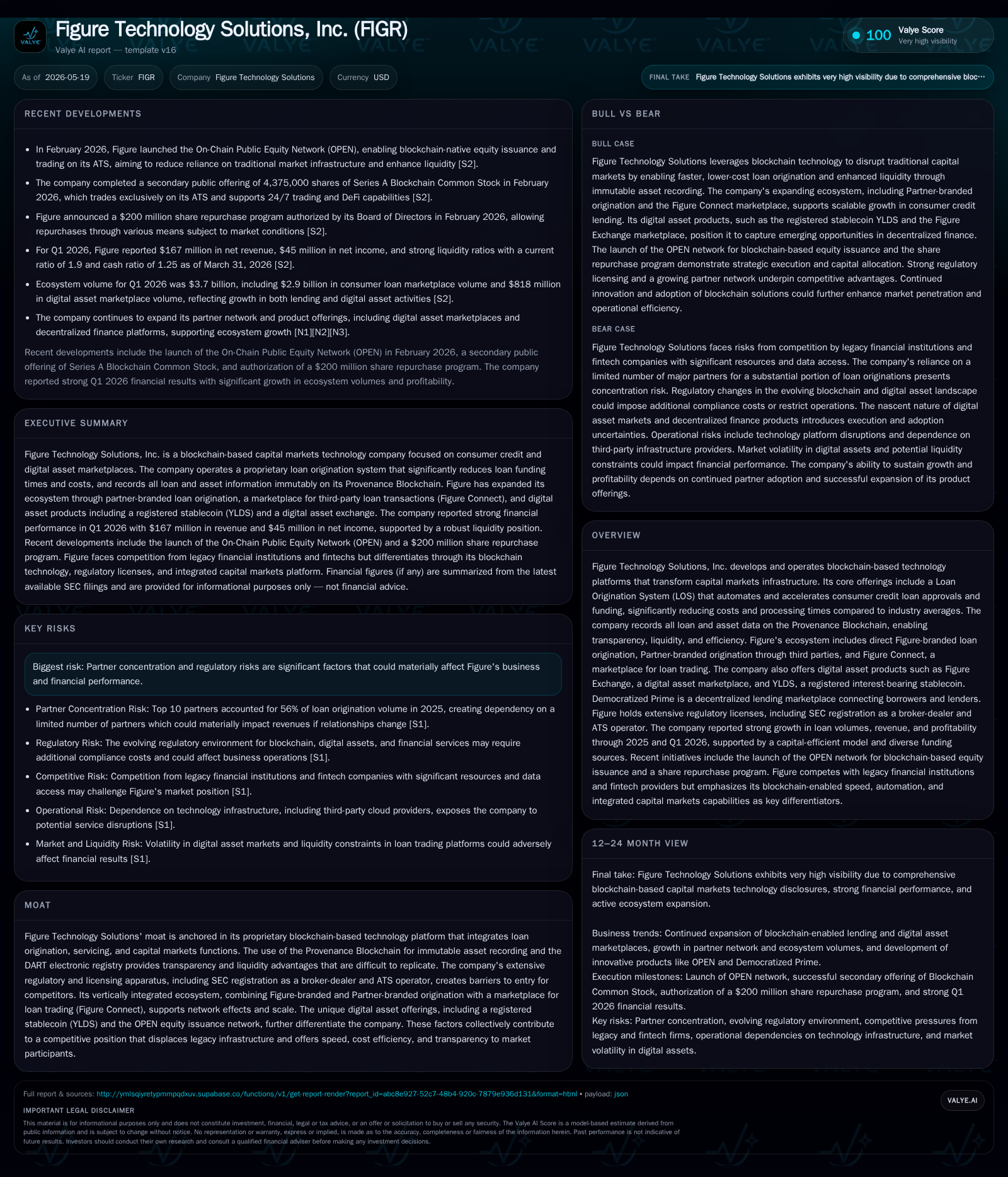
Figure Technology Solutions released its latest quarterly results highlighting the pivotal launch of its Blockchain Stock, a new class of equity security trading exclusively on its ATS, enabling 24/7 trading and DeFi collateralization. February 2026 also saw the rollout of OPEN, a blockchain-native public equity issuance and trading network designed to modernize capital markets by reducing reliance on legacy infrastructure. The company’s vertically integrated platform combines fast, cost-efficient loan origination with innovative digital asset products and marketplaces, establishing a robust ecosystem underpinned by proprietary blockchain technology. While growth drivers include expanding blockchain adoption in consumer credit and digital equity markets, risks remain around partner concentration and evolving regulation. Financially, Figure maintains a strong net cash position supporting ongoing innovation investments.
Recent Operating Highlights: Blockchain Stock Offering and OPEN Launch
The most material near-term development for Figure Technology Solutions surfaced in its Q1 2026 Form 10-Q filed May 15, 2026 [S2]. In February 2026, Figure completed a secondary public offering of 4,375,000 shares of its Series A Blockchain Common Stock that trades exclusively on the company’s own Alternative Trading System (ATS). This new class unlocks continuous, around-the-clock trading capability—24/7/365—which is rare among publicly traded equities typically confined to exchange hours. Equally distinctive is the capacity for holders to lend their Blockchain Stock transparently using decentralized finance (DeFi) protocols, enabling cross-asset collateralization that integrates conventional equities with blockchain-driven liquidity mechanisms.
Concurrently, Figure launched OPEN (On-Chain Public Equity Network) [S2], a transformative blockchain-based infrastructure layer allowing companies to issue native equity tokens directly on the Provenance Blockchain. OPEN facilitates secondary market trading entirely on Figure’s ATS, promising lower costs relative to legacy clearinghouses due to reduced intermediaries and streamlined settlement via smart contracts. Crucially, OPEN supports seamless two-way exchangeability between these blockchain-native securities and the company's Class A common stock listed on traditional exchanges, minimizing price divergence and enhancing active liquidity.
The combination of Blockchain Stock’s innovative tradability and OPEN’s issuance network marks a critical foundation expanding Figure’s disruptive footprint beyond consumer lending into public equity capital markets [S3]. This dual initiative repositions Figure not just as a fintech mortgage disruptor but as an architect of next-generation capital market ecosystems integrating conventional financial instruments with decentralized technologies.
Business Model: Vertical Integration of Loan Origination, Digital Assets, and Marketplaces
Figure monetizes several interconnected revenue streams anchored in proprietary blockchain-enabled technology. The core remains its Loan Origination System (LOS), which automates the origination process primarily for home equity lines of credit (HELOCs) and broader consumer credit products [S1]. Revenue arises from fees on directly originated loans under the Figure brand, partner-branded originations from third-party lenders leveraging Figure technology, servicing fees from securitized loans where Figure remains servicer post-sale, and transaction fees from loan trading via the Figure Connect marketplace.
Beyond loans, digital asset products contribute expanding revenue lines: the YLDS interest-bearing stablecoin registered as a security offers unique institutional use cases in collateralization and cross-border flows with income generated from net interest [S1]. Democratized Prime functions as a decentralized lending marketplace facilitating peer-to-peer capital deployment secured by diverse digital collateral with corresponding origination fee capture.
The recent inclusion of Blockchain Stock introduces incremental revenue opportunities linked to its ATS exclusivity—transaction fees on the blockchain-based equity marketplace—and broader ecosystem monetization through enhanced capital formation enabled by OPEN's native issuance model [S2]. By vertically integrating origination through digital assets issuance and secondary liquidity marketplaces within one platform ecosystem built atop immutable Provenance Blockchain records, Figure leverages network effects increasing stickiness for originators, investors, borrowers, and traders alike.
Competitive Positioning Within Capital Markets Infrastructure Innovation
Figure occupies a distinct niche wherein legacy capital markets exhibit entrenched inefficiencies rooted in fragmented infrastructures reliant on trust-based intermediation prone to latency, errors, audit costs and limited liquidity windows [S1]. Its comprehensive regulatory stance—SEC registrations as broker-dealer and operator of ATS supporting both consumer credit assets and public equities—forms a formidable entry barrier relative to emerging DeFi-only entrants lacking formal licenses.
This dual registration permits Figure to bridge regulated financial markets with programmable blockchain networks legally—a significant moat compared to pure crypto-native operations constrained by regulatory uncertainty. The company’s early-mover status in automating HELOC origination complemented with an established securitization footprint provides scale advantages over smaller fintech peers focused solely on origination without integrated servicing or secondary platforms.
Sector-Specific Value Chain Dynamics: Loan Origination Speed, Cost Structure, and Blockchain Impact
The efficiency gains achieved by Figure are considerable within the context of consumer credit loan processing. Through LOS automation paired with blockchain transaction recording, median loan funding time shrank to approximately 10 days as of December 31, 2025—vastly outperforming the industry median around 43 days [S1]. This speed acceleration is pivotal given typical underwriting throttles bottlenecking traditional HELOC offers.
On cost structure frontlines, average production cost per loan stands near $717 for FY2025 compared favorably against conventional mortgage origination costs hovering above $1,000 per loan [S1]. These savings stem from automation along underwriting pipelines combined with elimination/reduction of manual reconciliation via smart contract enforcement on ledger-based transactions.
Provenance Blockchain’s role transcends record-keeping; it materially improves transparency across loan ownership histories while facilitating securitization investors’ real-time access to asset performance data—fostering liquidity enhancements uncommon in historically opaque mortgage-backed securities markets [S1,S2]. Capacity appears scalable since blockchain nodes enable trust-minimized validations enabling high throughput without centralized bottlenecks common in legacy systems, although monitoring adoption rates will be crucial for realizing full platform utilization.
Switching costs translate beyond technology lock-in; standardized immutable collateral records underpin investor confidence encouraging retention downstream within ecosystems like Figure Connect’s loan marketplace or Democratized Prime lending pools where collateral quality assessment critically affects participation/reinvestment decisions.
Growth Catalysts: Expanding Blockchain Adoption in Consumer Credit and Equity Markets
Several tangible growth drivers exist for Figure poised to accelerate demand sustainably:
- The U.S. consumer credit market targeted exceeds $2 trillion with HELOCs benefiting from elevated housing prices combined with low resale volumes fueling demand for accessible home equity borrowing solutions [S1].
- Enhanced acceptance of digital assets by institutional clients expands YLDS circulation significantly—from nominal levels under $3 million early last year to ~$600 million circulating stablecoin balances as of March 2026 indicating rising adoption [S2].
- Democratized Prime sees accelerating volume reflecting growing user interest in decentralized lending structures providing attractive yield opportunities backed by collateral quality dashboards powered by proprietary risk analytics algorithms.
- OPEN’s ability to democratize public equity issuance lowers barriers for companies seeking financing alternatives amidst volatile macroeconomic conditions while providing shareholders novel liquidity avenues separating it from traditional slow cycle IPO methods [S11].
- Economic trends promoting portfolio margining across tokenized assets alongside traditional holdings present cross-product synergies amplifying retention through embedded financial interoperability uniquely enabled within Figure’s ecosystem [S2,S11].
Together these factors suggest structural rather than purely cyclical tailwinds bolstering revenue sources beyond mere transactional spikes or episodic market exuberances.
Key Risks: Partner Concentration, Regulatory Environment, and Market Adoption Challenges
Despite strong prospects several watchpoints temper enthusiasm:
- Partner concentration risk looms since much loan volume stems predominantly from select large partners relying heavily on Figure’s LOS—the failure or disengagement of which could impair origination backlogs materially affecting fee revenue visibility [S1].
- Regulatory uncertainty persists around rapidly evolving securities laws governing tokenized asset classes including implications for broker-dealer obligations connected to digital securities issuance/trading; policy shifts could raise compliance costs or restrict aspects of Table Open Network functionality limiting growth scope [S1,S16].
- Market adoption hurdles prevail given persistent skepticism toward hybrid models combining traditional equity structures with DeFi paradigms particularly among conservative institutional investors unwilling immediately to embrace novel trading mechanics despite liquidity promises.
- Scalability concerns include ensuring backend ATS matching engines sustain ultra-high frequency operations critical for continuous trading of Blockchain Stock as well as onboarding sufficient issuer interest onto OPEN allowing meaningful network effects that justify infrastructural investments [S2].
- Volatility risks relate also partly to nascent stablecoin yields (i.e., YLDS), whose sustained demand depends heavily on prevailing interest rate environments and trust metrics inherent within protocol governance frameworks intersecting regulated finance standards.
These risks frame ongoing operational vigilance requirements demanding adaptive compliance architectures paired with proactive partner diversification efforts.
What to Monitor Next: Volume Metrics, Technology Adoption, and Regulatory Updates
Key execution indicators will include:
- Quarterly figures showing incremental volume growth within Figure Connect marketplaces tracking originations sourced via third-party partners versus direct lending activity measuring diversification progress post-launch of new product features [S2].
- Uptake metrics monitoring OPEN-listed company issuances and trading volumes will shed light on commercial traction underlying public equity tokenization aspirations including retail/institution segmentation response curves capturing demand elasticity under variable issuance economics [S3,S11].
- Stablecoin circulation growth rate alongside associated yield generation benchmarks tied to YLDS provide proxy indicators for institutional acceptance dynamics critical in stabilizing recurring revenues tied to digital asset products [F1,S2].
- Regulatory environment updates particularly any definitive SEC guidance clarifying scope/applicability surrounding blockchain stock instruments or broker-dealer cyber-compliance mandates could markedly shift cost structures or market opportunity size assumptions [S1,S16].
- Executional milestones such as treasury management efficiencies reflected in buyback programs (e.g., recent repurchase of Class A shares related to Blockchain Stock offering) will highlight capital allocation discipline supporting shareholder value enhancement strategies [S2].
Observing these markers will help gauge whether innovative technology advantages are translating into sustainable market share expansion or remain nascent experiments constrained by externalities.
Financial Profile: Profitability Growth Supported by Capital Efficiency
The firm reported $506.9 million total net revenue with $133.9 million net income for FY2025 evidencing robust profitability improvement compared to prior years ($20 million FY2024 net income) alongside adjusted EBITDA margin approaching 49% signaling efficient scaling benefits materializing under its operating model [F1],[S18]. Liquidity remains strong entering Q1 2026 with over $1.46 billion cash & equivalents against approximately $319 million total debt yielding a net cash position near negative $1.15 billion reflective of prudent balance sheet management seeding innovation investment capacity without excessive leverage risk [F1],[S2].
This combination indicates that while investment cycles remain active especially following new product launches such as OPEN plus expanded blockchain stock operations requiring dedicated R&D spend plus regulatory compliance outlays; underlying cash flow robustness provides runway accommodating ongoing platform evolution without immediate refinancing pressures.
This analysis is based exclusively on information publicly filed with the SEC through May 19, 2026. It does not constitute investment advice but aims to provide an informed perspective on operating developments shaping Figure Technology Solutions’ strategic trajectory within disrupted capital markets ecosystems.
Disclaimer: This is research-only, informational analysis and not investment advice. It may include AI-generated interpretation and general industry context. Always verify important details using primary sources.

Comments