
FIS’s Growth and Profitability Tradeoff Amid Elevated Expenses and Strategic Acquisitions
FIS is navigating growth through acquisitions and digital innovation while managing integration costs and debt load.
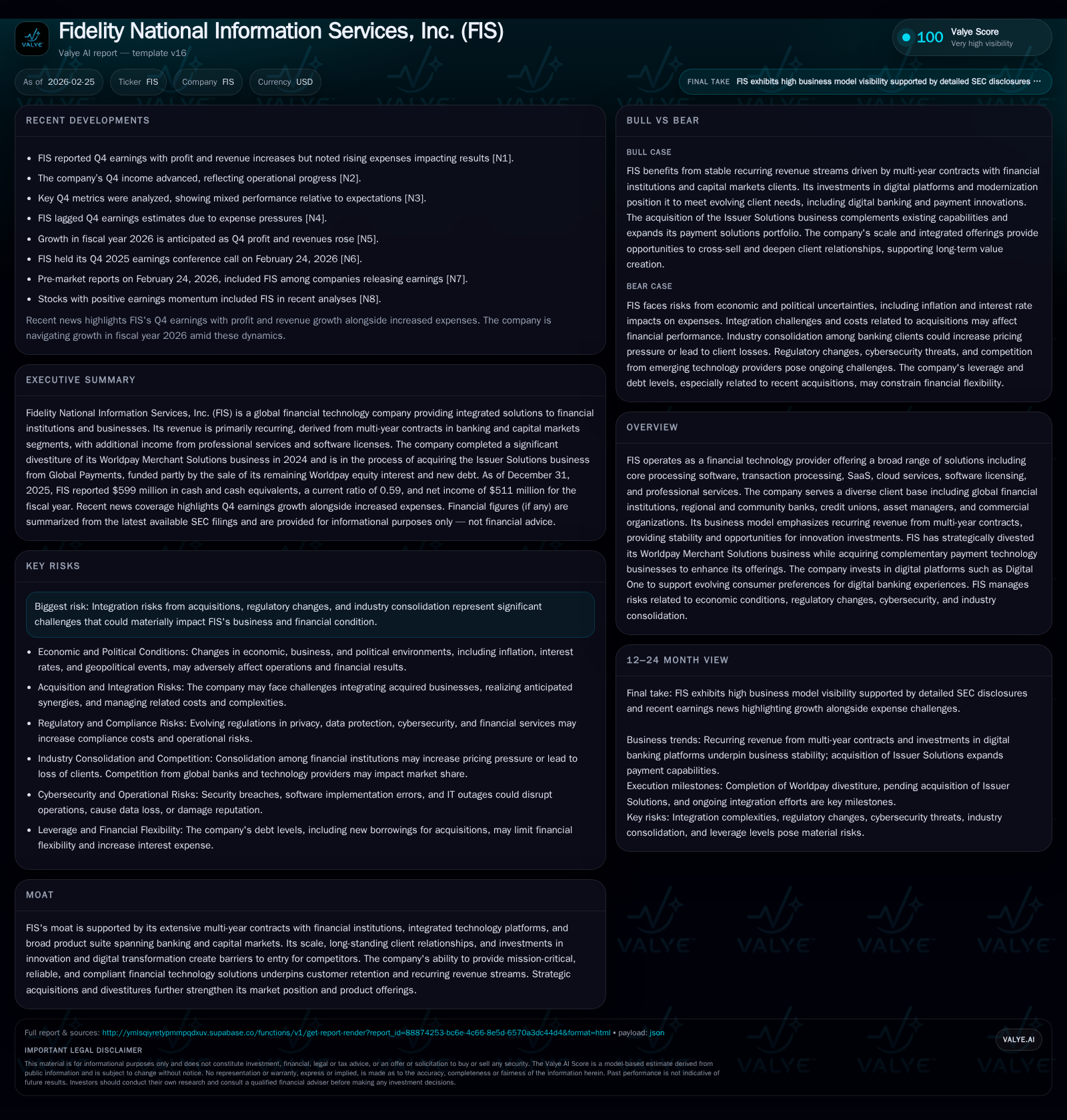
Fidelity National Information Services, Inc. (FIS) demonstrated steady recovery in operating income and net income in FY2025 following significant losses in 2022, driven by its Banking and Capital Markets segments. The firm’s recent acquisition of Issuer Solutions, funded through substantial bridge financing, enhances its payment capabilities but increases leverage and interest expenses. Elevated operating expenses due to integration and modernization investments pressured Q4 2025 earnings. FIS maintains investment-grade credit ratings and prioritizes capital allocation towards dividends and share repurchases alongside sizable capital expenditures. Future milestones focus on realizing synergies from acquisitions and controlling elevated costs to sustain profitability.
Executive Summary
Fidelity National Information Services (FIS) operates as a diversified fintech provider offering core banking software, payment transaction services, SaaS cloud solutions, software licensing, and professional services globally. Anchored by long-term multi-year contracts with financial institutions, the company benefits from predictable recurring revenues that fund ongoing innovation initiatives such as the AI-enabled Digital One platform.
Following substantial restructuring including the divestiture of its Worldpay Merchant Solutions segment, FIS’s strategic focus has sharpened on banking technology complemented by acquisitions like the Issuer Solutions business aimed at expanding issuer payment capabilities.
Historical Performance Overview
After a severe operating loss exceeding $16 billion in 2022 largely due to restructuring charges and impairments [F1], FIS has steadily recovered. Operating income improved from $331 million in FY2023 to $494 million in FY2024, reaching $529 million in FY2025 — a 7.1% year-over-year increase. Net income surged 81.9% to $511 million in FY2025 after $281 million in FY2024.
This turnaround is mainly attributable to strong performance in the Banking Solutions segment’s core processing services alongside growth within Capital Market Solutions’ advanced trading and risk management platforms.
Historical performance (annual)
| FY | Net ($bn) | CFO ($bn) | OpInc ($bn) | Capex ($mm) | Net YoY |
|---|---|---|---|---|---|
| 2025 | 0.5 | 0.5 | 154 | +81.9% | |
| 2024 | 0.3 | 0.5 | 97 | +12.0% | |
| 2023 | 0.3 | 4.3 | 0.3 | 142 | +101.5% |
| 2022 | -16.7 | 3.9 | -16.1 | 268 |
Note: Omitted columns lack sufficient annual XBRL coverage in the provided tags (need ≥2 annual points): Rev. Source: SEC companyfacts cache [F1].
Capital returns and efficiency (annual)
| FY | Div ($mm) | Buybacks ($bn) | FCF ($bn) |
|---|---|---|---|
| 2025 | 1.4 | ||
| 2024 | 800 | 4.0 | |
| 2023 | 1231 | 0.5 | 4.2 |
| 2022 | 1138 | 1.9 | 3.7 |
Source: SEC companyfacts cache [F1].
Note: Revenue data was not available in provided disclosures.
Segment Overview
Banking Solutions
This segment accounts for the majority of FIS’s revenues through integrated core processing software, transaction services, and complementary applications serving global financial institutions including regional banks and credit unions. Multi-year contracts generate recurring revenues that support sustained R&D investments enhancing digital client solutions.
Capital Market Solutions
Targeting asset managers, private equity firms, brokers, insurers and others worldwide, this segment offers recordkeeping, analytics, trade execution and risk management platforms benefiting from growing AI-driven automation adoption.
Recent Developments & Growth Drivers
In early 2026, FIS completed the acquisition of Global Payments’ Issuer Solutions business for approximately $7.7 billion funded via senior unsecured term loans totaling up to $8 billion [S9]. This acquisition broadens FIS’s payment issuer technology portfolio amid rising digital payments demand.
The company continues investing heavily in its Digital One platform that incorporates AI capabilities enabling hybrid human-AI transaction processing—a key fintech innovation aligned with industry trends toward automation [N9][S16].
However, elevated operating expenses driven by integration efforts—including software development—and rising personnel costs have pressured margins as reflected by Q4 earnings missing estimates [N1][N3].
Financial Condition & Capital Allocation
At fiscal year-end 2025, cash and equivalents stood at approximately $599 million against current liabilities of about $7.6 billion yielding a current ratio of roughly 0.59—indicating tight working capital requiring careful liquidity management [F1]. Long-term debt exceeds $10 billion with maturities spanning through mid-century at an effective weighted average interest rate near 3.8% after hedging strategies [S17][F1].
Capital deployment priorities include robust share repurchases totaling approximately $1.4 billion in FY2025 following prior elevated acquisition activity pauses. Quarterly dividends continue targeting growth aligned with adjusted EPS trends at roughly $0.40 per share recently declared [F1][S13]. Capital expenditures increased significantly by nearly 59% year-over-year to support cloud infrastructure migration critical for scalable SaaS delivery models [F1][S18].
Returns & Operational Metrics Analysis
Return on equity remains modest at approximately 3.7%, reflecting elevated equity base post-acquisition financing; free cash flow after capital expenditures remains strong at an estimated $4.18 billion indicating solid operational cash generation despite investment phase costs [F1].
Margin pressures stem partly from heightened purchase accounting amortization ($668 million FY2025) plus significant acquisition-related integration expenses ($689 million), constraining near-term net profitability expansion potential [S25][S26].
Industry Context & Competitive Positioning
Competitive intensity rises as cloud-native fintech entrants erode pricing power particularly among smaller community banks prone to vendor consolidation or modular solution adoption unbundling traditional suites offered by incumbents like FIS [S20]. Heightened regulatory scrutiny around data privacy, cybersecurity frameworks and AI usage demands continuous investment complicating cost structures.
Nevertheless FIS benefits from entrenched multi-year contracts coupled with extensive compliance certifications providing reliability assurances few competitors replicate—creating a retention moat amid evolving market dynamics.
Key Risks & Monitoring Points
- Integration risks related to the large-scale Issuer Solutions acquisition could delay synergy realization affecting near-term margins.
- Macroeconomic uncertainties including recession risks or adverse interest rate environments might dampen client IT spending.
- Cybersecurity incidents or regulatory changes regarding AI use may introduce legal or operational challenges requiring adaptive responses.
- Close monitoring of upcoming quarterly results will be essential to gauge expense normalization or margin improvement signaling successful post-investment cycle execution.
Conclusion
Fidelity National Information Services is strategically positioned at the forefront of financial institutions’ transformation toward modernized digital platforms yet balancing growth ambitions against rising expenses from acquisitions and platform evolution remains challenging. Strong cash flow underpins continued shareholder returns while sustaining profitability momentum demands disciplined integration management alongside effective deployment of AI-driven innovations within core offerings.
This analysis is based solely on publicly disclosed financial data without any extrapolation or investment advice.
Disclaimer: This is research-only, informational analysis and not investment advice. It may include AI-generated interpretation and general industry context. Always verify important details using primary sources.

Comments