
Firefly Aerospace: Contract Wins, Lunar Milestones, and the Challenge of Turning Scale into Profit
Firefly Aerospace has achieved high-profile operational milestones and secured major government contracts, yet persistent losses and market volatility highlight the tensions between capital intensity, execution risk, and the quest for commercial viability in the new space economy.
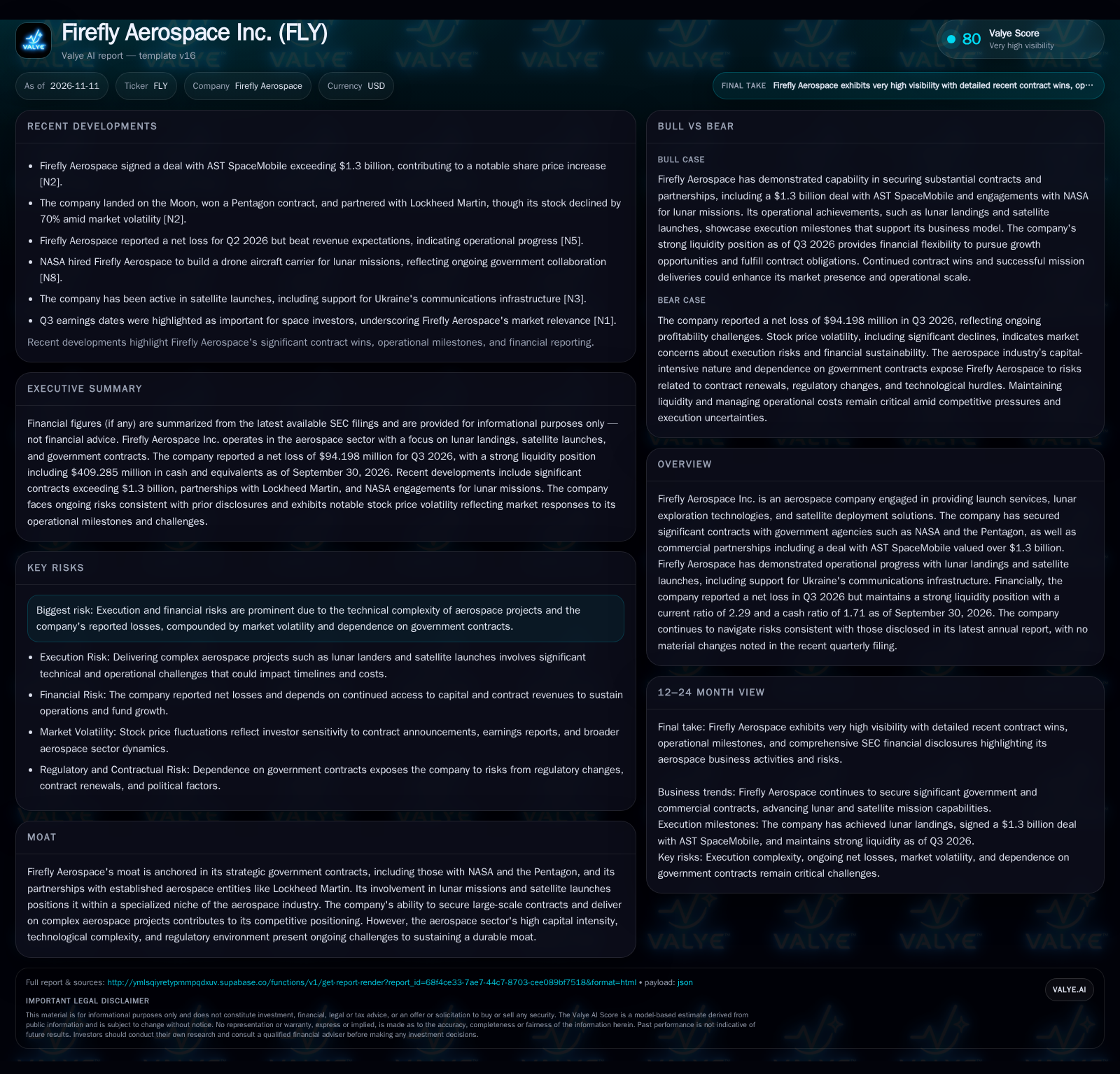
Firefly Aerospace’s recent lunar landing and government contract wins underscore its technical and commercial progress, but ongoing net losses and sharp stock swings reveal the company’s struggle to convert operational momentum into durable profitability. With over $400 million in cash and major partnerships—including with NASA and Lockheed Martin—Firefly’s future hinges on its ability to deliver on complex projects, manage capital demands, and sustain contract flow amid a volatile and competitive aerospace landscape. [S2] [N2]
Firefly Aerospace sits at the intersection of technical achievement and financial challenge. The company’s recent lunar landing and high-value government contracts—such as with NASA and the Pentagon—demonstrate operational prowess and market relevance. The tension between ambitious growth, execution complexity, and the quest for sustainable profitability defines Firefly’s current investment case and strategic dilemma. [S2] [N2] [N5]
Recent Milestones and Financial Position: The Dual Edge of Progress
Firefly Aerospace has achieved a series of headline milestones in 2026, including a lunar landing and securing Pentagon and NASA contracts, with the latter involving the construction of a drone aircraft carrier for lunar missions. These operational achievements are complemented by commercial partnerships, notably with Lockheed Martin, pointing to Firefly’s growing credibility in the governmental and defense aerospace ecosystem. Financially, the company reported a net loss of $94.2 million for Q3 2026 but held $409.3 million in cash and equivalents and $125.4 million in short-term investments at quarter-end, resulting in a current ratio of 2.29 and a cash ratio of 1.71. The company’s quarterly revenue exceeded expectations, but persistent losses and sharp stock price volatility—including a 70% decline reported in late October—underscore the market’s ambivalence about Firefly’s ability to translate technical progress into lasting shareholder value. [S2] [N2] [N5] [N8]
How Firefly’s Model Creates—and Consumes—Value
Firefly Aerospace’s revenue streams are rooted in launch services, lunar exploration technologies, and satellite deployment, with the lion’s share of current business coming from government and defense contracts. These contracts, while offering scale and visibility, often require significant upfront capital investment for R&D, manufacturing, and mission execution, creating a lumpy revenue profile and high fixed-cost base. Margins in government aerospace contracts can be attractive for established incumbents with scale and proven reliability, but for newer entrants like Firefly, the path to profitability is complicated by high non-recurring engineering costs, cost overruns, and penalties for schedule delays.
The economics of launch services and lunar technologies are further shaped by competitive bidding, milestone-based payments, and the need to continuously invest in next-generation platforms to keep pace with customer requirements and technological advances. Operating leverage could eventually improve as Firefly moves from one-off projects to more standardized and repeatable missions, but this transition is capital-intensive and fraught with execution risks. The company reported cash and liquidity metrics for the period; these figures do not by themselves establish operating runway, investment capacity, financial flexibility, or financing capacity. [S2]
Navigating a Crowded Launchpad: Firefly’s Place in the New Space Race
Firefly’s competitive position is defined by its ability to win and deliver on complex government contracts—an area where technical credibility, regulatory compliance, and mission track record are paramount. Its partnerships with major aerospace primes like Lockheed Martin and direct contracts with NASA and the Pentagon provide both validation and access to high-profile missions. However, the broader commercial space sector is intensely competitive, with entrenched players (including legacy aerospace contractors and newer private-sector entrants) vying for similar government and commercial opportunities.
Substitution risk is high: customers can choose among several launch providers, and government agencies may diversify contracts to encourage competition and redundancy. Firefly’s recent lunar landing and successful contract bids suggest some differentiation in technical capabilities, but the durability of its moat will depend on continued execution, cost discipline, and the ability to build a repeatable platform rather than a series of bespoke projects. The risk remains that larger, better-capitalized competitors could undercut pricing or accelerate innovation, squeezing Firefly’s margins and contract win rates over time.
From Milestones to Momentum: What a Virtuous Cycle Could Look Like
The most favorable scenario for Firefly Aerospace is one in which recent operational achievements—such as the lunar landing and major government contracts—translate into a virtuous cycle of contract wins, recurring mission revenues, and improved cost efficiency. If Firefly can reliably deliver on its existing backlog, meet NASA and Pentagon milestones on time and on budget, and demonstrate technical reliability, it could become a preferred partner for future missions, unlocking larger, multi-year contracts and potentially expanding into adjacent commercial markets.
Confirmation of this scenario would come from sequential growth in contract backlog, evidence of margin expansion as fixed costs are leveraged over a growing mission base, and the announcement of follow-on contracts or renewals with key government customers. Additional indicators might include successful launches with minimal delays or cost overruns, and the introduction of standardized platforms that reduce per-mission costs. Falsification would be signaled by continued schedule slips, high-profile mission failures, or a decline in contract win rates relative to peers.
Operational Progress Offset by Persistent Losses and Execution Hurdles
The most plausible near-term scenario is that Firefly continues to secure and deliver on government contracts, maintaining its relevance in the launch and lunar technology markets but struggling to achieve consistent profitability. Revenue may grow in fits and starts as milestone payments are recognized, but high operating expenses, R&D outlays, and the need for ongoing investment in next-gen platforms could keep the company in a loss-making position for several more quarters.
Falsification would come in the form of a sharp contraction in new contract flow, unexpected cost blowouts, or a rapid drawdown of the reported cash balance without clear progress toward operating breakeven.
When Capital Runs Thin: The Adverse Impact of Execution Slips and Contract Gaps
The principal risk for Firefly Aerospace is that a combination of execution missteps (such as mission failures, technical delays, or cost overruns) and a slowdown in new contract awards undermines both its financial position and its credibility with key government customers.
Confirmation of this adverse outcome would include a shrinking contract backlog, missed or penalized milestones, negative press around mission failures, and a downward spiral in liquidity metrics. A rapid stock price decline (beyond the already noted volatility) could signal waning investor confidence, further constraining the company’s ability to raise capital on favorable terms. Conversely, if Firefly manages to avoid these pitfalls, the downside scenario could be averted.
What Will Determine If Firefly’s Trajectory Is Sustainable?
Sequential changes in contract backlog and new government/commercial contract wins—these would indicate whether operational momentum is translating into future revenue visibility.
Quarterly cash burn rate and the pace of change in cash and short-term investments—if disclosed, this will show how quickly Firefly is consuming its liquidity cushion.
Execution against announced mission milestones, including the timely delivery of lunar and satellite projects—delays or overruns would flag rising risk.
Gross and operating margin trends as a test of whether scale is translating into improved profitability—improvement here would support the upside case.
Recurring revenue or repeat business from major government or commercial customers—if disclosed, this would suggest growing customer trust and reduced reliance on new wins.
Material changes in cost structure, such as R&D or SG&A as a percentage of revenue—a useful metric would be whether fixed costs are being leveraged as revenue grows.
Contract renewal rates and the mix of multi-year versus one-off project contracts—would help determine the durability of Firefly’s business model.
Stock price response to operational news, as a gauge of market sentiment and perceived execution risk—while volatile, major reactions to contract or mission updates can reveal shifting investor expectations.
Disclaimer: This is research-only, informational analysis and not investment advice. It may include AI-generated interpretation and general industry context. Always verify important details using primary sources.

Comments