
Dolphin Entertainment: Content Expansion Meets Liquidity Pressure in a Transforming Media Landscape
Dolphin Entertainment posted Q3 2026 net income of $230,277 on $16.0 million of revenue, reflecting continued content production momentum.
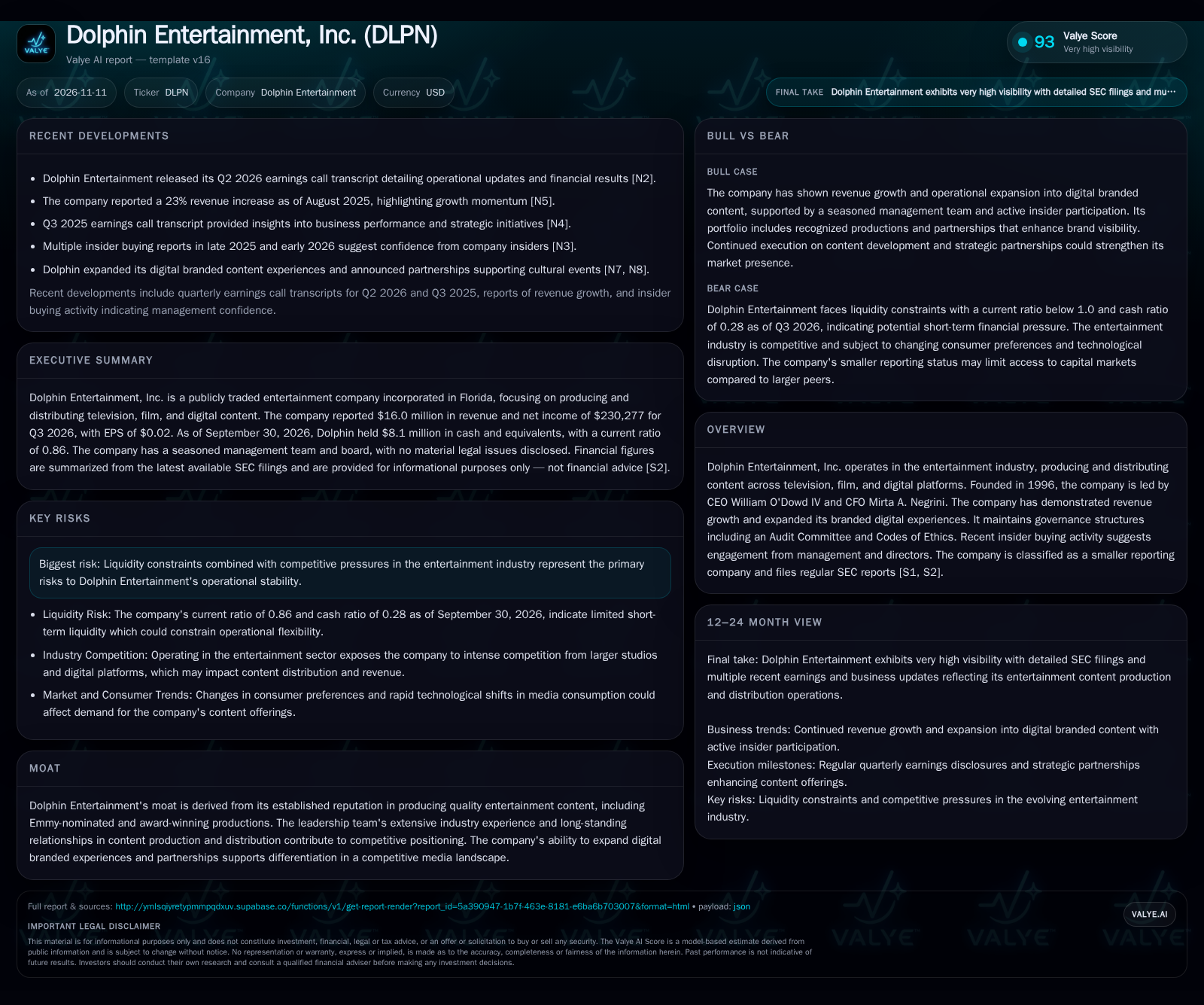
Dolphin Entertainment posted Q3 2026 net income of $230,277 on $16.0 million of revenue, reflecting continued content production momentum. However, a current ratio of 0.86 and $8.1 million in cash as of September 30, 2026, underscore tight liquidity. Recent insider buying and digital partnership expansion signal management engagement and strategic adaptation, but the company’s smaller scale and competitive industry amplify the need for disciplined execution and capital access. The core question: Can Dolphin’s creative and partnership strategies outrun its near-term financial constraints? [S2] [N3] [N7] [N8]
Dolphin Entertainment, Inc. sits at a strategic crossroads: the company has achieved quarterly profitability and continues to expand its digital and branded content footprint, yet it operates with a notably thin liquidity cushion. [S2] [N3] [N7] [N8]
Profitability Achieved, but Liquidity Tightens in Q3 2026
Dolphin Entertainment reported $16.0 million in revenue and $230,277 in net income for the quarter ended September 30, 2026, marking a period of operational profitability. Basic and diluted earnings per share were $0.02, a positive signal for shareholders after periods of mixed results [S2]. Yet, the company’s liquidity profile shows strain: cash and cash equivalents totaled $8.1 million, while current liabilities outpaced current assets, resulting in a current ratio of 0.86 and a cash ratio of just 0.28 [S2]. This balance-sheet posture limits near-term flexibility and raises the stakes for cash flow management and financing options. Multiple insider buying events in late 2025 and 2026 indicate management’s belief in the company’s trajectory, while recent digital content partnerships reflect ongoing business development [N3] [N7] [N8].
The company reported cash and liquidity metrics for the period; these figures do not by themselves establish operating runway, investment capacity, financial flexibility, or financing capacity. This scenario necessitates a rigorous focus on cash flow forecasting and working capital optimization to avoid liquidity shortfalls that might disrupt production schedules or partnership commitments. The insider buying activity, while encouraging, also raises the implicit expectation that management believes the company can navigate these pressures, but it simultaneously heightens scrutiny on execution risks given the thin margin for error.
Content Production Economics: Margin Volatility and Capital Demands
Dolphin’s core business—producing and distributing entertainment content—relies on project-based revenue streams that can fluctuate significantly quarter to quarter. Content economics in this segment are typified by high upfront production costs, variable revenue recognition timing (often tied to delivery milestones or distribution deals), and a mix of fixed and variable operating expenses. Gross margins can swing based on project mix, deal terms, and the success of individual releases. Expansion into digital and branded experiences may offer opportunities for higher-margin, recurring or licensing-based revenue, but also entails investment in creative development and partnership cultivation. As a smaller reporting company, Dolphin has limited financial scale, which may constrain its ability to absorb project overruns or invest aggressively in original IP. The company’s thin liquidity buffer heightens the importance of cash conversion cycles and prudent working capital management.
Given the project-based nature of Dolphin’s revenue, timing mismatches between cash outflows for production and inflows from distribution or licensing deals can create episodic liquidity stress. This dynamic is especially pronounced in smaller firms without diversified revenue streams or robust capital reserves. The company’s expansion into digital and branded content could mitigate some volatility if these initiatives generate more predictable, recurring revenue, such as licensing fees or long-term brand partnerships. However, these opportunities require upfront investment in creative development and marketing, which could exacerbate cash demands before the revenue benefits materialize. Therefore, the success of this strategic pivot depends not only on content quality and market reception but also on the company’s ability to tightly manage capital allocation and project pacing.
Navigating a Crowded Field: Scale Disadvantage vs. Creative Differentiation
Dolphin competes in a media environment dominated by larger studios, well-capitalized streamers, and digital-first platforms. Its competitive position benefits from an established track record and industry relationships, with a portfolio that includes recognized productions. However, the company’s smaller scale limits bargaining power with distributors and may restrict access to premium IP or marquee talent. As consumer preferences shift rapidly toward digital, on-demand, and branded experiences, Dolphin’s expansion into digital partnerships and event-based content could help differentiate its offering. The challenge is that barriers to entry in digital content are low, and larger players can outspend on marketing and talent. Success will hinge on the company’s ability to leverage its creative agility and relationships to win high-value projects or recurring digital contracts while managing cost discipline.
Dolphin’s position as a smaller player in a highly consolidated media landscape means it faces inherent disadvantages in negotiating power and resource availability. Larger competitors benefit from economies of scale, established distribution networks, and deeper pockets to absorb the risks of content experimentation or marketing spend. However, smaller scale can also confer agility, enabling faster decision-making and niche targeting, particularly in emerging digital formats and culturally resonant events. The company’s ability to carve out a defensible niche may hinge on leveraging unique creative assets and fostering close partnerships that larger players overlook or undervalue. Success in this context requires disciplined investment in high-potential projects and a keen understanding of evolving consumer preferences to avoid costly missteps.
Strategic Partnerships Drive High-Margin Digital Revenue
If Dolphin’s recent moves into digital branded content and cultural-event partnerships yield scalable, recurring revenue streams, the company could see improved margin stability and enhanced cash flow. A favorable scenario would involve securing multi-year deals with major brands, expanding digital distribution, or landing breakout content that drives licensing and ancillary revenue. Positive evidence would include a rising share of digital and branded content in the revenue mix, improved gross margins, and announcements of new, material partnerships or renewals. Confirmation would also come from sustained net profitability and visible improvement in working capital metrics. This scenario could be challenged if digital initiatives fail to achieve scale or are outcompeted by larger platforms.
Disciplined Execution Sustains Modest Growth Amid Tight Capital
The most plausible trajectory is that Dolphin continues to operate profitably at a modest scale, balancing content investments with disciplined cost control. Revenue growth may be episodic, tied to project timing and partnership wins, while digital expansion adds incremental but not transformative streams. Liquidity remains a constraint, and the company may need to seek opportunistic financing or strategic partnerships to fund larger projects. Evidence supporting this path would include continued quarterly profitability, stable or slowly reported liquidity-ratio trends, and a pipeline of announced but not blockbuster digital or branded projects. Any significant working capital shortfall, margin compression, or missed content delivery could undermine this equilibrium.
Liquidity Constraints Force Downscaling or Dilutive Capital Raise
If content investments outpace cash inflows or project delays occur, Dolphin’s reported current ratio and limited cash could force operational retrenchment. This could manifest as delayed projects, reduced content slate, or the need to raise capital on unfavorable terms, potentially diluting existing shareholders. Adverse evidence would be a decline in cash balances below critical thresholds, rising payables, or disclosure of covenant breaches or going-concern warnings. Competitive encroachment by larger studios or rapid shifts in consumer media consumption could further erode revenue and compress margins, accelerating financial stress. A scenario where digital expansion fails to deliver incremental margin would amplify downside risk.
Milestones That Will Determine Dolphin’s Ability to Outrun Its Constraints
The proportion of revenue derived from digital and branded content, as this mix shift would signal success (or lack thereof) in the company’s strategic pivot.
Announcements of multi-year or recurring partnerships with major brands; such deals would bolster revenue visibility and support margin expansion.
Gross margin trends, particularly in digital and branded content, as an indicator of scalability and project economics.
Any additional insider buying or selling activity, which could reflect changing management sentiment or near-term outlook.
Changes in the current ratio and cash position, especially if these metrics deteriorate further or improve following new business wins or financings.
Disclosures regarding new financing arrangements, credit facilities, or equity raises, as these will impact both operational flexibility and shareholder dilution.
Timely delivery and commercial success of announced projects, providing evidence of execution capability and market demand.
Disclaimer: This is research-only, informational analysis and not investment advice. It may include AI-generated interpretation and general industry context. Always verify important details using primary sources.

Comments