
GrowGeneration’s Strategic Restructuring: Margin Expansion, Multi-Channel Leverage, and the Search for Profitable Scale
GrowGeneration’s recent cost-cutting and retail optimization signal a shift toward higher-margin proprietary brands and diversified B2B channels, as the company navigates competitive pressures and evolving demand in specialty cultivation and storage.
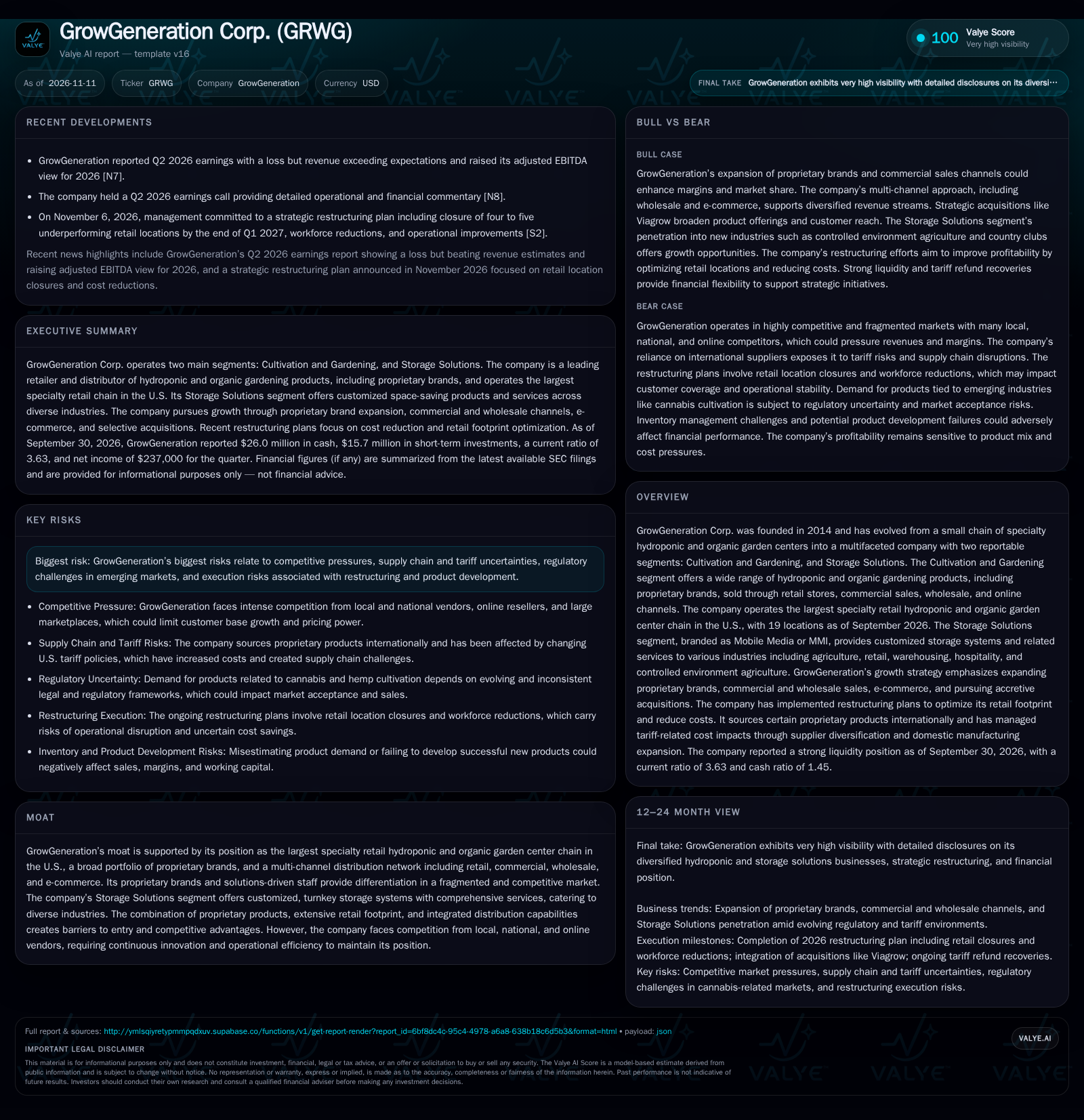
GrowGeneration has closed underperforming locations and refocused on proprietary brand growth, commercial sales, and its Storage Solutions business. Margin expansion and improved profitability depend on executing restructuring plans, growing B2B channels, and withstanding competitive and regulatory risks in fragmented, tariff-sensitive markets. [S1] [S2] [N7] [N8]
GrowGeneration Corp. is at a critical juncture, marked by a decisive restructuring plan that prioritizes margin improvement and operational efficiency over raw footprint expansion. With a reduced retail presence and a sharpened focus on proprietary brands, B2B channels, and its Storage Solutions segment, the company is betting on more profitable and defensible growth vectors. The next 12-18 months will test whether the pivot from retail-centric growth to multi-channel, margin-driven execution can deliver lasting shareholder value.
Restructuring Accelerates Shift Toward Higher-Margin Channels
GrowGeneration’s 2026 restructuring marks a significant operational reset: the company closed four underperforming retail locations this year, with plans for four to five more closures by Q1 2027. This move is part of a broader cost-reduction initiative that also includes workforce reductions and operational improvements aimed at restoring profitability. As of September 30, 2026, GrowGeneration operated 19 retail locations across nine states—down from 23 at the end of 2025. These closures reflect a strategic pivot away from lower-margin, high-overhead retail stores toward more scalable channels like commercial sales, wholesale, e-commerce, and proprietary brand expansion. Net income for Q3 2026 was $237,000, essentially breakeven, highlighting the challenge of restoring consistent profitability while executing structural changes. [S2]
Margin Dynamics and Multi-Channel Leverage Define Profit Potential
GrowGeneration’s economics hinge on product mix, channel strategy, and scale-driven efficiency. The Cultivation and Gardening segment sells a wide array of products—nutrients, additives, lighting, and environmental controls—through retail, commercial, wholesale, and e-commerce channels. Proprietary brands such as Charcoir, Drip Hydro, Power Si, Ion Lighting, The Harvest Company, and Viagrow are positioned as margin drivers, as they allow the company to capture more value relative to third-party brands. The Storage Solutions (MMI) segment, meanwhile, provides customized, high-density storage systems and related services, with a mix of project-based and recurring revenue streams.
Retail operations, while offering visibility and customer engagement, are capital- and labor-intensive, with significant fixed costs. By contrast, commercial and wholesale sales—especially those involving proprietary brands—are less reliant on physical footprint and can scale more efficiently, with higher average ticket sizes and potentially lower customer acquisition costs if the company can leverage its distribution and relationships. E-commerce further reduces overhead and may provide better gross margins, though it is subject to intense online competition. The Storage Solutions division operates with project-based revenue and service fees, which may be lumpy but can be lucrative if the company achieves deeper penetration in targeted verticals such as CEA and hospitality.
International sourcing of components and products introduces cost volatility via tariffs and supply chain disruptions but also enables margin optimization through supplier diversification. The $2.6 million in IEEPA tariff refunds recognized in 2026 as cost of sales reductions provided a temporary margin tailwind, but ongoing exposure remains a structural risk. Operating leverage will be tested as the company shrinks its retail base while seeking to grow higher-margin channels.
Fragmented Markets and Shifting Channels: Navigating Competitive Headwinds
GrowGeneration faces a fragmented competitive landscape in both core segments. In hydroponics and gardening, competition comes from local specialty vendors, national chains, and large online marketplaces. The company differentiates through breadth of product, proprietary brands, solutions-driven staff, and distribution capabilities, but must constantly defend against price competition and commoditization—especially as online resellers and mass-market retailers expand their offerings.
The Storage Solutions segment contends with large distributors, specialist firms, and local/regional installers. Here, differentiation hinges on custom design, a wide accessory portfolio, and end-to-end services (from site survey to installation). The ability to cross-sell storage solutions to cultivation customers and vice versa could provide some integrated advantage, though this is not yet proven at large scale.
Customer loyalty and switching costs in both segments appear limited, given the availability of comparable products and services elsewhere. The company’s multi-channel model helps diversify revenue streams and reduce reliance on any single customer or channel—no customer accounted for more than 10% of net revenues in recent years. However, this also means that competitive intensity remains high and margin pressure is a constant threat, particularly if proprietary brands fail to sustain differentiation or if larger players intensify price competition.
Margin Expansion and Channel Optimization Could Unlock Earnings Growth
The most favorable scenario for GrowGeneration is one in which the restructuring delivers sustainable cost savings, and the company successfully shifts sales to higher-margin proprietary brands and scalable B2B channels. This pivot would allow for improved gross and operating margins, reduced fixed overhead, and more resilient earnings—even as the retail footprint contracts. If Storage Solutions achieves deeper penetration into controlled environment agriculture (CEA), hospitality, and new verticals, it could provide a second engine of less cyclical, project-based growth.
Confirmation would come from sequential improvement in gross margin, evidence of proprietary brands’ mix increasing as a share of total sales, and higher commercial/wholesale revenue contribution. Additional signs would include Storage Solutions backlog growth (if disclosed), repeat customer wins across both segments, and positive EPS trends that persist beyond one-off tariff refunds or cost-cutting measures.
Profitability Hinges on Execution Amid Ongoing Market Volatility
The most plausible path forward is one of gradual improvement in profitability as restructuring benefits flow through, but with persistent headwinds from competitive pricing, regulatory uncertainty, and supply chain volatility. GrowGeneration is likely to see moderate top-line growth as B2B channels and proprietary brands offset lost retail sales, but margin expansion may be incremental rather than dramatic.
Evidence supporting this scenario would include stable or slightly rising gross/operating margins, steady commercial and Storage Solutions sales, and a return to consistent, albeit modest, net profitability. Potential falsifiers would be continued net losses despite cost cuts, stagnation in proprietary brand penetration, or evidence that retail closures are eroding market presence faster than B2B channels can compensate.
Overall, the company’s liquidity provides time to execute, but long-term success depends on building defensible advantages in both core segments and adapting quickly to shifts in customer demand and regulatory frameworks.
Competitive and Regulatory Pressures Could Undermine Restructuring Gains
The negative scenario is one where competitive intensity, ongoing price wars, and regulatory headwinds in cannabis-related markets overwhelm the impact of restructuring. If proprietary brands fail to gain traction or competitors undercut GrowGeneration on price and service, gross margins could deteriorate, and the benefits of cost reduction may be offset by declining revenue and market share.
Additional risks include supply chain disruptions, new tariffs, or inability to diversify suppliers—any of which could compress margins further. In the Storage Solutions segment, project delays, cyclical demand, or loss of key accounts could result in lumpy or declining revenue. If the company is forced into further retail closures or layoffs beyond the current plan, this could signal deeper structural challenges.
Confirmation of this scenario would come from sequential gross margin compression, persistent net losses, negative free cash flow, or evidence of customer attrition and market share loss. Liquidity, while healthy now, could become a concern if operational underperformance persists.
Milestones and Metrics That Will Validate GrowGeneration’s Strategic Pivot
Gross margin trends by segment and channel—particularly the mix of proprietary brands versus third-party products.
Proprietary brand penetration as a percentage of total sales (if disclosed) and evidence of repeat commercial/wholesale customer adoption.
Storage Solutions order backlog and project pipeline growth, especially in new verticals such as CEA and hospitality (if disclosed).
Sequential changes in operating expenses and SG&A as a share of revenue, to gauge restructuring effectiveness.
Progress on planned retail closures and any unplanned reductions in workforce or footprint beyond the announced restructuring.
Top-line growth or stability in commercial, wholesale, and e-commerce channels versus continued contraction in retail sales.
Tariff and supply chain cost impacts, including any additional refunds or new headwinds from international sourcing.
Net income/EPS trends and free cash flow generation, with attention to sustainability after one-off restructuring or tariff impacts.
Disclaimer: This is research-only, informational analysis and not investment advice. It may include AI-generated interpretation and general industry context. Always verify important details using primary sources.

Comments