
Fifth District Bancorp: Stable Mortgage Niche Confronts Scale Limits and Competitive Pressures in New Orleans Banking
Fifth District Bancorp, a recently converted mutual-to-stock savings and loan holding company, leverages a conservative fixed-rate residential mortgage portfolio in the New Orleans metro area. While its stable asset base and capital return initiative provide visibility, limited market share, intense competition, and concentrated interest-rate exposure raise questions about its long-term growth and profitability trajectory.
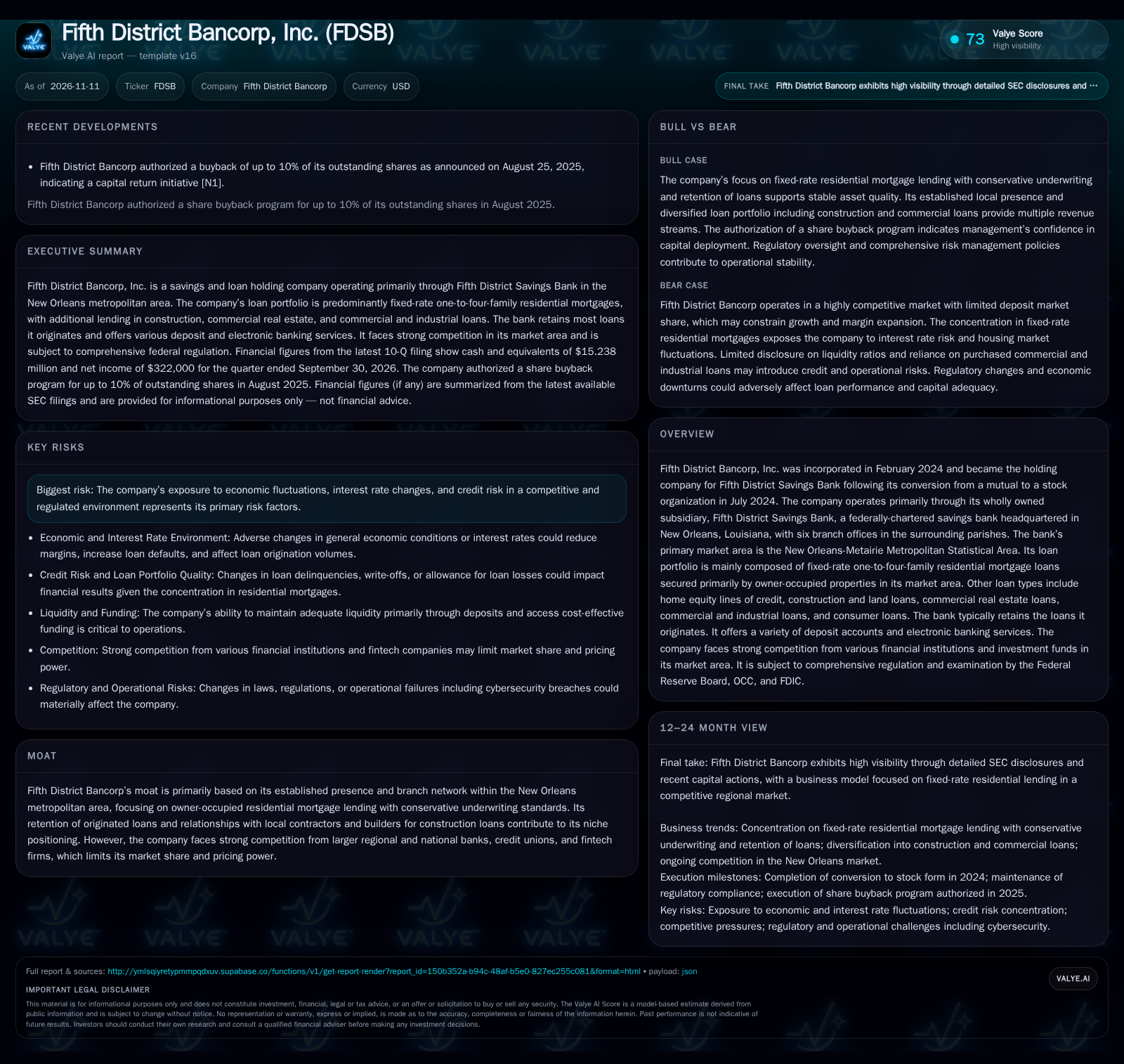
Fifth District Bancorp operates as a savings and loan holding company focused on fixed-rate residential mortgages in the New Orleans area, with a conservative lending profile and a recent share buyback authorization. Despite stable asset quality and regulatory compliance, its modest deposit market share and competitive landscape constrain growth, and its loan concentration heightens sensitivity to interest rate and housing market shifts. The bank’s ability to diversify revenue streams, defend margins, and manage funding costs will determine whether it can translate local stability into sustainable shareholder returns. [S1] [S2] [N1]
Fifth District Bancorp, Inc., headquartered in New Orleans, stands as a newly public savings and loan holding company with deep roots in its local market and a conservative, mortgage-centric balance sheet. Its recent conversion from mutual to stock form and initiation of a 10% share buyback program reflect a drive for capital efficiency and shareholder alignment. Yet, despite its stable residential loan focus and regulatory discipline, Fifth District faces structural headwinds: limited deposit market share, aggressive regional competition, and a risk profile tightly linked to local housing and interest rate cycles. The bank’s near-term performance will hinge on its ability to defend margins, grow its customer base, and navigate the inherent constraints of its niche business model. [S1] [S2] [N1]
Recent Conversion, Conservative Mortgage Portfolio, and Capital Return Moves Shape Today’s Profile
Fifth District Bancorp became the holding company for Fifth District Savings Bank in July 2024 after converting from mutual to stock form, marking a structural shift that enables greater capital flexibility and shareholder alignment. The company’s loan portfolio remains heavily focused on fixed-rate, one-to-four-family residential mortgages, comprising 86.3% of total loans as of December 2025. This asset composition underpins a stable, predictable income stream but also concentrates risk in the local housing market and interest rate environment. Financially, as of September 30, 2026, the company reported $534.4 million in assets, $393.2 million in deposits, and $322,000 in net income for the quarter, with cash and equivalents totaling $15.238 million. In August 2025, Fifth District authorized a buyback of up to 10% of its outstanding shares, signaling management’s willingness to deploy capital to support shareholder value. [S1] [S2] [N1]
How Lending Mix, Deposit Funding, and Retained Loans Drive Fifth District’s Earnings Profile
Fifth District’s core economics are rooted in the spread between the interest earned on loans—primarily fixed-rate residential mortgages—and the cost of funding, which is largely driven by retail deposits. The bank’s loan book is characterized by short- and medium-term fixed-rate mortgages with conservative loan-to-value limits, reducing credit risk but exposing the company to interest rate mismatch: when market rates rise, funding costs can outpace loan yields. The retention of most originated loans means Fifth District collects interest income over time but forgoes gain-on-sale revenue and increases its exposure to both credit and duration risk.
Deposit funding, a traditional advantage for community banks, is challenged by the company’s modest scale and market share, limiting pricing power and potential to lower cost of funds. Noninterest income is likely modest, given the absence of large fee-based businesses or wealth management operations. Operating leverage is limited by the fixed costs of a six-branch network and regulatory compliance, but expense discipline and a lack of rapid expansion may help offset margin compression. Capital needs are moderate under current scale, with the recent buyback authorization suggesting surplus capital, though growth or credit shocks could quickly shift the capital position.
Local Brand Strength Meets Large-Scale Rivals and Nonbank Aggressors
Fifth District’s niche lies in its entrenched presence in the New Orleans-Metairie metropolitan area, with longstanding relationships and a branch footprint that supports customer loyalty. Its focus on conservative mortgage lending and retention of loans may attract risk-averse borrowers and reinforce trust within its community. However, the company faces formidable competition from a spectrum of institutions: large money center and regional banks able to offer broader product suites and technology, as well as credit unions, mortgage banking firms, and increasingly, fintechs and investment funds targeting deposit and lending relationships.
With deposit market share ranging from 0.39% to 2.30% across its core parishes and ranking outside the top five in all markets, Fifth District’s ability to attract low-cost deposits and originate new loans is structurally limited. Larger competitors can outspend on technology, marketing, and product innovation, while fintechs may siphon off prime borrowers with streamlined digital offerings. The company’s moat rests on local brand, relationships, and underwriting discipline—but these advantages may be increasingly eroded as digital and nonbank competitors reshape customer expectations.
Margin Defense and Local Trust Enable Profitable Niche Growth
If Fifth District can leverage its local reputation and conservative underwriting to deepen relationships with existing customers and win switchers disenchanted with impersonal national banks, it could modestly expand its deposit base and lending volume. Success would likely require targeted marketing, selective product innovation (such as enhanced digital banking), and continued vigilance on asset quality. Retaining high credit standards while carefully growing construction and commercial lending could diversify revenue sources without undermining risk discipline.
The upside scenario would be confirmed by steady or rising net interest margin despite a changing rate environment, continued low credit losses, and incremental growth in deposit and loan balances—particularly in the face of larger competitors. Evidence of successful buyback execution, stable capital ratios, and increased noninterest income would further strengthen the case for Fifth District as a stable, profitable niche player.
Stable but Constrained: Mortgage-Centric Model Maintains Earnings, Faces Growth Headwinds
The most plausible path is one of slow, steady performance: Fifth District maintains asset quality and modest profitability by sticking to its core residential mortgage franchise, but struggles to grow market share in a saturated, competitive environment. Margins may gradually compress as deposit costs rise and loan yields are locked in, forcing tight expense control and a focus on operational efficiency. The share buyback could offset dilution and support EPS, but is unlikely to fundamentally alter the bank’s earnings trajectory.
This scenario would be confirmed by relatively flat loan and deposit balances, stable but unspectacular net income, and ongoing regulatory compliance. Failure to materially grow market share or diversify income streams, coupled with continued low credit losses, would reinforce the view of Fifth District as a durable—but not rapidly scaling—community bank.
Interest Rate Shocks or Housing Weakness Expose Risk Concentrations
The greatest vulnerability lies in the company’s concentrated exposure to fixed-rate residential mortgages. Should interest rates rise quickly or local housing markets weaken, Fifth District could face a double squeeze: higher funding costs would erode net interest margin, while asset quality could deteriorate if borrowers struggle to meet payments. The absence of adjustable-rate or subprime lending limits certain risks but also restricts flexibility in repricing assets.
Competitive dynamics could further intensify downside risk if larger banks or fintechs aggressively target the New Orleans market with promotional rates or superior digital experiences, siphoning away deposits and originations. Evidence of rising nonperforming loans, higher charge-offs, net interest margin compression, or a drop in regulatory capital ratios would validate a downside thesis.
What Will Clarify Fifth District Bancorp’s Path: Franchise Stability or Margin Erosion?
Quarterly trends in net interest margin, especially relative to changes in deposit funding costs and market interest rates.
Disclosed nonperforming loan and charge-off rates, which would illuminate actual credit risk in the retained mortgage portfolio.
Growth or contraction in deposit balances and market share across Jefferson, Orleans, and St. Tammany Parishes.
Evidence of successful execution of the share buyback program, including the percentage of shares repurchased and average repurchase price.
Any shift in loan portfolio composition—such as increased construction, commercial, or purchased loans—that could affect risk and revenue mix.
Updates on noninterest income streams or new fee-generating product introductions, if disclosed.
Regulatory capital ratios and any commentary on capital management strategy, especially if credit or market conditions deteriorate.
Indicators of customer acquisition or retention success, such as new account openings or digital adoption metrics, if disclosed.
Disclaimer: This is research-only, informational analysis and not investment advice. It may include AI-generated interpretation and general industry context. Always verify important details using primary sources.

Comments