
Black Rock Coffee Bar: Scaling a Unique Drive-Thru Model Under Margin and Liquidity Pressures
Black Rock Coffee Bar, now the largest fully company-owned coffee chain in the U.S., continues to expand rapidly with differentiated offerings and a strong loyalty program.
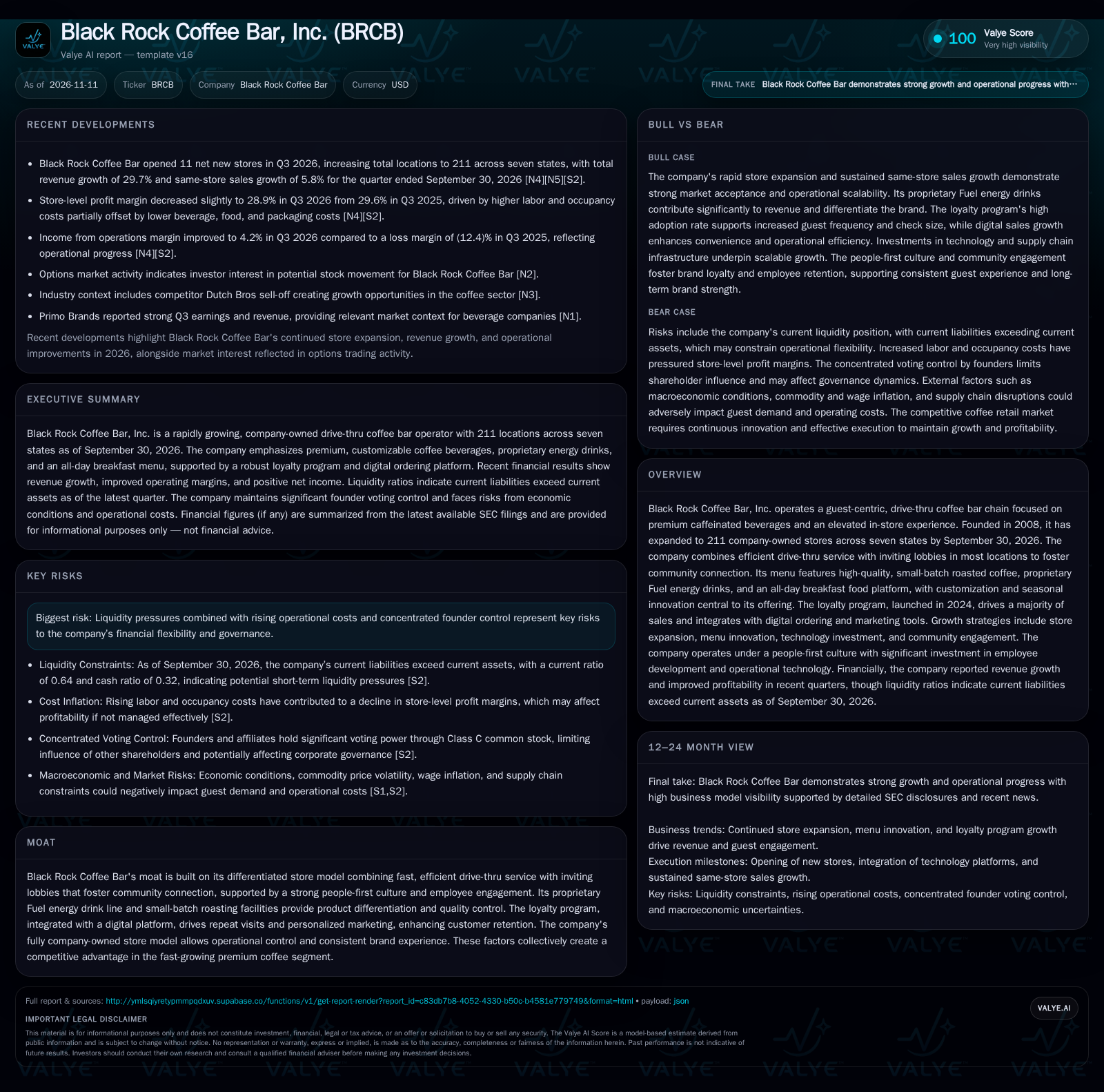
Black Rock Coffee Bar operates 211 company-owned drive-thru coffee bars across seven states, leveraging a proprietary energy drink line, robust loyalty adoption, and technology-driven operations. Recent results show strong revenue growth and improved operating margins, but store-level profit margins have come under pressure from higher labor and occupancy costs. Liquidity remains tight, with current liabilities exceeding current assets as of September 2026. Execution on new store openings, cost control, and guest retention will be critical to validating the company's differentiated growth thesis in a highly competitive coffee market. [S1] [S2] [N4] [N5]
Black Rock Coffee Bar has emerged as a high-growth player in the premium coffee segment, boasting the largest 100% company-owned store base in the United States. The company’s differentiated blend of drive-thru efficiency, in-store community focus, and proprietary beverage offerings has driven rapid expansion and strong guest engagement, evidenced by double-digit revenue growth and robust loyalty adoption. As Black Rock pushes for further growth, its ability to balance expansion with margin discipline and cash management will be pivotal in determining whether it can solidify its standing in a fiercely competitive market.
Recent Expansion and Margin Dynamics Shape Black Rock’s Near-Term Outlook
As of September 30, 2026, Black Rock Coffee Bar operated 211 company-owned stores across seven states, having opened 11 net new locations in Q3 2026. This rapid expansion contributed to total revenue growth of 29.7% and same-store sales growth of 5.8% for the quarter. The store-level profit margin, however, decreased slightly to 28.9% from 29.6% a year prior, primarily due to increased labor and occupancy costs. Despite this, operational improvements led to an income from operations margin of 4.2%, a significant turnaround from a (12.4)% loss margin in Q3 2025. Liquidity remains a concern, with current liabilities exceeding current assets (current ratio 0.64, cash ratio 0.32, and $13.6 million in cash as of September 2026). These facts underscore a business balancing robust growth with emerging margin and liquidity pressures. [S2] [N4] [N5]
Unit Economics, Revenue Mix, and the Challenge of Scaling Profitably
Black Rock’s revenue model relies on high-frequency, high-ticket beverage transactions at company-owned locations, with a significant contribution from proprietary Fuel energy drinks (24% of 2025 revenue) and a broad menu of customizable coffee and breakfast items. The launch of a loyalty program in 2024 has driven higher guest frequency and larger check sizes, with 63% of 2025 sales tied to loyalty members, suggesting a strong repeat business engine. Digital sales, at 16% of store revenue in late 2025, introduce additional convenience and may help drive incremental volume, though digital ordering can entail higher third-party fees and operational complexity.
The company’s 100% company-owned model allows for full control over the guest experience and operational standards but also concentrates fixed costs—such as labor, occupancy, and technology investments—within the parent entity. Store-level profit margins of 28.9% remain attractive in the context of specialty coffee retail, but recent compression highlights the sensitivity of the model to wage and rent inflation. Operating leverage is evident in the rebound from a negative to a positive operating margin as scale increases, but further margin expansion will likely require either decelerating cost growth, improved per-store productivity, or more favorable mix (e.g., higher Fuel or food attachment rates). The capital intensity of company-owned growth, coupled with a current liquidity squeeze, raises questions about the pace and sustainability of further expansion without external capital or improved cash generation.
Defensible Differentiation or Commodity Risk in a Crowded Coffee Market?
Black Rock’s competitive position rests on a blend of drive-thru convenience, in-store community, and proprietary products like Fuel energy drinks. The fully company-owned model enables consistent execution and quality control, while small-batch roasting facilities support freshness and menu innovation. The loyalty program and digital integration foster customer retention and data-driven marketing, potentially raising switching costs for frequent guests.
However, the U.S. coffee retail landscape is intensely competitive, with national chains, regional players, and independent shops all targeting similar demographics. Major chains offer scale benefits, loyalty ecosystems, and established digital platforms, while emerging drive-thru concepts and convenience-focused competitors continue to proliferate. While Black Rock’s Fuel line and people-first culture offer points of differentiation, these may be eroded if competitors replicate similar offerings or if consumer preferences shift. The question is whether Black Rock’s current advantages are sufficiently durable to resist commoditization and margin pressure as the segment matures.
Loyalty, Product Innovation, and Operational Scale Drive a Virtuous Growth Cycle
A favorable scenario sees Black Rock leveraging its high loyalty penetration, proprietary beverage mix, and operational data to drive sustained same-store sales growth and successful new store openings. If the company continues to innovate around its Fuel and food platforms, deepens digital engagement, and maintains a strong people-first culture, it could see further increases in guest frequency and check size. Operating leverage from a larger store base, combined with more efficient labor and supply chain management, could allow store-level and operating margins to stabilize or expand, offsetting inflationary pressures.
If disclosed, improved working capital management or a strengthened liquidity position would also support this thesis.
Growth Continues Amid Margin Compression and Funding Constraints
The most plausible outlook is that Black Rock maintains a moderate pace of new store openings and loyalty-driven revenue growth, but faces ongoing margin pressure from labor and occupancy cost inflation. Store-level profit margins may remain in the high-20s percentage range, with operating margins stabilizing at low single digits as the company absorbs additional fixed costs from expansion and invests in technology and marketing.
Liquidity constraints could limit the pace of expansion or require periodic external financing if cash generation does not keep up with investment needs. The company’s differentiated offerings and strong guest engagement are likely to support continued relevance in core markets, but competitive intensity and macroeconomic headwinds may cap upside. Evidence supporting this scenario would include steady, but not accelerating, same-store sales growth, flat or slightly declining per-store margins, and limited improvement in liquidity ratios over the next several quarters.
Margin Erosion and Liquidity Stress Threaten the Expansion Model
In a less favorable scenario, persistent cost inflation—particularly rising wages and occupancy expenses—outpaces Black Rock’s ability to drive higher per-store sales or offset with menu mix. If same-store sales growth decelerates, guest frequency softens, or competitive discounting intensifies, store-level margins could erode further, pushing operating profitability back into negative territory. Tight liquidity, as evidenced by current liabilities exceeding current assets, could force a slowdown in store openings, defer needed investments, or prompt dilutive capital raises.
Evidence confirming this scenario would include sequential or year-over-year declines in store-level profit margin, negative operating margins, slower pace of new store openings, rising accounts payable or short-term borrowings, and little to no improvement in the company’s cash position. Any sign of customer defection or declining loyalty program participation would further pressure the thesis.
Concrete Milestones and Trends That Will Validate or Challenge the Black Rock Thesis
Quarterly same-store sales growth trends and how they compare to broader industry benchmarks and inflation rates.
Store-level profit margin and the company’s ability to stabilize or expand it in the face of rising labor and occupancy costs.
Changes in the company’s liquidity position, including current and cash ratios, and whether current liabilities continue to exceed current assets.
Pace and productivity of new store openings, including unit economics of recent cohorts if disclosed.
Adoption and incremental impact of the loyalty program, particularly its effect on guest frequency and check size.
Fuel energy drink and food attachment rates, as a rising mix would support margin and differentiation.
Management commentary or disclosure on external financing needs, capital allocation, or plans to address liquidity stress.
Trends in employee retention, turnover, and wage inflation, as these directly affect both cost structure and guest experience.
Disclaimer: This is research-only, informational analysis and not investment advice. It may include AI-generated interpretation and general industry context. Always verify important details using primary sources.

Comments