
SUJA LIFE, INC.: Navigating Liquidity, Losses, and the Search for a Profitable Growth Model
SUJA LIFE, INC. faces ongoing net losses and only reported liquidity position coverage, even as analyst attention and public disclosures increase. The company's future hinges on translating operational transparency and potential product expansion into sustained profitability amid industry and financial headwinds.
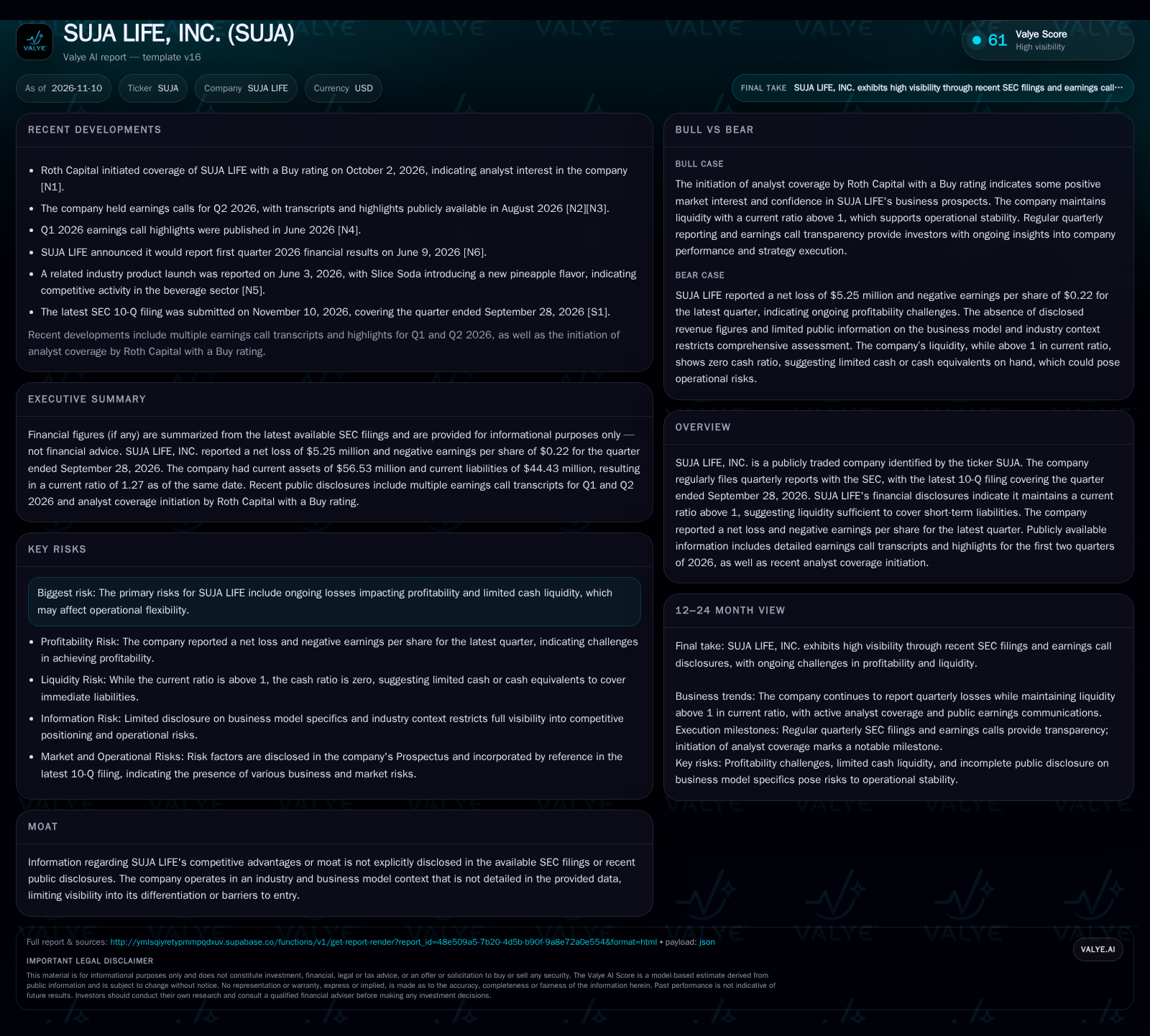
SUJA LIFE, INC. reported a Q3 2026 net loss of $5.25 million and a current ratio of 1.27, with cash on hand of $15.5 million as of September 28, 2026. Roth Capital initiated coverage with a Buy rating, bringing attention to the company despite persistent losses and reported liquidity position. The path forward depends on SUJA LIFE's ability to manage capital needs, improve margins, and clarify its competitive position.
SUJA LIFE, INC. enters late 2026 with a balance of incremental analyst attention and persistent financial headwinds. Despite these challenges, the initiation of analyst coverage and regular public disclosures suggest an organization aiming for greater capital markets visibility.
Recent Losses, Liquidity Position, and Analyst Initiation Define SUJA LIFE’s 2026 Landscape
SUJA LIFE, INC. reported a net loss of $5.25 million for the quarter ending September 28, 2026, with basic and diluted earnings per share at -$0.22 [S1]. The company's current assets stood at $56.53 million against current liabilities of $44.43 million, resulting in a current ratio of 1.27. As of the same date, SUJA LIFE held $15.5 million in cash, not including restricted cash, and had access to a revolving credit facility and delayed draw term loan commitments [S1]. The company’s liquidity is thus a combination of cash and credit, rather than a large reported cash balance. In October 2026, Roth Capital initiated coverage with a Buy rating, highlighting the company’s growing visibility in the public markets despite its ongoing losses [N1]. This juxtaposition of financial strain and external validation sets the stage for SUJA LIFE’s near-term strategic and operational choices.
Economic Model Unclear: Capital Needs and Margin Structure Under Scrutiny
SUJA LIFE’s public filings do not disclose revenue figures or granular details about its product lines, pricing structure, or customer base [S1]. The company reported cash and liquidity metrics for the period; these figures do not by themselves establish operating runway, investment capacity, financial flexibility, or financing capacity. As a holding company dependent on subsidiary distributions, SUJA LIFE’s ability to access cash is subject to debt covenants, which may restrict internal capital movement if financial tests are not met [S1]. The lack of disclosed recurring revenue or contract structure makes it difficult to assess revenue stability or customer retention. If SUJA LIFE operates in a consumer products sector—as suggested by references to manufacturing and logistics—the economics likely hinge on volume growth, supply chain efficiency, and brand differentiation. Fixed costs from production facilities and seasonal fluctuations could amplify earnings volatility until the company reaches greater scale or margin improvement.
The absence of disclosed revenue and margin details complicates evaluation of SUJA LIFE’s unit economics, which are critical to understanding scalability and profitability potential. If the company’s cost structure is heavily weighted toward fixed manufacturing overhead, incremental volume growth could drive meaningful operating leverage, improving margins as scale increases. Conversely, if variable costs dominate, margin expansion may be limited without pricing power or supply chain efficiencies. The potential seasonality of consumer demand, common in beverage or wellness categories, could also induce cash flow volatility, necessitating prudent capital management. Moreover, the degree to which SUJA LIFE can leverage digital marketing or direct-to-consumer channels would influence customer acquisition costs and lifetime value, key drivers of sustainable growth.
Opaque Differentiation and Unclear Moat in a Crowded Consumer Market
No explicit information is available regarding SUJA LIFE’s competitive advantages, market share, or product differentiation [S1]. The company’s risk disclosures reference challenges common to consumer brands, such as supply chain reliability, brand management, and regulatory compliance. If SUJA LIFE operates in the health, beverage, or wellness sector—as the name and manufacturing references may imply—it faces intense competition from both established players and emerging brands. Typical competitive levers in such markets include product innovation, distribution reach, pricing power, and marketing spend. Without details on customer loyalty, switching costs, or proprietary offerings, it is difficult to assert that SUJA LIFE possesses a defensible moat. Analyst coverage could indicate perceived growth potential or a differentiated story, but absent evidence of recurring customer relationships or unique IP, the company likely competes on brand, distribution, or price rather than structural barriers.
In highly competitive consumer markets, differentiation often hinges on proprietary formulations, brand authenticity, or exclusive distribution agreements. Without evidence of such moats, SUJA LIFE’s competitive positioning may rely heavily on marketing spend and channel partnerships, which can be costly and yield diminishing returns. The company’s ability to innovate product lines or pivot to emerging consumer trends could provide a transient advantage but may require ongoing investment that pressures margins. Furthermore, supply chain resilience is critical; disruptions or cost inflation in raw materials could erode profitability, especially if pricing flexibility is limited by competitive dynamics. If SUJA LIFE can establish meaningful switching costs or community engagement around its brand, it may better defend market share against incumbents and new entrants.
Profitability Inflection Possible if Volume Growth and Margin Expansion Align
A bullish scenario for SUJA LIFE would require the company to leverage its liquidity and public company status to drive significant revenue growth and/or margin improvement. This could occur if SUJA LIFE successfully launches new products, captures a larger share of a growing end-market, or realizes cost efficiencies in production and logistics. Access to credit facilities and the potential for external financing provide a window for investment in brand building, sales infrastructure, or operational streamlining. Confirmation of this scenario would come from a marked reduction in net losses, positive operating cash flow, and evidence of revenue acceleration—such as disclosed top-line figures showing double-digit growth or a shift to positive EPS. Additional analyst upgrades or strategic partnerships would further validate the narrative of an inflection toward profitability. Falsification would occur if losses persist or widen, or if liquidity becomes strained despite incremental borrowing.
Most Likely Trajectory: Continued Losses, Operational Adjustments, and Search for Scale
Given SUJA LIFE’s current financial profile and limited public disclosure, the most plausible path is a continuation of quarterly net losses, punctuated by incremental operational changes aimed at cost control or revenue stabilization. The company may seek to optimize working capital, renegotiate supplier contracts, or adjust product mix to improve margins. The base scenario would be confirmed by ongoing but narrowing net losses, stable or improving liquidity ratios, and management commentary focused on operational discipline rather than aggressive expansion. Falsification would come from either a rapid swing to profitability (indicating an upside break) or a deterioration in liquidity and loss escalation (signaling downside risk).
Liquidity Constraints and Persistent Losses Could Force Restructuring or Dilution
If SUJA LIFE fails to stem its quarterly losses, the company's reported cash balance and reliance on debt facilities could quickly become liabilities. In this scenario, operating cash burn outpaces new inflows, and debt covenants begin to restrict the ability to move cash between entities or support growth initiatives. The company may be forced to pursue dilutive equity raises, asset sales, or cost-cutting that undermines growth prospects. Confirmation would be a declining cash balance despite credit utilization, negative working capital trends, or management disclosures about seeking strategic alternatives. A breach of loan covenants, missed payments, or materially adverse changes in supplier or customer relationships would further validate the downside thesis.
Signals That Will Determine If SUJA LIFE Can Transition to Sustainable Growth
Disclosure of quarterly or annual revenue figures—if provided—would illuminate the scale and trajectory of the business.
Gross margin trends, if disclosed, would help assess whether losses are driven by pricing pressure, input costs, or operational inefficiency.
Operating cash flow and free cash flow metrics would reveal the sustainability of SUJA LIFE’s funding model.
Updates on the utilization and terms of the revolving credit facility and delayed draw term loan would indicate liquidity flexibility or constraints.
Any evidence of recurring revenue, contract length, or customer retention rates would clarify the stability of SUJA LIFE’s business.
Details on product launches, channel expansion, or new partnerships would signal strategic execution and potential growth levers.
Management commentary on cost structure, capital allocation, or restructuring plans would provide insight into near-term priorities and risk management.
Changes in analyst coverage, ratings, or target prices could reflect shifting market perceptions and external validation or skepticism.
Disclaimer: This is research-only, informational analysis and not investment advice. It may include AI-generated interpretation and general industry context. Always verify important details using primary sources.

Comments