
Sunrise Realty Trust After the SRT Merger: Integration, Dilution, and the Path to REIT Scale
Following its merger with SRT, Sunrise Realty Trust faces the dual challenge of realizing promised scale and synergies while navigating integration risks, potential tax complications, and shareholder dilution. The company’s recent financial performance shows operational profitability, but the real test lies in managing merger fallout and leveraging its expanded platform for sustainable returns.
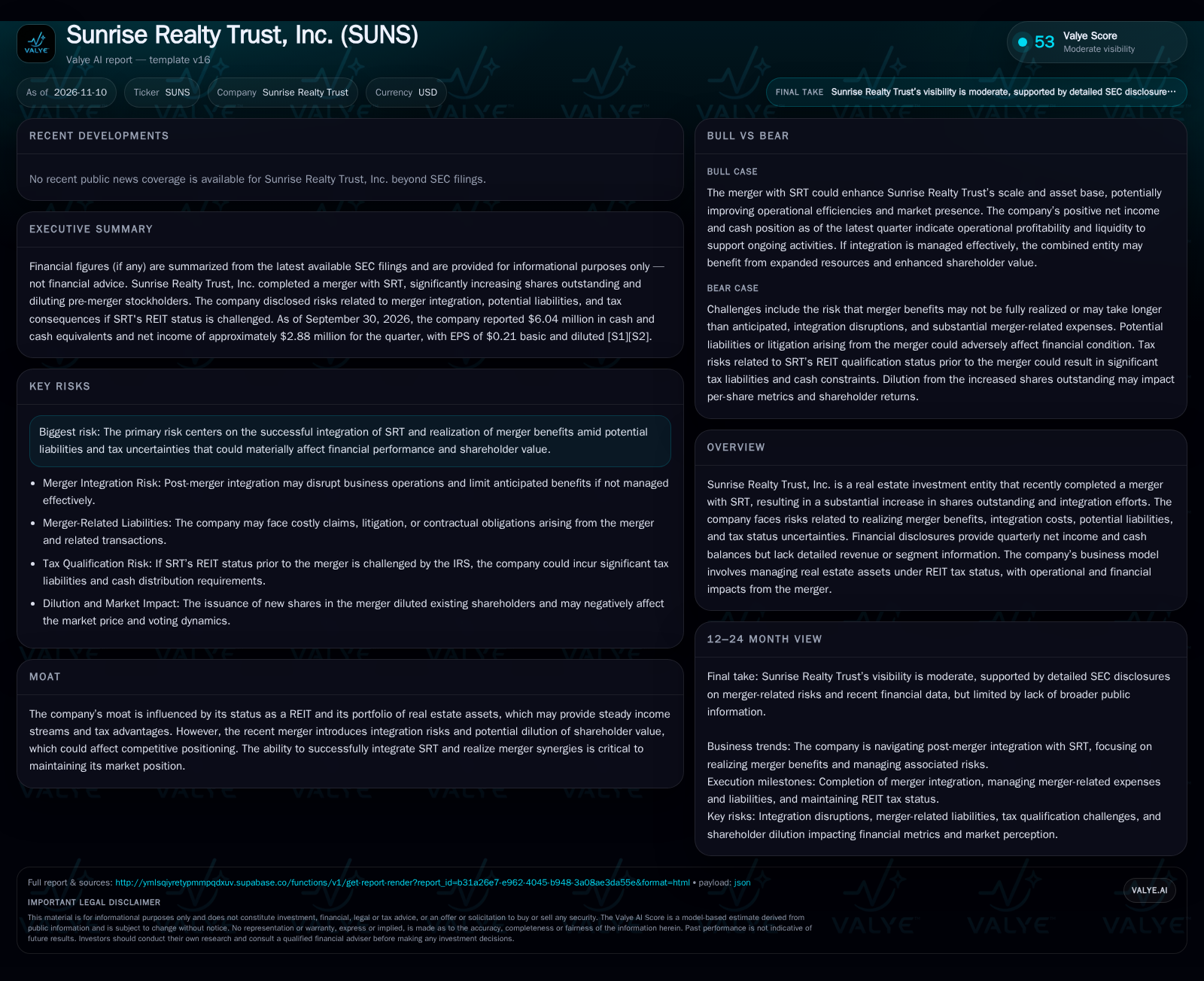
Sunrise Realty Trust’s recent merger with SRT significantly increased its share count and asset base, positioning the company for greater scale but also introducing integration complexity, dilution, and tax risk. While the company reported positive quarterly net income and cash, the success of the merger will depend on effective integration, realization of operational efficiencies, and resolution of outstanding tax and liability exposures. Sustainable value creation hinges on managing these risks and capitalizing on the expanded portfolio’s income potential. [S1] [S2]
Sunrise Realty Trust, Inc. stands at a critical juncture following its merger with SRT—a transaction that rapidly expanded its asset base and share count but also introduced a complex web of integration challenges, potential liabilities, and tax uncertainties. The ability of Sunrise Realty Trust to convert its new scale into durable shareholder value will depend on the effectiveness of its integration strategy and its success in navigating regulatory and operational landmines.
Merger Impact: Dilution, Integration, and Immediate Financial Snapshot
The completion of Sunrise Realty Trust’s merger with SRT resulted in the issuance of 8,464,977 new shares, bringing total shares outstanding to 21,980,828 and diluting the ownership and voting interests of pre-merger shareholders. This immediate dilution changes the per-share economics and influences shareholder dynamics going forward. [S1] [S2]
Integration of the two entities is a major near-term focus, with management attention and resources diverted toward aligning systems, processes, and personnel. The company has incurred, and expects to continue incurring, expenses related to this integration, which could temporarily depress reported profitability. There are also risks of liabilities, claims, or litigation emerging from the merger, any of which could adversely affect the company’s financial condition.
On the financial front, Sunrise Realty Trust reported $2.88 million in net income and $6.04 million in cash as of September 30, 2026. Basic and diluted EPS for the quarter stood at $0.21. However, there is no detailed revenue or segment breakdown available, and liquidity ratios are not disclosed, limiting transparency into underlying operational drivers. [S2]
A significant regulatory risk remains: if the IRS challenges SRT’s REIT status prior to the merger, Sunrise could face retroactive tax liabilities, forced distributions, and cash constraints, all of which could meaningfully impact its operational and potential financial flexibility. [S1]
How Sunrise Realty Trust’s Model Could Generate Value Post-Merger
Sunrise Realty Trust operates as a real estate investment trust (REIT), targeting income generation from its portfolio of real estate-backed loans. Its typical investment profile is a $15-100 million loan secured by transitional or construction commercial real estate, with a 2-5 year duration, floating rate pricing (SOFR plus spread), and a loan-to-value ratio capped at 75%. Loans are structured to include origination and exit fees, providing upfront and back-end revenue streams.
The company aims for a portfolio net IRR in the low-teens, potentially rising to the mid-teens when leveraging its capital structure. Its target capitalization is one-third equity, one-third secured debt, and one-third unsecured debt, with an anticipated leverage ratio of 1.5:1 debt-to-equity. This structure is designed to enhance returns through prudent leverage while maintaining REIT compliance.
Operating leverage in this model is moderate: fixed costs are largely tied to external management and platform fees, while variable costs scale with portfolio growth and integration requirements. Capital needs are ongoing, as real estate lending is inherently capital-intensive and requires continual access to both debt and equity markets to fund new originations and refinance maturing assets.
The merger with SRT could, in theory, allow Sunrise to achieve greater economies of scale, spread fixed costs over a larger asset base, and access a broader pool of borrowers and sponsors. However, integration frictions and the absorption of any underperforming assets or liabilities could offset these benefits in the near term.
Competitive Dynamics for a Merged REIT Platform
Sunrise Realty Trust competes with both public and private REITs, specialty finance companies, and non-bank real estate lenders. Its ability to originate loans across diverse property types and geographies in the Southern U.S. positions it to capture a broad market, but also exposes it to regional real estate cycles and competitive pricing pressures.
Potential advantages include the expanded platform and asset base post-merger, which could facilitate larger and more diverse loans, attract better-quality sponsors, and negotiate more favorable terms. The company’s affiliation with Tannenbaum Capital Group may provide additional sourcing and execution capabilities.
However, counterforces are significant. Integration risk could create operational distractions or impair underwriting discipline. The dilution from the merger could make it harder to deliver per-share growth, especially if synergies are slow to materialize. Additionally, in a competitive lending environment, spreads may compress, and credit risk may rise if economic conditions deteriorate.
Substitution risk comes from direct lending funds, traditional banks (if credit conditions improve), and alternative capital providers. Sunrise’s ability to maintain competitive terms and risk-adjusted returns will be critical to sustaining its position.
When Integration Delivers: Scale, Efficiency, and Enhanced Returns
If Sunrise Realty Trust executes a seamless integration with SRT—aligning systems, retaining key personnel, and realizing targeted synergies—the company could achieve meaningful operating leverage. A larger, diversified loan portfolio may allow for more stable cash flows, reduced cost of capital, and the ability to absorb asset-specific shocks.
Expanded scale could enhance sourcing capabilities and pricing power, resulting in improved net interest margins and fee income. If portfolio credit quality remains high and leverage is managed prudently, Sunrise could deliver on its target IRR and potentially outperform peers on a risk-adjusted basis.
A clean IRS determination on SRT’s pre-merger REIT status would further clear the path for value creation.
Integration Challenges Temper Near-Term Returns, but Platform Remains Intact
The most plausible outcome is a period of operational and financial adjustment as Sunrise digests the SRT merger. Integration costs, management distraction, and the absorption of any underperforming or legacy SRT assets may weigh on reported results for several quarters.
Per-share earnings and dividend growth could stagnate or modestly decline as dilution and integration expenses offset the benefits of a larger platform. However, if the company avoids major credit losses, litigation, or tax surprises, the underlying business model should remain intact and capable of delivering mid-single-digit returns as integration stabilizes.
Evidence supporting this scenario would be flat to slightly declining EPS in the near term, moderate increases in G&A or restructuring expenses, and intermittent disclosure of integration milestones achieved. Absence of major adverse tax or legal developments would suggest the company is managing its risks, even if not yet delivering full synergy benefits.
Tax and Liability Shocks Derail Post-Merger Value Creation
The most adverse scenario involves Sunrise Realty Trust being hit with material liabilities or tax assessments related to SRT’s pre-merger REIT status. If the IRS challenges this status, the company could be forced to pay corporate income taxes, recognize built-in gains, or make unplanned distributions—eroding available cash and potentially forcing asset sales or capital raises under unfavorable terms.
Integration could also founder if unexpected claims, litigation, or contractual obligations emerge, leading to asset impairments or outsized legal expenses. Operational disruption could cause credit quality to deteriorate, increasing loan losses and further pressuring earnings.
Falsification of this scenario would be evidenced by timely and positive tax rulings, clean audit opinions, and the absence of disclosed material liabilities or litigation. Conversely, any announcement of tax settlements, asset sales to meet distribution requirements, or large legal reserves would confirm downside risk materializing.
Milestones and Metrics That Will Reveal Sunrise Realty Trust’s Post-Merger Trajectory
Progress on integration milestones—such as system harmonization, staff retention, and realized cost synergies—would help test whether merger benefits are achievable.
Trends in per-share earnings and dividend levels will indicate whether dilution is being offset by genuine operational improvement.
Credit quality metrics (e.g., non-performing loans, charge-offs, or loss reserves), if disclosed, would reveal the underlying health of the expanded portfolio.
Any IRS communication or public disclosure regarding SRT’s pre-merger REIT status would be a pivotal indicator of potential tax risk.
Legal and regulatory disclosures related to merger-related liabilities, claims, or litigation will be crucial for assessing risk overhang.
Changes in leverage ratios and capital structure—such as debt-to-equity, secured/unsecured debt mix, or undrawn revolver capacity—would provide insight into potential financial flexibility.
Portfolio growth and loan origination volume, if disclosed, would help assess whether the expanded platform is translating into higher revenue-generating activity.
Management’s guidance on integration costs and timing, as well as long-term return targets, will clarify the expected pace and scope of post-merger value creation.
Disclaimer: This is research-only, informational analysis and not investment advice. It may include AI-generated interpretation and general industry context. Always verify important details using primary sources.

Comments