
Upexi’s Solana-Centric Treasury Model: Yield Ambitions, Liquidity Tension, and the Capital Market Engine
The company’s fortunes now hinge on Solana’s performance, validator discipline, and the willingness of markets to fund further token accumulation.
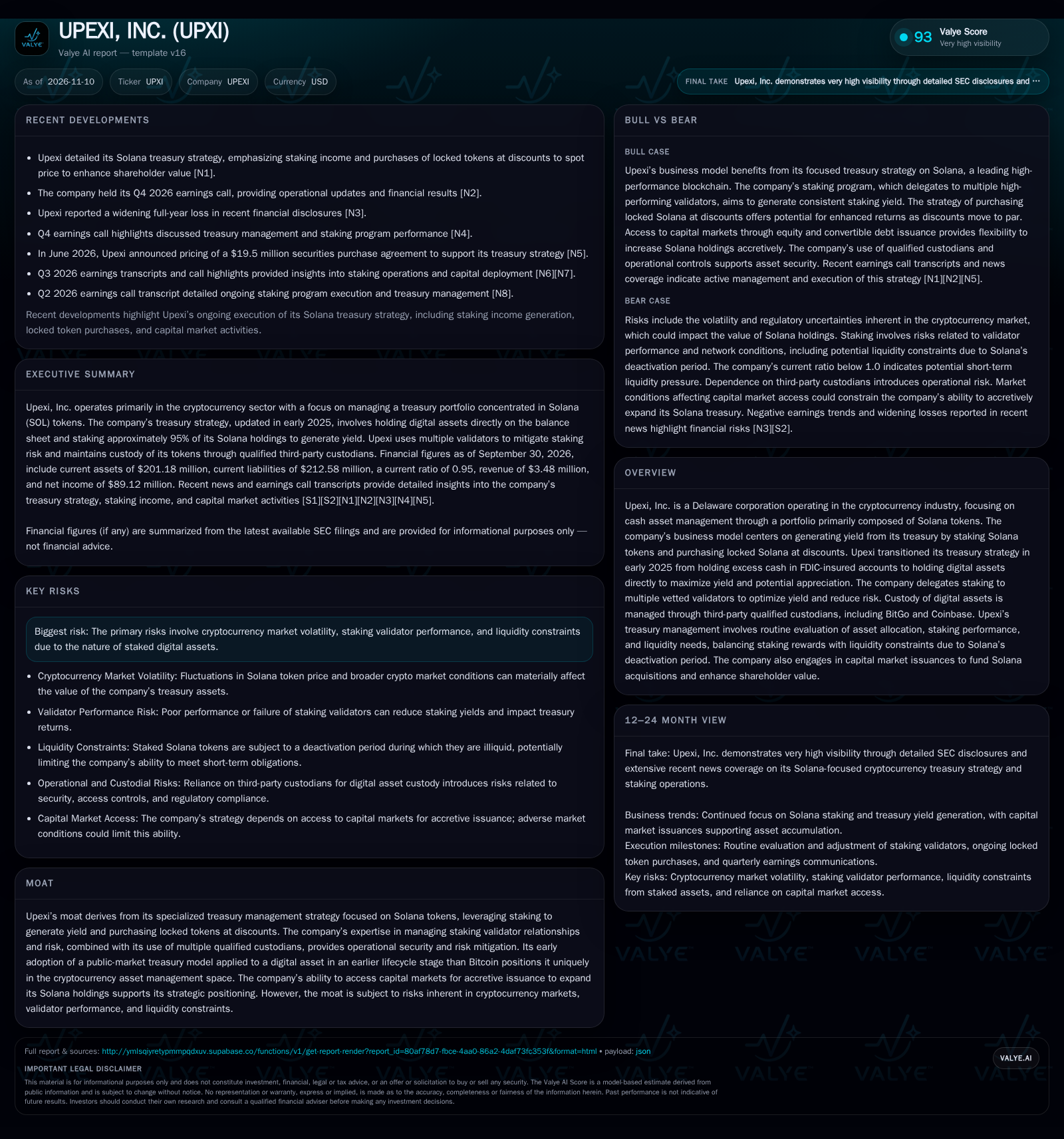
Upexi, Inc. manages a treasury almost entirely composed of Solana (SOL) tokens, staking 95% of its holdings and buying locked tokens at discounts to boost yield and potential capital gain. While this strategy has produced high net income recently, the company’s current ratio is below 1.0, and ongoing expansion depends on capital market access. [S1] [S2] [N1] [N5]
Upexi, Inc. has staked its corporate trajectory on a concentrated bet: deploying nearly all of its treasury into Solana (SOL), with a sophisticated program of staking for yield and opportunistic purchases of locked tokens at discounts. Investors must weigh the appeal of crypto-native yield against the structural vulnerabilities of such a tightly focused strategy.
Solana Exposure, Staking Execution, and the Liquidity Trade-off
Upexi’s defining move has been to shift its treasury almost entirely into Solana tokens, with approximately 95% of those tokens staked through a diversified validator set to earn network yield. This transition from traditional FDIC-insured cash management to direct digital asset holding was completed in early 2025, and it now shapes all core financial outcomes. As of September 30, 2026, Upexi reported $201.18 million in current assets and $212.58 million in current liabilities, yielding a current ratio of 0.95 and a cash ratio of 0.03. This means that nearly all liquidity is tied up in crypto, with only a reported cash balance available for immediate needs. The company’s net income for the quarter was a striking $89.12 million on revenue of just $3.48 million—an outcome driven by digital asset revaluation and staking income rather than operating business activity. Upexi’s ongoing Solana acquisition is fueled by capital market transactions, including a $19.5 million securities purchase agreement announced in June 2026. [S1] [S2] [N1] [N5]
Mechanics of a Crypto Treasury: Yield, Principal Risk, and Capital Rotation
Upexi’s economics are fundamentally distinct from traditional operating companies. Value is created (or destroyed) by three levers: staking yield, appreciation (or depreciation) of Solana, and the ability to purchase locked tokens at a discount to spot. By staking 95% of its Solana, Upexi earns protocol-level yield, with returns dependent on validator performance and overall network economics. The use of multiple validators spreads risk but does not eliminate exposure to network-wide events or validator underperformance. The company’s strategy to buy locked tokens at a discount introduces an additional source of potential capital gain, contingent on the discount narrowing as tokens unlock. However, this ties up capital and increases exposure to Solana’s price volatility during the lock-up period.
Operating leverage in this model is atypical: fixed costs are low, but bottom-line results are highly sensitive to Solana’s price swings and staking yield variability. The business requires little incremental capital to operate, but ongoing expansion and the ability to take advantage of discounts on locked SOL depend on fresh capital—typically sourced from equity or convertible debt issuance. Liquidity management is complicated by the 48-hour deactivation period for staked tokens, creating a structural lag in converting crypto to cash for obligations. The economics are therefore a high-beta play on Solana’s future, with an overlay of operational and capital market execution risk.
Positioning in the Digital Asset Treasury Niche: Early Mover or Risk Magnet?
Upexi is not a conventional asset manager or blockchain project; it is a publicly listed entity operating a Solana-centric treasury strategy. This sets it apart from crypto ETFs, closed-end funds, and traditional operating companies. Its core competitive edge is the specialization in Solana staking mechanics and the ability to size up locked-token arbitrage opportunities, paired with capital markets expertise for accretive issuance. Early adoption of a model that applies active treasury management to a digital asset with high throughput and staking rewards (Solana, as opposed to Bitcoin) could provide a unique positioning—especially if Solana continues to scale and attract developer and investor interest.
However, this positioning is not unassailable. Other public or private entities could replicate the model, and Upexi’s reliance on capital markets and third-party custodians introduces vulnerabilities. The absence of proprietary technology, customer relationships, or true operational moat means that Upexi’s advantage is largely executional and financial, not structural. Its fortunes are closely tied to Solana’s ecosystem health, validator performance, and the company’s own ability to maintain disciplined risk management and secure capital at reasonable terms.
If Solana Surges and Staking Yields Hold: Compounding Value Creation
The most favorable scenario for Upexi is a sustained bull market for Solana. In this environment, the company’s staked tokens would appreciate, while staking yields remain attractive and locked-token discounts narrow as market demand persists. Upexi could recycle capital from successful token unlocks into new discounted purchases, compounding returns. Continued access to capital markets at reasonable terms would allow the company to expand its Solana treasury, leveraging both yield and appreciation. The combination of protocol-level income and mark-to-market gains would drive outsized net income, supporting further capital issuance at favorable valuations.
Evidence confirming this scenario would include: sustained or rising Solana prices, robust staking yields, repeated capital raises at attractive terms, and positive mark-to-market revaluations driving consistently strong net income. Additional confirmation would come from management’s ability to secure new locked-token deals at meaningful discounts and to maintain validator performance without slippage or security incidents.
Managing Volatility: Yield Offsets Choppy Asset Prices and Capital Access Ebbs
The most plausible path forward is one of significant volatility rather than smooth compounding. Solana’s price may fluctuate, with periods of appreciation offset by sharp corrections, and staking yields may compress as network participation grows or protocol incentives change. Upexi’s net income would swing quarter-to-quarter based on asset revaluations, even as operating revenue remains modest. The ability to continue acquiring locked tokens at discount may be limited if capital markets become less receptive or if discounts narrow in a more efficient market.
In this scenario, Upexi survives by careful liquidity management—balancing the yield from staking and occasional capital gains from locked token arbitrage against the real risk of having to liquidate assets at unfavorable prices to meet obligations. The current ratio below 1.0 means that any prolonged period of depressed Solana prices or illiquidity could force difficult choices. Confirmation of this scenario would include choppy quarterly results, occasional but not continuous capital raises, and a gradual tightening of liquidity cushions. Falsification would occur if Upexi either secures a major new source of stable operating revenue, or if it loses access to capital markets and is forced into asset sales at distressed prices.
If Solana Falters or Capital Markets Close: Liquidity Crunch and Forced Liquidations
The adverse scenario is triggered if Solana’s price declines sharply and/or staking yields fall due to network changes or validator failures. In this case, Upexi’s asset base shrinks, and the company’s liquidity position—already tight—becomes critical. If the company cannot raise new capital, it may be forced to unwind staking positions early (enduring the 48-hour deactivation lag) and sell Solana into a weak market, crystallizing losses. Locked token purchases could become value traps if discounts persist or widen, and if unlocks coincide with market lows.
Operationally, this scenario would manifest in negative net income, deterioration of the current ratio, and potentially distress-level cash ratios. If capital markets are unreceptive—due to either company-specific performance or broader risk-off sentiment—Upexi could face a solvency event. Confirming evidence would include repeated quarters of negative mark-to-market income, inability to raise new funds, and forced asset sales below cost. Falsification would require either a rapid rebound in Solana’s price, a new source of liquidity or revenue, or a strategic pivot away from the current model.
Benchmarks for Testing Upexi’s Solana Treasury Thesis
Track the percentage of Solana staked and validator performance metrics; a useful metric would be realized versus target staking yield, if disclosed. [S1]
Watch for the frequency, size, and pricing terms of new capital raises—particularly whether Upexi can secure accretive terms or faces dilution. [N5]
Evaluate the average discount achieved on locked Solana purchases and the realized gains when these tokens unlock, if disclosed. [S1] [N1]
Assess Solana network health and price trends, as Upexi’s asset value and income are highly sensitive to these external variables.
Scrutinize quarterly net income composition to distinguish between realized staking income, mark-to-market revaluation, and operating revenue. [S2]
Review management commentary for any signals of stress regarding liquidity management, validator risk, or capital market receptivity. [N2] [N3] [N4] [N6] [N8]
Disclaimer: This is research-only, informational analysis and not investment advice. It may include AI-generated interpretation and general industry context. Always verify important details using primary sources.

Comments