
Actelis Networks: Navigating Delisting, IoT Transition, and Geopolitical Exposure in a Challenging Connectivity Market
Actelis Networks faces a pivotal period marked by its delisting from Nasdaq, a shift from Telco to IoT verticals, and persistent geopolitical and supply chain risks. While liquidity coverage remains, the company’s ability to execute on its IoT growth ambitions and restore capital market access will determine its next chapter.
Actelis Networks, now trading OTC after a Nasdaq delisting, is transforming its business from traditional Telco connectivity toward IoT applications. The company’s path forward will depend on successfully leveraging its installed base, managing operational risks, and meeting uplisting requirements amid continued uncertainty. [S1] [S2]
Actelis Networks stands at a strategic crossroads after its Nasdaq delisting, as it seeks to reorient its business from legacy telecommunications toward the expanding Internet of Things (IoT) sector. The company’s financials reveal reported liquidity position coverage but continued operating losses, and its operational base in Israel introduces significant geopolitical uncertainty. With ambitions to requalify for a major exchange and diversify its customer mix, Actelis must address vulnerabilities in supply chain management, market access, and cybersecurity—all while demonstrating that its IoT transition can meaningfully offset Telco declines and deliver sustainable growth.
Recent Delisting, IoT Transition, and Financial Position Define the Current Landscape
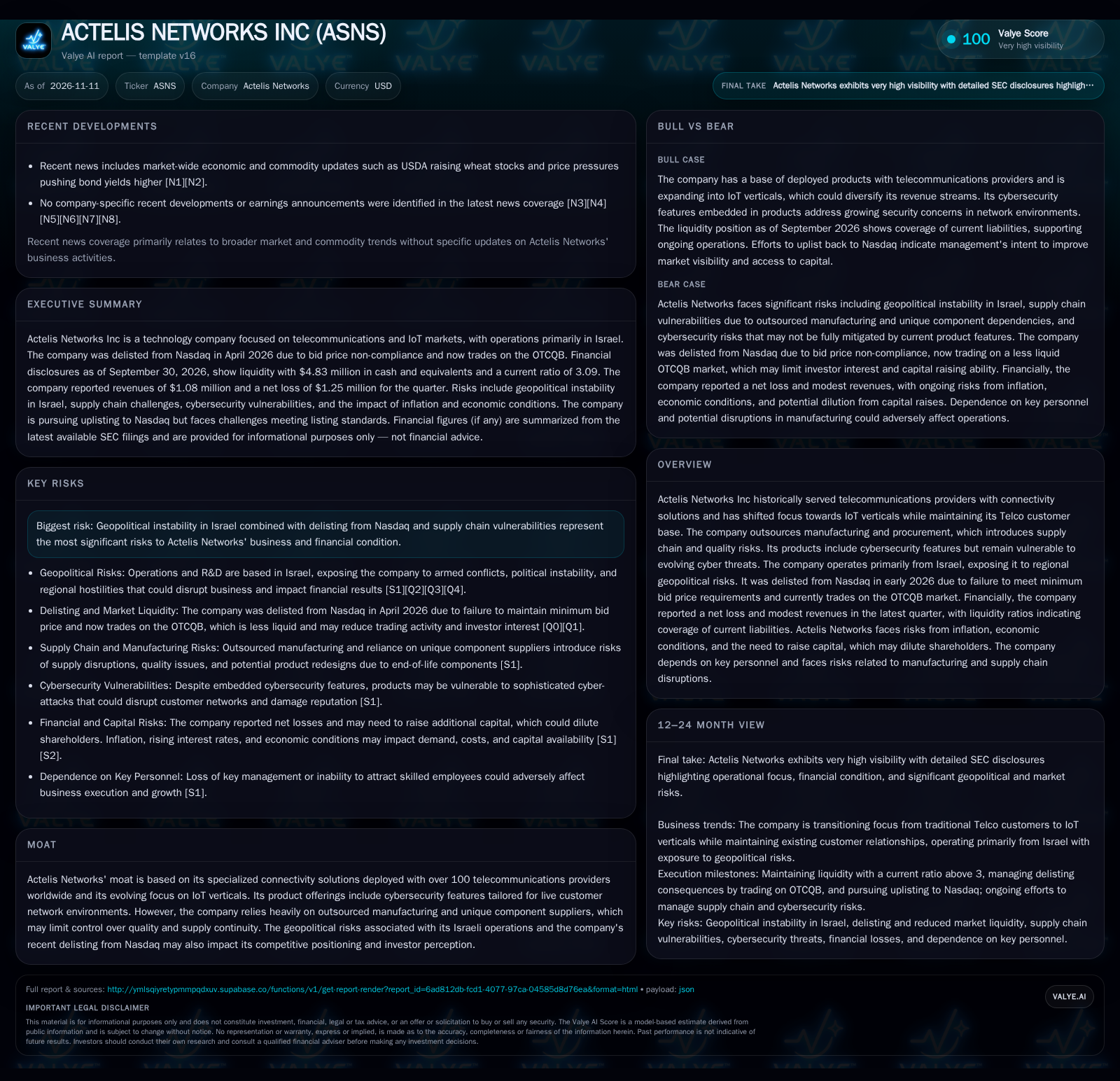
Actelis Networks was delisted from the Nasdaq Capital Market in April 2026 after failing to maintain the minimum bid price, forcing a move to the less liquid OTCQB Venture Market. The company is pursuing a return to Nasdaq but currently does not meet listing standards and may require a reverse stock split to comply. At the same time, Actelis is transitioning its business model: while it retains its Telco customer base—now just 27% of 2025 revenues—the primary focus is increasingly on IoT verticals. Financially, as of September 30, 2026, the company had $4.83 million in cash and equivalents, a current ratio of 3.09, and reported $1.08 million in quarterly revenues against a net loss of $1.25 million. Operations and R&D are based in Israel, which exposes the company to substantial geopolitical risk. [S1] [S2]
How Actelis Could Capture Value in Connectivity: Revenue Mix, Cost Structure, and Leverage
Actelis historically generated revenues by providing connectivity solutions to telecommunications providers, with a business model likely centered on hardware sales, integrated software, and ongoing support contracts. The pivot to IoT verticals suggests a move toward more diversified and potentially higher-growth end markets, where value can be created through embedded connectivity, network management, and security features tailored for industrial or municipal use cases.
The company outsources manufacturing and procurement to external partners, which keeps fixed capital requirements low but raises exposure to supply chain disruptions, component shortages, and quality control issues. This model reduces operating leverage but may limit margin expansion if component costs rise or if redesigns are needed due to end-of-life parts. The cost structure is thus a blend of variable costs tied to production volume and some fixed costs in R&D and SG&A.
In the IoT space, recurring revenue from software subscriptions, network monitoring, and cybersecurity services could be a path to higher-margin growth if Actelis can shift its commercial model accordingly. However, without granular disclosure on contract structure, the relative split between one-time product sales and recurring service revenue is unclear. The company's need to fund ongoing losses and potential product redesigns means capital access remains a critical constraint. [S1] [S2]
Competitive Dynamics: Specialized Legacy, New Entrants, and the Challenge of IoT Differentiation
Actelis’ long-standing relationships with over 100 Telco providers provide a deployed asset base and some degree of switching friction, but Telco spending on legacy infrastructure is generally mature or declining. In the IoT arena, the competitive landscape is more fragmented, with a mix of established industrial networking vendors, low-cost hardware suppliers, and software-centric players pursuing device and data management solutions.
Actelis’ differentiation may rest on its ability to deliver reliable, secure connectivity in complex environments, leveraging its experience in mission-critical Telco deployments. However, the shift to IoT requires new integrations, vertical-specific features, and potentially different sales channels. Outsourced manufacturing exposes Actelis to risks that vertically integrated competitors may better control, and larger players may have scale advantages in procurement, R&D, and channel reach.
Cybersecurity features are a necessary but not sufficient differentiator, as baseline security is now expected in most connectivity and IoT solutions. The challenge is to build an ecosystem or service layer that creates retention and pricing power—otherwise, Actelis risks commoditization as IoT hardware margins erode.
IoT Expansion Offsets Telco Decline: What Would a Successful Transition Look Like?
The most favorable scenario for Actelis is that its pivot to IoT verticals gains traction, driving new customer wins and a higher proportion of revenue from recurring software or service contracts. The company could leverage its existing Telco relationships to cross-sell IoT solutions, while its installed base provides references and a platform for upselling.
Confirmation would come from sequential IoT revenue growth, disclosure of multi-year customer contracts, and evidence of improved gross margins tied to software or services. If Actelis can demonstrate that its solutions are integral to critical infrastructure projects or industrial automation deployments, it could command higher pricing and reduce churn.
Falsification would occur if IoT revenue remains immaterial, margins stagnate or decline, or if customer concentration increases without evidence of new vertical adoption. A stable or growing backlog (if disclosed), and successful entry into new geographies or use cases, would further support the upside thesis.
Incremental Progress Amid Ongoing Losses and Market Constraints
The most plausible near-term outcome is that Actelis achieves modest progress in IoT while legacy Telco revenues continue to decline or remain flat. The company manages to maintain operations with its current liquidity, but persistent net losses and thin gross margins limit internal reinvestment. Supply chain and geopolitical risks are managed but not eliminated, resulting in periodic disruptions or elevated costs.
Confirmation of this scenario would include stable or slowly growing total revenue, continued quarterly net losses, and no material improvement in margin profile. The company may announce new IoT customer relationships or pilot projects, but these remain too small to fundamentally change the revenue mix. Progress toward a Nasdaq uplisting is slow, with compliance hurdles (such as minimum bid price or market cap) remaining unresolved.
Falsification would occur if the company either achieves a breakthrough in IoT scale or faces a severe operational or financial setback that accelerates losses or necessitates a major restructuring.
Compounding Risks: Loss of Market Access, Supply Chain Shocks, or Geopolitical Disruption
The adverse scenario is defined by a convergence of risks: further Telco revenue attrition is not offset by IoT growth, while operating losses erode the company’s liquidity cushion. A significant supply chain disruption—such as a key component shortage or quality failure—forces costly redesigns or delays, impacting customer delivery and reputation.
Geopolitical instability in Israel could directly disrupt R&D, operations, or supply logistics, leading to lost contracts or inability to fulfill orders. The continued inability to uplist to a major exchange restricts access to capital, exacerbating dilution risk if external funding is needed. Increased cyber threat activity could also expose product vulnerabilities, harming customer trust.
Confirmation of this scenario would include a rapid decline in cash or current ratio, disclosure of major operational disruptions, further delisting or regulatory setbacks, or a need for emergency capital at punitive terms.
Milestones That Will Determine Actelis Networks’ Trajectory in IoT and Connectivity
Sequential IoT revenue growth and the proportion of total revenue derived from IoT verticals (if disclosed) would help test whether the business transition is gaining traction.
Gross margin trends, particularly any improvement driven by software or services rather than hardware, would indicate success in capturing higher-value opportunities.
Disclosure of multi-year or recurring revenue contracts in IoT, or evidence of a growing backlog, would be key to assessing revenue visibility and customer retention.
Progress toward Nasdaq uplisting, including any announced plans for a reverse split or compliance with listing requirements, will affect market access and capital raising ability.
Updates on supply chain stability, such as mitigation of component shortages or successful product redesigns, would help gauge operational resilience.
Material impacts from geopolitical events in Israel—such as disruptions to R&D, operations, or logistics—could quickly alter the risk profile.
Cash burn rate and changes in the current or cash ratio over time will clarify the company’s financial runway and need for additional capital.
Product or platform security incidents, or customer disclosures related to cybersecurity breaches, would be critical in evaluating reputational and operational risk.
Disclaimer: This is research-only, informational analysis and not investment advice. It may include AI-generated interpretation and general industry context. Always verify important details using primary sources.

Comments