
Mercury Systems: Advancing Defense Electronics with AI and Open Modular Designs
Mercury Systems is pivoting from a challenging FY2026 to a profitable start in FY2027, leveraging its modular, secure electronics platform for defense and aerospace markets. As the demand for AI-enabled, mission-critical processing rises, the company’s dual business model and commitment to open standards could enable it to capture share in a $66 billion global Tier 2 and Tier 3 defense electronics market. The challenge: sustaining innovation and margin expansion amid customer concentration, technological complexity, and volatile defense spending.
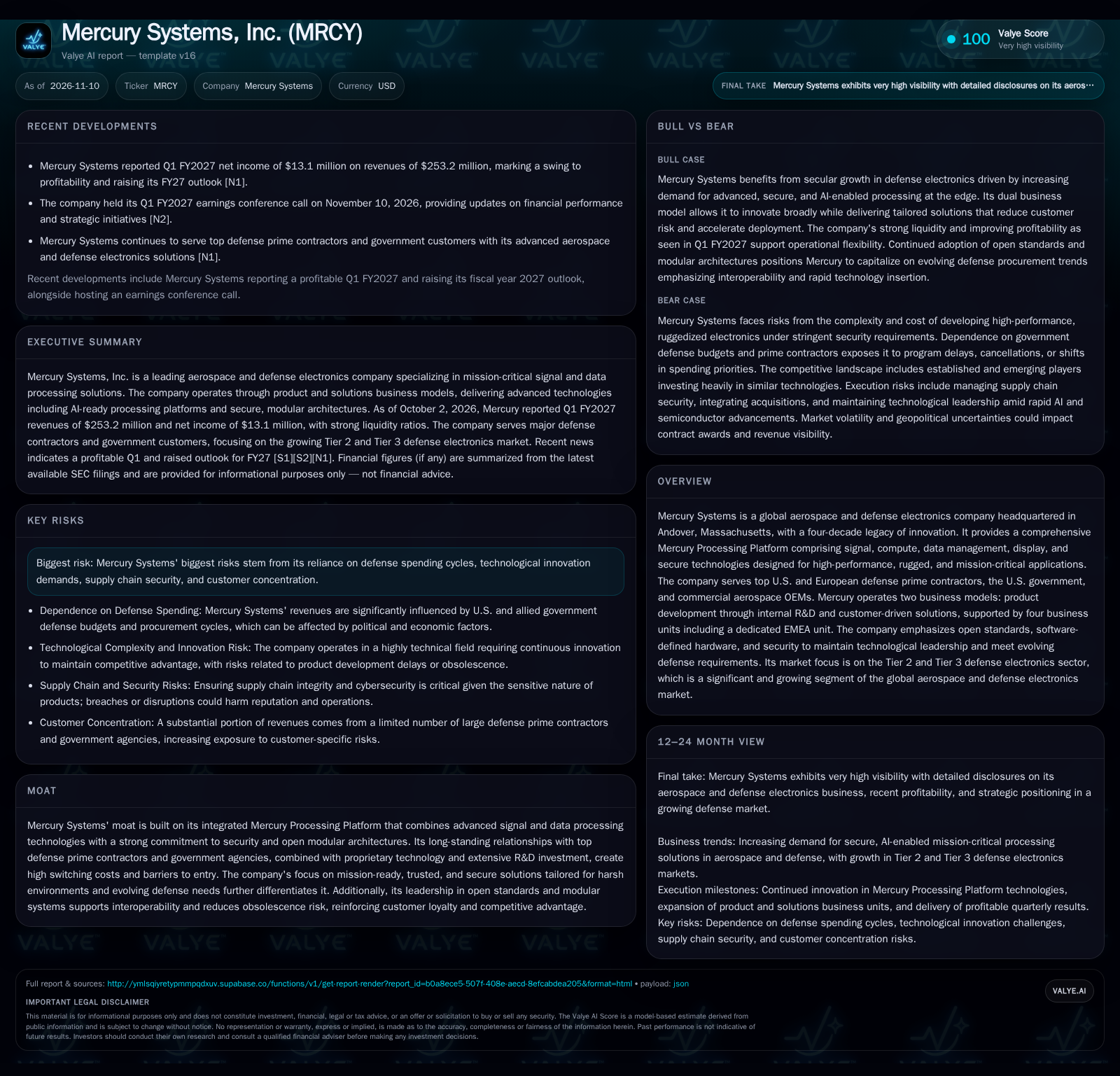
Mercury Systems reported a profitable Q1 FY2027 with $253.2 million in revenue and $13.1 million net income on October 2, 2026, after a net loss in FY2026. The company’s modular, AI-ready processing platforms target the growing Tier 2 and Tier 3 defense electronics sector, with a focus on security and open standards. Execution risk remains around innovation pace, customer concentration, and defense budget cycles. Watch for contract momentum, margin trends, and evidence that its differentiated platform is driving sustained growth [S1] [S2] [N1].
Mercury Systems, Inc. stands at a pivotal juncture in the defense electronics landscape. After swinging from a net loss in FY2026 to a profitable first quarter of FY2027, the company is leaning on its modular, secure Mercury Processing Platform to address growing demand for AI-enabled, mission-critical solutions in aerospace and defense. With a $66 billion Tier 2 and Tier 3 market opportunity and a business model balancing R&D-driven products and tailored solutions, Mercury’s next phase depends on its ability to innovate, deepen customer integration, and navigate the persistent risks of program delays, budget cycles, and margin pressure. The coming year will test whether its technology and business architecture can deliver durable growth and profitability [S1] [S2] [N1].
Q1 Profitability and Market Strategy Poise Mercury for FY2027
Mercury Systems reported Q1 FY2027 revenue of $253.2 million and a net income of $13.1 million as of October 2, 2026, reversing the net loss of $29.7 million booked for all of fiscal 2026 [S2] [S1]. The company reported cash and liquidity metrics for the period; these figures do not by themselves establish operating runway, investment capacity, financial flexibility, or financing capacity. [S1] The company’s dual business model—standard R&D-driven products plus custom solutions—remains central to its strategy as it seeks to capture more value from both prime defense contractors and government customers [S1].
Revenue Drivers: Modular Systems, Tailored Solutions, and Enhanced Margins
Mercury’s revenue model is anchored in two streams: internally funded, broadly applicable products and customer-driven, custom solutions. The product business leverages R&D to create standardized modules and subsystems, which, if widely adopted, could offer high operating leverage and attractive incremental margins due to the repeatability of design and manufacturing. The solutions business, in contrast, focuses on integrating Mercury’s technologies into bespoke configurations that meet specific customer requirements, typically yielding higher revenue per engagement but potentially lower margins due to customization and engineering intensity.
Pricing power in defense electronics is often determined by technological differentiation, integration into mission-critical systems, and compliance with stringent security and interoperability standards. Mercury’s focus on open modular architectures and AI-ready processing could allow it to command premium pricing—especially if its systems reduce customers’ time-to-field or facilitate future upgrades. However, the capital intensity of ongoing R&D and the need to maintain secure, trusted supply chains mean that fixed costs are significant, and gross margin expansion will likely depend on scaling product sales and maintaining discipline in custom solution execution.
The company’s Q1 FY2027 profitability suggests early progress in balancing these dynamics, but the sustainability of margin improvement will hinge on the mix of product versus solution sales, manufacturing efficiencies, and the company’s ability to amortize R&D across a broader product base [S1] [S2].
Competitive Advantages and Industry Challenges in Defense Electronics
Mercury Systems operates in a highly competitive segment of the defense electronics value chain, facing both established defense contractors and emerging technology firms. Its competitive edge rests on several pillars: a proprietary Mercury Processing Platform, deep integration with prime contractors, and a reputation for trusted, secure electronics tailored for SWaP-constrained environments. The company’s commitment to open standards (such as VPX, VITA, and REDI) and modularity increases interoperability, which is increasingly valued by defense procurement agencies seeking to avoid vendor lock-in and enable rapid technology refresh cycles [S1].
Switching costs for customers can be high when Mercury’s subsystems are deeply embedded in mission platforms, particularly if security and certification requirements would require costly redesigns or requalification with alternative vendors. However, these advantages are counterbalanced by the rapid pace of semiconductor and AI innovation, which can erode technological moats if Mercury fails to keep up. Large defense primes and new entrants alike are investing in similar AI-enabled, secure processing technologies, and the company’s reliance on a relatively concentrated customer base may limit its bargaining power in contract negotiations.
While Mercury’s integration of commercial technology into rugged, secure solutions is a differentiator, competitors with deeper vertical integration or greater R&D scale could pressure pricing and margins. The question is whether Mercury can continue to differentiate its offerings fast enough to maintain both customer stickiness and premium economics.
Margin Growth Fueled by Platform Expansion and AI Integration
The most favorable scenario for Mercury Systems would see sustained adoption of its modular, AI-ready platforms across a broad array of defense and aerospace programs. If the company’s investments in open standards, trusted supply chains, and secure architectures become potentially leading requirements for new mission-critical applications, Mercury could achieve both revenue acceleration and margin expansion. The platform approach allows customers to incrementally upgrade capabilities without full system redesigns, potentially driving recurring product pull-through and reducing customer churn.
Confirmation of this scenario would come from a rising proportion of product sales versus custom solutions, expanding adjusted EBITDA margins, and multi-program wins with new and existing prime contractors. Evidence of Mercury’s technology being specified as a baseline in next-generation defense programs, as well as successful integration of AI-enabled subsystems, would further validate the thesis. Conversely, if margin gains prove fleeting or product sales do not scale, it would challenge the platform leverage hypothesis.
Growth Outlook Reflecting Defense Spending Cycles and Operational Demands
A pragmatic outlook for Mercury Systems sees the company growing in line with the overall Tier 2 and Tier 3 defense electronics market—driven by secular demand for secure, modular, and AI-capable mission systems, but tempered by the realities of defense procurement cycles and execution risk. The company is likely to maintain a mix of high-margin product sales and lower-margin, but stickier, custom solutions. Operating leverage may improve incrementally if R&D investments yield reusable platform components and if manufacturing and supply chain efficiencies are realized.
This scenario would be confirmed by steady (but not explosive) revenue growth, stable or modestly expanding adjusted EBITDA margins, and evidence of repeat business from top customers. Contract wins in new geographies or adjacent markets (such as commercial aerospace or non-traditional defense applications) would reinforce the sustainability of the model. However, persistent customer concentration, delayed program awards, or margin compression from competitive pricing would signal a need to reassess the durability of the company’s growth trajectory.
Risks from Delays, Innovation Shortfalls, and Budget Volatility
The adverse scenario for Mercury Systems involves a convergence of external and internal headwinds: major defense program delays or cancellations, budget pressures in key customer governments, and intensified competition from both legacy and disruptive entrants. If Mercury’s technology roadmap falls behind emerging AI and semiconductor advances, or if security incidents undermine its trusted supplier status, the company could face both revenue contraction and margin compression.
Indicators of this scenario would include a shrinking order book, rising reliance on low-margin custom work to backfill lost product sales, and either flat or declining adjusted EBITDA margins. Deteriorating relationships with prime contractors, loss of design wins to competitors, or a visible uptick in customer churn would further substantiate the downside. In this environment, fixed R&D and supply chain costs could quickly outpace revenue, leading to renewed losses and raising questions about the sustainability of the business model.
Factors Influencing the Longevity of Mercury’s Platform Leadership
Growth in the proportion of standardized product revenue versus custom solutions, if disclosed, would clarify the scalability and profitability of Mercury’s platform model.
Adjusted EBITDA margin trends over the next several quarters will indicate whether margin expansion is being achieved through operating leverage or is stalling due to cost pressures.
The pace and size of new multi-year contract awards, especially with new customers or on next-generation defense programs, would test the company’s competitive positioning.
Evidence of deeper integration into U.S. and allied defense prime contractor platforms—such as Mercury technologies being adopted as baseline standards—would support the stickiness and necessity of its solutions.
Any disclosed changes in customer concentration, particularly diversification beyond the top few contractors, would signal reduced revenue risk.
Updates on R&D spend and product development milestones, especially in AI-enabled and cybersecurity-enhanced offerings, would reveal the company’s ability to keep pace with industry innovation.
Disclosures around supply chain security initiatives, cyber defense incidents, or trusted microelectronics certifications would help gauge risk management effectiveness.
If provided, backlog growth or order book disclosures would offer visibility into future revenue streams and demand momentum.
Disclaimer: This is research-only, informational analysis and not investment advice. It may include AI-generated interpretation and general industry context. Always verify important details using primary sources.

Comments