
Satellogic: Building a Next-Generation Earth Observation Platform Amid Execution and Capital Demands
Satellogic’s Merlin constellation ambitions, multi-year commercial agreements, and strong cash reserves set the stage for expansion in the earth observation sector. Yet persistent negative operating cash flow and a rapidly evolving competitive landscape demand disciplined execution and ongoing access to capital.
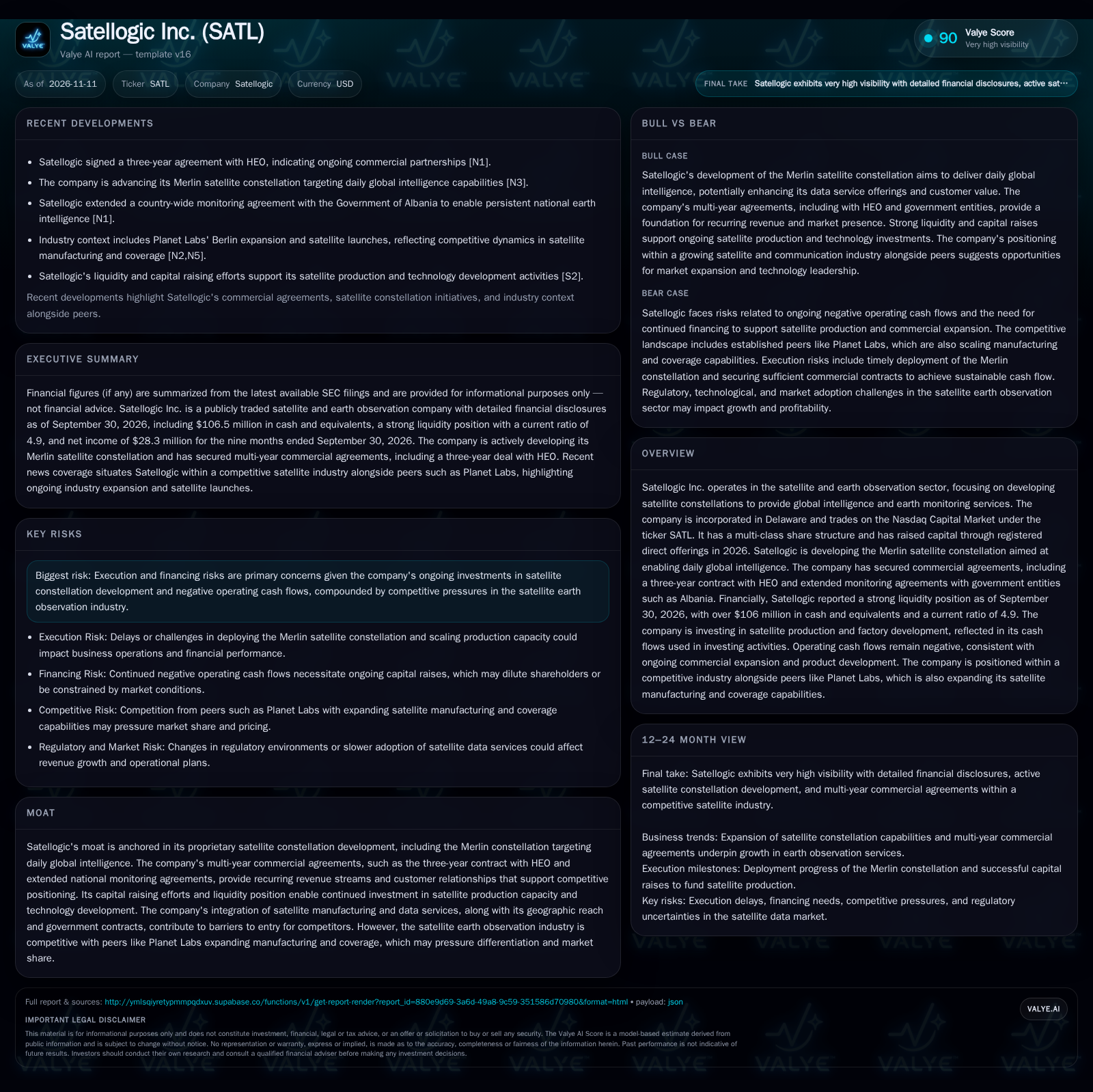
Satellogic is advancing its Merlin satellite constellation and has secured multi-year agreements, including with HEO and the Albanian government. The company reported $106.5 million in cash as of September 2026 and positive net income, but continues to post negative operating cash flow due to heavy investment in satellite production. Its success will hinge on timely constellation deployment, customer adoption, and maintaining funding momentum in a competitive industry.
Satellogic Inc. is positioning itself as a leading provider of earth observation and global intelligence services, leveraging its proprietary Merlin satellite constellation and a series of multi-year commercial agreements. As industry competition accelerates, Satellogic’s ability to convert technological progress and early customer wins into sustainable, cash-generating operations will define its trajectory.
Where Satellogic Stands: Capital, Contracts, and Constellation Progress
Satellogic entered the final quarter of 2026 with $106.5 million in cash and cash equivalents, current assets of $126.8 million, and current liabilities of $25.9 million, resulting in a current ratio of 4.9 and a cash ratio of 4.12 [S2]. This balance sheet strength reflects a recent wave of capital raising, including $31.2 million from stock issuances in the first nine months of 2026 [S2]. The company posted $28.3 million in net income for the same period, but operating cash flow remained negative at $18.8 million, underscoring the ongoing investment required for satellite production and the Merlin constellation’s development [S2].
On the commercial front, Satellogic secured a three-year agreement with HEO and extended a country-wide monitoring deal with the Albanian government, both signaling traction in institutional and government markets [N1]. The Merlin constellation aims to deliver daily global intelligence, with continued capital deployment into satellite components and production infrastructure [N3] [S2]. These developments position Satellogic at a critical inflection point: with liquidity and commercial relationships in place, the challenge shifts to execution and scaling recurring revenues.
Revenue Models and Cost Structure in Satellite-Based Earth Intelligence
Satellogic’s core business model is predicated on deploying a proprietary constellation (Merlin) to deliver high-frequency earth observation data to commercial and government clients. While the company has signed multi-year agreements, such as the three-year HEO contract, the specific commercial mechanics—such as the proportion of revenue from recurring subscriptions versus project-based services—are not fully disclosed in public filings or news [N1]. Thus, revenue visibility is partially supported by these agreements, but the ultimate economics depend on the breadth of adoption and the scalability of data delivery.
The business is capital-intensive, with significant upfront investment in satellite manufacturing, launch, and ground infrastructure. Cash flows from operating activities remain negative, indicating that near-term profitability is dependent on continued access to external capital and the ramp-up of higher-margin data services [S2]. If Satellogic achieves scale, operating leverage could be substantial: once the core satellite network is in orbit, incremental data sales to additional customers may carry high gross margins, given low variable costs per delivered image or dataset. However, the path to this positive leverage is constrained by ongoing R&D, constellation maintenance, and frequent technology upgrades, as well as the need to finance future satellite launches.
The company’s recent net income suggests that certain one-off or non-cash items may be influencing reported profitability, given that operating cash flow remains negative [S2]. This points to the importance of monitoring cash conversion and sustainable free cash flow as opposed to headline earnings.
Competitive Levers and Industry Countercurrents
Satellogic operates in a dynamic and crowded satellite earth observation market, facing direct competition from firms like Planet Labs and other satellite and data analytics providers. The company’s perceived advantages include its proprietary satellite technology, focus on high-cadence global coverage (daily intelligence), and a willingness to engage in multi-year commercial agreements with both institutional and government clients [N3] [N1].
However, competitive counterforces are intensifying. Planet Labs and similar peers are scaling both their satellite fleets and their manufacturing capabilities, which could erode any early-mover or technology advantage. Price competition is plausible as satellite imaging becomes commoditized and barriers to entry fall due to declining launch costs and advances in small-satellite technology. The value chain is also evolving: customers increasingly demand not just raw imagery but analytics, integration, and actionable insights—areas where software, machine learning, and data fusion capabilities become differentiators.
Government contracts, such as the Albanian monitoring agreement, may provide some insulation from pure price competition, but large institutional customers often have significant bargaining power and may seek multi-vendor solutions to reduce dependency. Switching frictions for customers could be moderate, as integration and analytics pipelines may be customized, but the underlying data can be sourced from multiple providers if standards are open.
How Merlin’s Deployment Could Unlock Operating Leverage and Recurring Revenue
If Satellogic succeeds in deploying the Merlin constellation to deliver daily global coverage, and effectively commercializes this capacity through additional multi-year agreements, the company could transition from capital-intensive buildout to a high-margin, recurring revenue model. The critical causal chain is: rapid satellite deployment → increased data collection frequency and coverage → higher-value service offerings → expansion of institutional and government customer base → conversion of demand into recurring revenue streams.
Evidence that would confirm this scenario includes a sustained increase in multi-year contract signings, growth in contracted annual recurring revenue (if disclosed), and a shift from negative to positive operating cash flow as constellation utilization rises. Additional proof points would be customer case studies highlighting new analytics use cases enabled by Merlin, and the announcement of cross-industry partnerships leveraging Satellogic’s data platform.
Falsification would be seen in persistent negative cash flows even after a major constellation deployment, stagnating customer additions, or price compression driven by intensified competition and lack of differentiation.
Executing Amid Capital Constraints and Industry Evolution
The most plausible outlook is that Satellogic continues its phased constellation buildout, secures additional but lumpy commercial agreements, and gradually ramps recurring revenues—while remaining dependent on periodic capital raises to fund operations.
Confirmation of this scenario would include continued announcements of government and institutional deals, steady investment in satellite production, and periodic registered direct offerings or other financing events to extend liquidity. The company may report modest improvements in cash flow as utilization rises, but full self-sufficiency may remain several years away.
Falsification would be signaled by a sudden slowdown in contract wins, inability to close new financing rounds, or operational setbacks (e.g., launch delays or satellite failures) that delay the commercial ramp.
Execution Slips, Funding Tightens, and Competitive Pressures Mount
A more adverse scenario could unfold if Satellogic experiences delays in deploying the Merlin constellation, faces technology setbacks, or fails to convert early customer relationships into broader adoption. Persistent negative operating cash flow, in the absence of additional financing, could force the company to scale back development or accept unfavorable terms on future capital raises, diluting shareholders.
Intensifying competition—especially if rivals like Planet Labs accelerate their own constellation deployments or undercut pricing—could erode Satellogic’s customer base or force margin concessions. Regulatory shifts or slower-than-expected adoption of satellite intelligence by key government and enterprise customers would compound these pressures.
Confirmation of this scenario would be evident in declining contract activity, cash burn rates outpacing available liquidity, or public disclosures of restructuring, asset sales, or management turnover in response to capital constraints.
Milestones and Metrics That Will Test Satellogic’s Long-Term Viability
Number of satellites launched and operational in the Merlin constellation relative to stated targets—progress here will confirm or challenge execution capability.
Annualized value and duration of new commercial contracts signed (if disclosed), especially with government and institutional clients, as evidence of market traction.
Net operating cash flow trends quarter-over-quarter, to gauge the pace toward sustainable operations.
Frequency and terms of new capital raises or registered direct offerings, which will reveal the company’s ability to access financing and the dilution cost for shareholders.
Retention rate and expansion of existing customer agreements—renewals or upsells would validate product-market fit and switching frictions.
Gross margin evolution as satellite utilization rises—a useful metric would be unit economics per customer segment, if disclosed.
Any delays, failures, or anomalies in satellite launches or constellation operations, as these could materially affect both revenue and cost trajectories.
Competitive developments in the satellite earth observation sector—such as new constellation launches, pricing moves, or technology shifts by Planet Labs and other direct peers.
Disclaimer: This is research-only, informational analysis and not investment advice. It may include AI-generated interpretation and general industry context. Always verify important details using primary sources.

Comments