
International Tower Hill Mines: Development-Stage Gold Producer Backed by Reported Liquidity Position Despite No Revenue Stream
With a substantial reported cash balance and a flagship Alaskan gold project, International Tower Hill Mines remains in the capital-intensive pre-revenue phase. The company’s future hinges on project advancement, gold price cycles, and the new CEO’s ability to navigate permitting, funding, and execution risks.
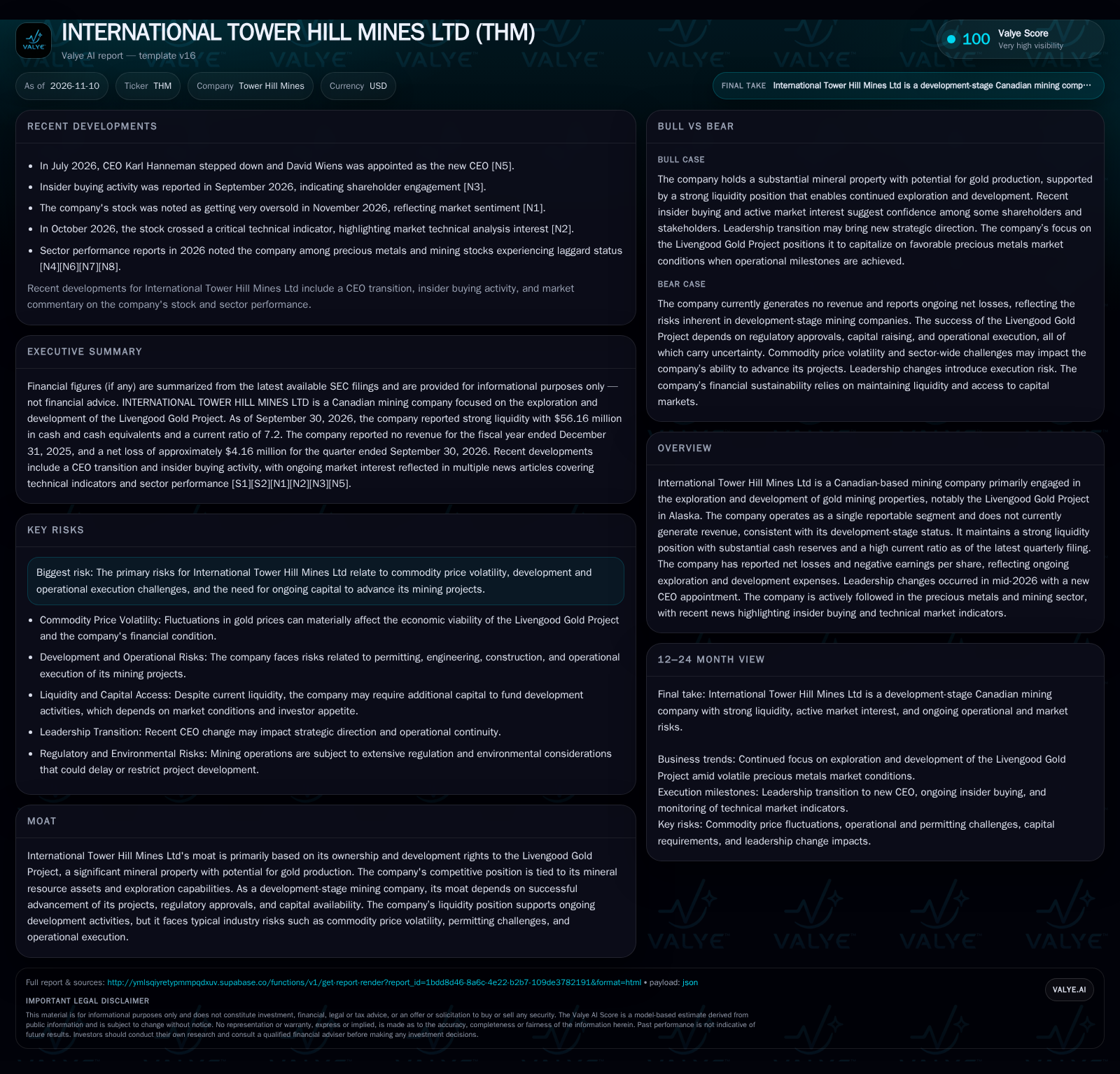
International Tower Hill Mines Ltd (THM) holds the Livengood Gold Project in Alaska and reported $56.16 million in cash as of September 30, 2026, but continues to generate no revenue and operate at a net loss. A CEO transition in July 2026 and recent insider buying have kept market interest active, yet the path to production and cash flow remains unproven. The key question is whether THM can convert its mineral asset into a viable mining operation before capital constraints or market volatility intervene. [S2] [N3] [N5]
The company’s ability to move from exploration to production—under new leadership and amid volatile gold markets—will determine whether its cash reserves become a bridge to value creation or a dwindling buffer against mounting costs and uncertainties.
Recent Developments in Liquidity and Leadership at Tower Hill
As of September 30, 2026, International Tower Hill Mines reported $56.16 million in cash and cash equivalents, and a current ratio of 7.2, reflecting a reported liquidity position. The company’s current assets totaled $108.68 million against current liabilities of $15.08 million [S2]. Despite this liquidity, THM reported zero revenue for the fiscal year ended December 31, 2025, and a net loss of $4.16 million for the quarter ended September 30, 2026, with negative EPS of $0.02 [S2]. All business activity is focused on the Livengood Gold Project in Alaska, with no other operating segments or revenue streams. In July 2026, David Wiens succeeded Karl Hanneman as CEO, marking a leadership transition at a critical juncture [N5]. Insider buying in September and technical trading activity in the fall of 2026 have kept the stock in market conversations, but have not changed the underlying business position [N1] [N2] [N3].
Economic Foundations: Project Viability, Capital Requirements, and Cost Considerations
International Tower Hill Mines’ economic model is typical of single-asset, development-stage gold exploration companies. Cash is consumed through exploration, permitting, feasibility studies, and fixed corporate overhead, with no offsetting revenue until the Livengood project is either sold, partnered, or advanced to commercial production. The company’s primary costs are labor, permitting, technical studies, and ongoing land and environmental expenditures. These are largely fixed or semi-fixed until construction, at which point capital expenditures would become dominant.
Revenue, if achieved, would come from future gold production, which would require significant up-front capital investment—often hundreds of millions of dollars for a project of Livengood’s reported scale. The company reported cash and liquidity metrics for the period; these figures do not by themselves establish operating runway, investment capacity, financial flexibility, or financing capacity. Operating leverage is high: fixed costs dominate until production, then scale benefits could accrue if the project reaches commercial output and gold prices are favorable. However, until a construction decision is made and funded, the company remains exposed to ongoing cash burn and dilution risk.
The capital-intensive nature of development-stage mining projects like Livengood necessitates careful financial planning and risk management. Given the scale of required investment, the timing and structure of financing rounds can materially affect shareholder value and project viability. For instance, equity raises during periods of weak gold prices or unfavorable market sentiment may lead to significant dilution, whereas strategic partnerships might mitigate financing risk but often require relinquishing some control or future cash flow rights.Moreover, the company’s ability to manage permitting timelines and technical uncertainties directly influences capital deployment schedules, which in turn affectreported liquidity position and cost projections. This interplay underscores the importance of adaptive capital strategies aligned with project milestones and market conditions.
Evaluating Tower Hill’s Position Through Asset Quality and Industry Trends
THM’s moat is anchored in its control of the Livengood Gold Project, a large-scale resource in a mining-friendly jurisdiction. In the development-stage mining segment, competitive advantage is driven less by operating scale and more by asset quality, permitting progress, and access to capital.
Competitors include other North American junior gold developers and explorers, many of whom compete for capital, partnerships, and investor attention. Substitution risk is high: if other gold projects advance faster or offer better economics, capital may migrate elsewhere. THM’s ultimate competitive position will be determined by the Livengood project’s feasibility, permitting progress, and the ability to secure financing or a strategic partner before its liquidity buffer erodes. Sector-wide gold price volatility and investor sentiment towards mining juniors remain important exogenous forces.
In assessing THM’s competitive position, it is critical to consider the regulatory and geopolitical environment of Alaska as a mining jurisdiction. While mining-friendly policies can facilitate permitting and operational stability, evolving environmental regulations and community relations may introduce delays or additional costs. Furthermore, the competitive landscape is shaped by the availability of alternative gold projects with different risk profiles, resource grades, and development timelines. Investors and capital providers often compare these factors when allocating funds among junior developers. Thus, THM’s ability to demonstrate superior asset quality, efficient permitting progress, and robust project economics relative to peers will be decisive in attracting and retaining investment interest amid a crowded and cyclical sector.
Potential Triggers for Market Reassessment and Value Enhancement
The most constructive scenario for THM involves a sequence where the new CEO accelerates technical de-risking and permitting progress at Livengood, while sustaining a disciplined cost base. A major milestone—such as a positive updated feasibility study, receipt of a key permit, or a strategic partnership/joint venture with a senior gold producer—could validate the project and unlock access to construction capital. If gold prices remain robust or strengthen, the project’s economics could become more attractive, increasing its strategic value to larger mining companies.
Evidence that would support this upside pathway includes: public disclosure of advanced permitting status, meaningful progress on technical studies (such as resource upgrades or cost reductions), announcements of project-level financing or partnership, and gold prices at or above long-term incentive levels. Sustained insider buying or new institutional investors could reinforce market confidence. Falsification would come from delays, cost overruns, or an inability to attract partners or capital as cash reserves decline.
Ongoing Development Faces Challenges in Financing and Permitting
The most plausible near-term scenario is continued technical and permitting work at Livengood, funded from existing cash, with ongoing operating losses and no revenue. The company may issue periodic updates on exploration or study progress, but absent a major breakthrough, the share price and market sentiment will likely track gold price cycles, sector flows, and technical trading signals. As cash is consumed, THM may need to raise additional capital through equity, debt, or asset-level transactions, potentially diluting existing shareholders.
Confirmation of this scenario would be continued quarterly losses, no revenue, and steady but incremental project updates. Any capital raise or evidence of asset sales or project farm-outs would reinforce this path. Falsification would occur if the company announced a major project advancement, secured a strategic partner, or signaled a near-term move to construction.
Liquidity Constraints Pose Risks of Delays and Investor Fatigue
A negative scenario would see project permitting or technical advancement stall, causing the company to burn through its cash reserves without reaching a financing or partnership catalyst. If gold prices decline or capital markets for junior miners tighten, THM could face increasingly dilutive financings or even be forced to halt development and seek strategic alternatives, such as asset sales at distressed valuations.
Early warning signs would be a lack of meaningful project updates, higher-than-expected cash outflows, unsuccessful or highly dilutive capital raises, and adverse gold price movements. Downside could be further exacerbated if sector sentiment weakens or if the new CEO’s transition creates operational or strategic uncertainty.
Liquidity constraints not only risk delaying project milestones but can also impair the company’s strategic flexibility. In a constrained cash environment, management may be forced to prioritize short-term survival over long-term value maximization, potentially leading to suboptimal decisions such as asset sales at discounted prices or accepting onerous financing terms. Additionally, prolonged uncertainty and negative market sentiment can erode investor confidence, reducing access to capital and increasing cost of funds. This dynamic can create a feedback loop where deteriorating financial conditions exacerbate operational challenges, making recovery more difficult. Monitoring the company’s cash flow projections against actual burn rates and financing outcomes is therefore essential to anticipate and mitigate downside risks.
Key Milestones and Performance Measures Influencing Tower Hill’s Future
Quarterly cash burn and ending cash balance: Tracking how quickly the company is consuming its liquidity will be critical to assessing runway and funding needs.
Disclosure of permitting progress or receipt of key environmental and mining permits: These are gating factors for project advancement and investor confidence.
Updates on technical studies, resource estimates, or feasibility study milestones: Any improvement or de-risking could change the project’s perceived value.
Announcements of project-level financing, joint ventures, or strategic partnerships: These would validate the project and reduce financing risk.
Gold price trends relative to project break-even and incentive levels: Sustained high prices would support project economics and investor interest.
Insider transaction activity was reported in the cited source; this activity does not by itself establish insider confidence.
If disclosed, terms and pricing of any future equity or debt raises: The degree of dilution or financing cost will impact existing shareholder value.
Disclaimer: This is research-only, informational analysis and not investment advice. It may include AI-generated interpretation and general industry context. Always verify important details using primary sources.

Comments