
Eastern Company: Engineered Solutions Under Margin Pressure as Market Cyclicality and Imports Intensify Competitive Demands
Recent declines in volume and profitability highlight Eastern’s exposure to cyclical transportation markets and globalized cost competition. The company’s ability to maintain engineering-driven differentiation, manage input volatility, and execute on cost discipline will determine whether it can stabilize margins and return to growth.
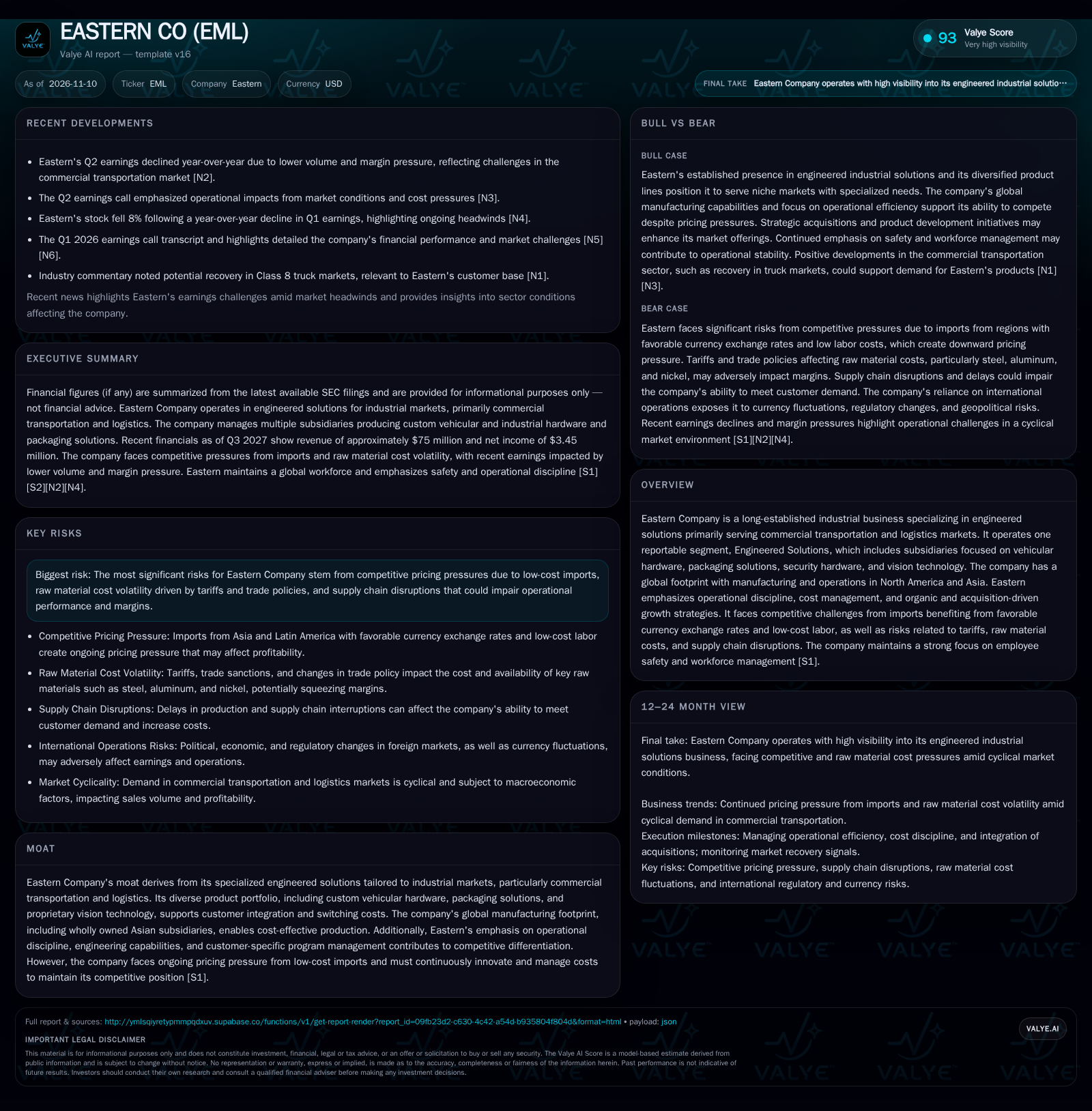
Eastern Company’s Q3 2027 results reflect ongoing volume and margin challenges, primarily driven by weaker commercial transportation demand and intensified import competition. While its engineered solutions and global manufacturing footprint offer differentiation, persistent pricing pressure, raw material cost swings, and supply chain risks cloud the outlook. Execution on cost discipline, product innovation, and market recovery will be critical for future performance. [S2] [N2] [N4]
Eastern Company, a legacy provider of engineered solutions for industrial and commercial transportation markets, is navigating a challenging phase marked by declining volumes and margin compression. Recent quarters have seen year-over-year drops in earnings as the company contends with cyclical demand in logistics, persistent pricing pressure from global imports, and input cost volatility. Eastern’s ability to defend its differentiated product offering, maintain cost-effective operations across its North American and Asian footprint, and adapt to shifting market dynamics will be pivotal as it seeks to restore profitability and growth.
Recent Earnings Signal Margin Compression and Market Headwinds
Eastern reported Q3 2027 revenue of $74.98 million and net income of $3.45 million, with basic and diluted EPS of $0.57. This follows consecutive quarters of year-over-year earnings declines, including a notable drop in both Q1 and Q2 linked to lower volumes and sustained margin pressure. [S2] [N2] [N4]
Management commentary and news coverage attribute these declines to weaker demand in the commercial transportation sector—the company’s primary end market—as well as to cost pressures and competitive dynamics. Notably, Eastern’s stock price reacted negatively to these results, reflecting investor concerns over the persistence of these headwinds. [N2] [N4]
The company reported cash and liquidity metrics for the period; these figures do not by themselves establish operating runway, investment capacity, financial flexibility, or financing capacity. [S2]
How Eastern’s Economics Respond to Cyclical Volumes and Input Volatility
Eastern’s revenue model is anchored in the sale of engineered hardware and solutions to commercial transportation and logistics customers. This includes custom and standard vehicular hardware, security products, packaging solutions, and vision technology, with much of the value proposition built on tailored engineering and integration into customer workflows. [S1]
The company’s cost structure is exposed to both fixed and variable elements: manufacturing operations (especially in North America) carry significant fixed overhead, while materials (steel, aluminum, nickel) and labor—particularly in Asia—introduce variable costs. Periods of lower demand, such as those currently observed, tend to erode operating leverage, compressing margins as fixed costs are spread over a smaller revenue base.
Raw material costs and supply chain reliability are persistent swing factors. Tariffs, trade policy shifts, and input price fluctuations can rapidly alter gross margins, while disruptions can affect both cost and delivery reliability. Eastern’s approach—balancing domestic and Asian sourcing, and maintaining a diversified product set—may help buffer but not eliminate these risks.
The company’s ability to generate incremental margin improvement typically hinges on higher volumes (restoring operating leverage), cost discipline, and product mix shifts toward higher-value engineered solutions. In the current environment, all three levers appear challenged.
Can Differentiated Engineering Offset Import-Driven Price Erosion?
Eastern’s competitive position is rooted in its ability to deliver custom engineered solutions, often with integration and program management services that create switching frictions for established customers. Its global manufacturing presence, including wholly owned Asian subsidiaries, gives it some cost flexibility and geographic reach. [S1]
However, the most acute threats are from imports benefiting from favorable currency exchange rates and lower labor costs. These competitors can undercut prices, especially on standardized hardware, forcing Eastern to either compress margins or cede volume. The company’s advantage is more defensible where customer requirements demand bespoke engineering, proprietary vision/security technology, or stringent quality and safety standards.
Other U.S. and international industrial hardware suppliers, as well as Asian contract manufacturers, represent the main peer set. The sustainability of Eastern’s edge will depend on its ability to continue innovating, deepen customer integration, and perhaps selectively automate or relocate production to maintain cost competitiveness. The risk is that, over time, even specialized solutions become commoditized or are subject to disruptive substitution.
If Transportation Markets Recover and Cost Pressures Ease, Margin Rebound Is Possible
A favorable scenario for Eastern would involve a cyclical rebound in commercial transportation and logistics demand, driving higher order volumes across its engineered solutions portfolio. This would allow the company to regain operating leverage, improve capacity utilization, and potentially pass through some cost increases to customers, especially for custom or integrated offerings.
Easing of raw material prices—whether through improved supply chains, lower tariffs, or global commodity trends—would further support gross margin recovery. If Eastern continues to invest in product innovation and leverages its global manufacturing footprint to control costs, incremental margin expansion could follow.
Confirmation of this scenario would come from sequential volume growth in transportation-related orders, stabilization or improvement in gross margins, and renewed year-over-year earnings growth. Evidence of customer wins in higher-value engineered solutions or new product launches would also support the thesis.
Prolonged Margin Pressure as Eastern Endures a Tough Cycle
The most plausible near-term outcome is that Eastern remains under pressure from weak transportation demand and persistent input inflation. While the company may stabilize revenues through product breadth and customer relationships, margins are likely to remain compressed as price competition and raw material volatility continue.
Cost discipline—via operational efficiency, selective sourcing, and incremental automation—may prevent further erosion, but significant margin expansion is unlikely without a rebound in end-market demand. The company’s global footprint provides some resiliency, but also exposes it to geopolitical and currency risks.
This scenario would be confirmed by flat or only modestly improving revenues, continued margin compression or stagnation, and little evidence of pricing power. Ongoing commentary about competitive pricing and input cost headwinds would reinforce the outlook.
Deeper Market Downturn or Supply Shocks Could Trigger Losses
In a more adverse scenario, further deterioration in commercial transportation markets—due to economic slowdown or structural shifts—would drive additional volume declines. If raw material costs spike or supply chain disruptions intensify, Eastern could face negative operating leverage, leading to losses at the net income line.
Aggressive price competition from imports could force the company to discount even further, eroding any remaining margin on standardized products. In this environment, fixed costs become a heavier burden, and the risk of underutilized capacity increases.
This downside would be evidenced by sequential and year-over-year revenue declines, negative gross or operating margins, and possible restructuring or divestiture activity. Any signs of working capital strain or liquidity stress—such as declining cash balances or increased borrowing—would serve as additional red flags.
Testing Eastern’s Resilience: What Could Validate or Break the Thesis
Quarterly gross margin trends: Sustained improvement would suggest progress on cost control or pricing, while further compression would signal persistent headwinds.
Volume growth in transportation and logistics product lines: Sequential or year-over-year increases would indicate potential market recovery.
Mix shift toward higher-value engineered solutions (if disclosed): A greater share of custom or integrated product sales could help offset pricing pressure.
Raw material cost indices and tariff impacts: Monitoring input cost trends and management commentary for signs of relief or escalation.
Customer retention and new contract wins (if disclosed): Evidence of sticky relationships or new program launches would imply competitive differentiation.
Operating expense discipline: Flat or declining SG&A as a percentage of sales would indicate cost control.
Cash flow from operations: Positive and stable operating cash flow would support balance-sheet resilience, especially if margins remain thin.
Supply chain stability: Any reported disruptions, delays, or inventory imbalances could foreshadow further operational challenges.
Disclaimer: This is research-only, informational analysis and not investment advice. It may include AI-generated interpretation and general industry context. Always verify important details using primary sources.

Comments