
Yubo International Biotech Confronts Zero Revenue, Regulatory Hurdles, and Liquidity Crisis
The next year will test whether the company can achieve commercial traction or overcome compounding structural risks.
The company’s position is further complicated by exposure to PRC tax and foreign exchange regulations, as well as potential delisting risks under the Holding Foreign Companies Accountable Act. Its ability to transition from regulatory survival to commercial viability remains unproven and is the central question for investors [S2] [S1].
Yubo International Biotech Ltd finds itself at the intersection of financial distress and regulatory complexity. Its operations in the PRC and Hong Kong expose it to a web of tax, currency, and compliance challenges, while looming delisting threats under U.S. law further cloud the path forward. The company’s next chapter will hinge on its ability to achieve operational traction, secure funding, and maintain compliance in a restrictive and uncertain environment.
Current State Marked by Liquidity Crunch, Lack of Revenue, and Regulatory Challenges
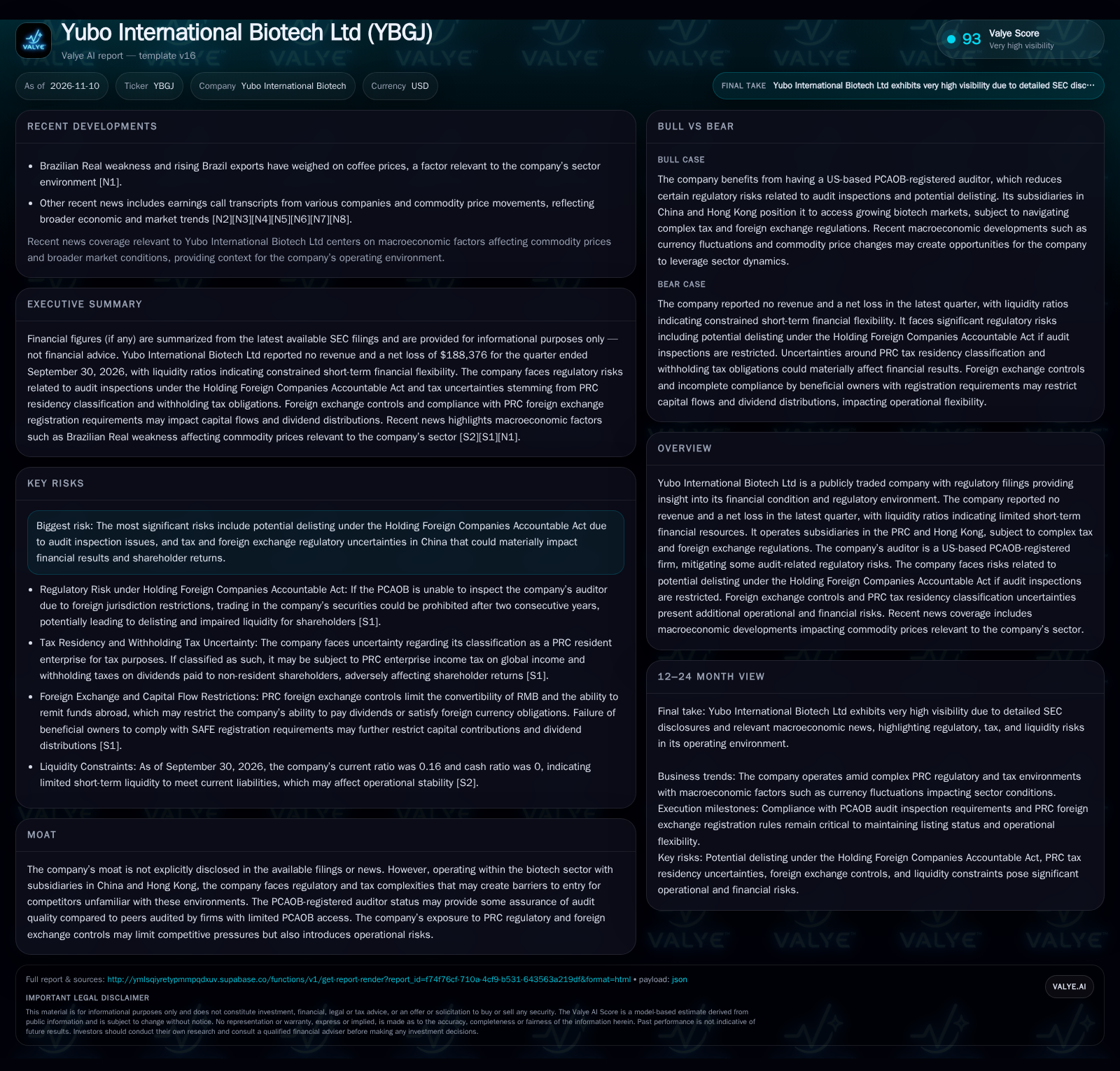
As of September 30, 2026, Yubo International Biotech Ltd reported cash and cash equivalents of only $11,989, with current assets totaling $579,352 against current liabilities of $3,549,427. The company reported cash and liquidity metrics for the period; these figures do not by themselves establish operating runway, investment capacity, financial flexibility, or financing capacity. The company posted zero revenue and a net loss of $188,376 for the quarter, underscoring the lack of any ongoing commercial activity or product monetization [S2]. Against this backdrop, Yubo must also contend with regulatory complexities tied to its PRC and Hong Kong subsidiaries—including uncertainty over tax residency and the potential for significant withholding taxes on dividends [S1]. Finally, it remains exposed to the risk of delisting under the U.S. Holding Foreign Companies Accountable Act should PCAOB audit inspections become restricted [S1]. These factors collectively frame a scenario where both operational continuity and future growth are at immediate risk.
Potential Value Creation Hinges on Successful Commercialization
At present, Yubo International Biotech Ltd is not generating revenue, so its business economics are theoretical rather than demonstrated. In a typical biotech model, value creation depends on the successful development, regulatory approval, and commercialization of proprietary technologies or products—often with high fixed development costs, long lead times, and binary outcomes. If Yubo were to commercialize a biotech product, revenue would likely depend on a mix of licensing, direct sales, or service contracts, with gross margins highly sensitive to scale and regulatory approval. Fixed R&D and compliance costs are likely substantial, and without scale, negative operating leverage can quickly erode capital. The company’s capital needs are acute: with scant cash and a negative net working capital position, it would likely require substantial outside funding—either through equity, debt, or strategic investment—to support product development, regulatory filings, or market entry. Until there is evidence of a monetizable pipeline or product launch, Yubo’s cost base is all but guaranteed to outstrip any revenue, compounding liquidity stress.
China-Focused Biotech Faces Entry Barriers and Operational Challenges
Yubo’s subsidiaries in China and Hong Kong suggest potential access to large and fast-growing biotech markets, but the regulatory and tax environment creates both barriers to entry and severe operational friction. On one hand, competitors unfamiliar with PRC regulations or unable to secure PCAOB-compliant audits may face higher hurdles to U.S. capital markets. However, Yubo’s own position is weakened by its lack of commercial traction and acute liquidity shortfall. In the broader context, established biotech firms—whether domestic PRC players or multinational pharmaceutical companies—enjoy scale, regulatory expertise, and often deep local relationships. For Yubo to carve out a sustainable niche, it would need either a proprietary technology that cannot be easily replicated or a regulatory position that allows it to operate where others cannot. Currently, neither advantage is evident. The company’s PCAOB-registered auditor reduces some audit risk relative to certain PRC peers, but this is insufficient to offset the existential threats posed by its financial structure and lack of revenue.
Turnaround Depends on Commercial Success Coupled with Regulatory Approvals
The most favorable scenario for Yubo International Biotech would involve a rapid transition from zero revenue to securing a commercial contract, product launch, or licensing deal—ideally in a regulatory environment where capital flows and profit repatriation are not obstructed. This could plausibly be triggered by successful R&D, a partnership with a better-capitalized firm, or regulatory approval of a key asset. In such a case, new revenue streams could provide the foundation for external financing, improved liquidity, and operational stability. Confirmation of this scenario would require a material revenue announcement, evidence of customer adoption, and regulatory filings showing improved working capital or a successful capital raise. Falsification would occur if the company continues to report zero revenue, fails to secure new funding, or faces regulatory setbacks such as delisting or adverse tax rulings.
Without Commercial Gains, Financial Stress and Event Risks Will Intensify
Given the absence of revenue, ongoing net losses, and a current ratio well below 1.0, the most plausible near-term scenario is continued operational strain—potentially leading to creditor action, forced restructuring, or a search for strategic investors. Without evidence of a commercial breakthrough, the company will likely continue to burn cash, with mounting regulatory and compliance costs in both the U.S. and China. In this scenario, delisting risk under the Holding Foreign Companies Accountable Act remains elevated, especially if PCAOB access to auditors is restricted or if the company falls out of compliance. The most likely confirming evidence for this scenario would be continued disclosure of zero revenue, persistent net losses, and no material change in the capital structure. Any improvement in liquidity or operational flexibility would require a significant change in one or more of these areas.
Restructuring or Delisting Loom as Liquidity and Regulatory Risks Escalate
The adverse scenario for Yubo International Biotech involves a compounding cycle of liquidity exhaustion, regulatory non-compliance, and loss of public listing. With current liabilities vastly exceeding liquid assets and no revenue inflow, the company is at risk of being unable to meet basic obligations, which could prompt creditor action or insolvency proceedings. Simultaneously, if the PCAOB loses access to audit the company’s U.S.-based auditor, or if PRC authorities reclassify the company’s tax residency, Yubo could face forced delisting and material tax liabilities. Signs confirming this scenario would include default events, disclosure of regulatory actions, notice of delisting, or an inability to file timely audited financials.
Key Elements Influencing Yubo’s Ability to Withstand Financial and Regulatory Strains
Disclosure of any material revenue, product launch, or signed commercial contract would provide evidence of commercial traction.
Filing or announcement of a capital raise, debt restructuring, or strategic investment would help assess liquidity and survival prospects.
Updates on PCAOB audit inspection status and any SEC or exchange notifications regarding potential delisting risk.
Changes in PRC tax residency classification, PRC withholding tax rates, or related regulatory rulings affecting profit repatriation.
Evidence of compliance or non-compliance with SAFE Circular 37 registration requirements by beneficial owners.
Announcements regarding any restrictions or relaxations in PRC foreign exchange controls impacting capital flows.
If disclosed, breakdown of R&D pipeline status, regulatory submissions, or product approval milestones to gauge near-term commercial potential.
Any communication from creditors, default notices, or legal proceedings related to liquidity shortfall.
Disclaimer: This is research-only, informational analysis and not investment advice. It may include AI-generated interpretation and general industry context. Always verify important details using primary sources.

Comments