
Capricor Therapeutics: Duchenne Cell Therapy at the Regulatory Crossroads
Capricor’s late-stage Duchenne muscular dystrophy program demonstrates clinical promise and reported liquidity position, but the company’s future depends on FDA approval, commercial execution, and the scalability of its cell and exosome platforms.
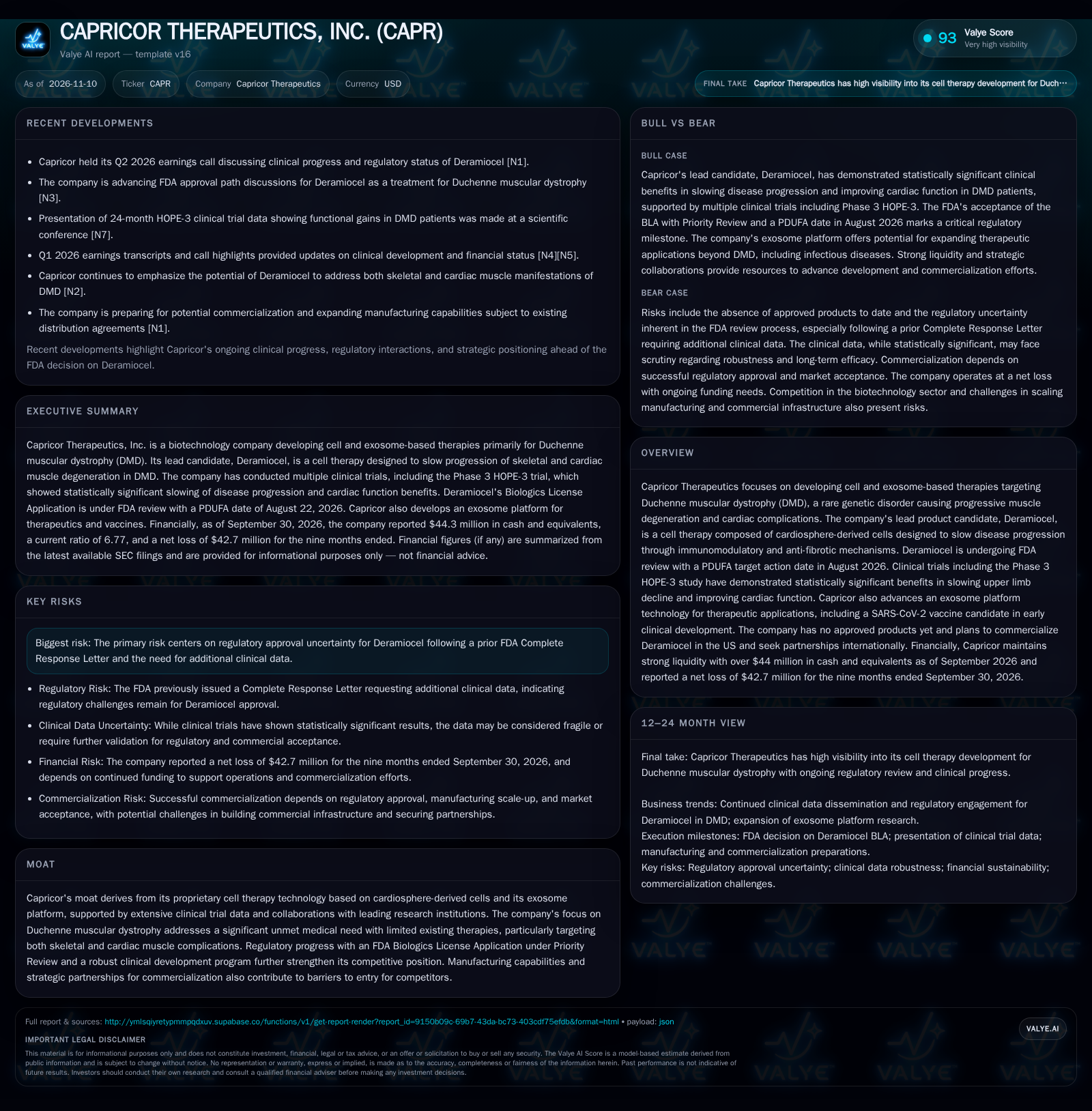
Capricor Therapeutics is advancing Deramiocel, a cell therapy for Duchenne muscular dystrophy, with statistically significant late-stage trial data and reported liquidity position ($44.3M cash as of September 2026). The company’s exosome platform and collaborations broaden future optionality, but regulatory approval and commercialization of Deramiocel remain critical value inflection points. Ongoing net losses and the need for further funding highlight execution risk even as clinical data and partnerships provide potential upside. [S2] [N3]
Capricor Therapeutics stands at a critical juncture, having delivered statistically significant late-stage results for its lead Duchenne muscular dystrophy therapy while preparing for the complex transition from clinical development to commercialization. With reported liquidity position and a differentiated exosome platform, Capricor has optionality beyond its flagship program. However, the company’s future hinges on regulatory approval for Deramiocel, the scalability of its manufacturing and commercial operations, and its ability to convert clinical promise into sustainable revenue. Upcoming FDA decisions and market adoption will determine whether Capricor’s scientific advances translate into durable business value.
Late-Stage Clinical Progress and Cash Reserves Define Capricor’s Present Position
Capricor’s lead asset, Deramiocel, produced statistically significant results in the HOPE-3 trial, slowing upper limb disease progression by 54% and left ventricular ejection fraction decline by 91% versus placebo, with additional evidence of reduced myocardial fibrosis and improved cardiac MRI metrics. This is a meaningful achievement in Duchenne muscular dystrophy (DMD), where cardiac complications are a leading cause of mortality and few therapies address both skeletal and cardiac muscle involvement. [N7]
Financially, Capricor reported $44.3 million in cash and equivalents, current assets of $202.3 million, and a current ratio of 6.77 as of September 30, 2026. Net loss for the first nine months of 2026 was $42.7 million. [S2]
The company is actively pursuing FDA approval for Deramiocel and preparing for potential commercialization, including manufacturing scale-up and commercial infrastructure expansion, subject to existing distribution agreements. [N3] [N1]
Commercialization Pathways and the Economics of Advanced Cell Therapies
Capricor’s business model revolves around creating value through successful clinical development, regulatory approval, and commercialization of cell and exosome-based therapies, with Deramiocel as the flagship. In rare diseases like DMD, pricing can be premium due to high unmet need and limited competition, but actual revenue realization depends on payer acceptance and the ability to scale manufacturing efficiently. If approved, Deramiocel could command orphan-level pricing, but the capital intensity of cell therapy manufacturing, distribution, and patient support is significant.
The company’s fixed costs are currently dominated by R&D and infrastructure build-out, with variable costs likely to rise as commercialization approaches. Manufacturing scale and process robustness are critical for margin expansion; in cell therapies, margins can initially be thin due to bespoke processes and regulatory compliance, but can improve with automation and process optimization.
Capricor’s exosome platform, while still in early clinical stages, offers the potential for pipeline diversification. However, without approved products or disclosed commercial agreements, the platform’s economics remain speculative. The company’s net losses and ongoing need for funding reflect the capital requirements and long development cycles typical of innovative biotech models.
The economics of advanced cell therapies like Deramiocel hinge critically on the ability to achieve manufacturing scalability while maintaining product consistency and regulatory compliance. Given the autologous or allogeneic nature of such therapies, production complexity often leads to high per-unit costs initially. However, if Capricor can successfully implement automated bioprocessing technologies and optimize supply chain logistics, the marginal cost per treatment could decrease substantially, improving gross margins. Moreover, reimbursement negotiations will likely depend on demonstrating clear clinical benefit and cost-effectiveness relative to standard of care, which may require robust health economics and outcomes research post-approval.
Targeting a Niche with High Barriers—and Intensifying Innovation
Capricor’s focus on DMD—especially the cardiac dimension—addresses a significant unmet need and creates a potential competitive moat, as few therapies meaningfully impact both skeletal and cardiac muscle function. The company’s cell therapy approach is differentiated from small molecule and gene therapy competitors, but must ultimately demonstrate superior or complementary outcomes to gain adoption.
Barriers to entry include complex manufacturing, regulatory know-how, and the need for robust clinical evidence. Capricor’s collaborations with leading academic and government institutions provide validation and potential access to expertise and non-dilutive funding.
However, the competitive landscape is dynamic. Gene editing, RNA-based therapies, and next-generation cell/exosome platforms represent both competitive threats and possible future partners. Large pharma companies could enter the DMD space with greater scale and commercial reach, potentially squeezing smaller players unless Capricor can lock in first-mover advantage or secure strong distribution partnerships.
Regulatory Success and Market Adoption Could Transform Capricor’s Scale
If Deramiocel secures FDA approval based on HOPE-3 data and Capricor executes a successful launch, the company could rapidly transition from clinical-stage to commercial-stage, with the potential for orphan-level pricing and global expansion. Early adoption by key neuromuscular and cardiology centers—especially if supported by real-world evidence of cardiac and functional benefit—would drive revenue inflection.
Exosome platform progress, particularly a successful proof-of-concept in infectious disease or other high-value indications, could further diversify revenue streams and attract strategic partners or acquirers.
Confirmation of this scenario would come from regulatory approval announcements, disclosed launch timelines, robust initial sales, payer coverage wins, and new development or commercial partnerships.
Incremental Progress Amid Regulatory and Commercial Uncertainty
The most plausible trajectory is a period of regulatory review for Deramiocel, with potential for additional data requests or post-marketing commitments from the FDA. Manufacturing and commercial preparations proceed in parallel but at a measured pace, with operating losses continuing until product approval and launch.
Capricor may secure initial approval in a subset of DMD or with label restrictions, requiring ongoing investment in post-marketing studies, real-world data collection, and payer negotiations. The exosome platform advances slowly, with further early-stage studies but limited near-term revenue contribution.
Evidence affirming this scenario would include modest, stepwise progress in regulatory milestones, continued R&D spend, and periodic capital raises to extend runway, but without transformative commercial or partnership announcements.
Regulatory Setbacks or Commercial Barriers Could Erode Value
An adverse scenario could materialize if the FDA requires additional pivotal data or delays approval of Deramiocel, which would extend the company’s timeline to market and increase funding needs. Fragility in the clinical data—such as lack of real-world reproducibility or safety concerns—could undermine confidence among regulators, payers, or prescribers.
Manufacturing or supply chain challenges, or failure to secure commercial partnerships, could limit launch capacity even if approval is granted. The exosome platform may fail to generate compelling clinical data or attract development partners, reducing optionality.
This scenario would be confirmed by FDA requests for new or larger studies, delayed or negative regulatory decisions, downward revisions to cash guidance, or announcements of workforce reductions and pipeline reprioritization.
Milestones That Will Shape Capricor’s Next Chapter
Regulatory feedback and FDA decision dates for Deramiocel will be pivotal in determining time-to-market and required further investment.
Updates on commercial manufacturing readiness—such as facility qualification, process validation, and supply chain robustness—would help test scalability.
Disclosure of pricing and reimbursement negotiations, if any, will clarify revenue potential and payer acceptance.
Early launch metrics, such as patient starts and prescriber adoption rates (if disclosed), would provide leading indicators of commercial traction.
Progress in exosome platform clinical trials, including data readouts or advancement to later stages, will test pipeline optionality.
Announcements of new or expanded strategic partnerships—especially with commercial distributors or large pharma—would validate Capricor’s go-to-market strategy.
Any reported safety signals, adverse events, or real-world efficacy data post-launch would affect both adoption and regulatory positioning.
Disclaimer: This is research-only, informational analysis and not investment advice. It may include AI-generated interpretation and general industry context. Always verify important details using primary sources.

Comments