
F&M Bank Corp: Regional Focus, Margin Expansion, and the Stakes of Branch Growth in Virginia Banking
F&M Bank Corp’s recent margin expansion and earnings growth highlight the underlying strength of its core community banking model, but rising credit provisions, cost pressures, and a concentrated regional footprint create a complex risk-reward profile as it seeks to extend its reach in Virginia.
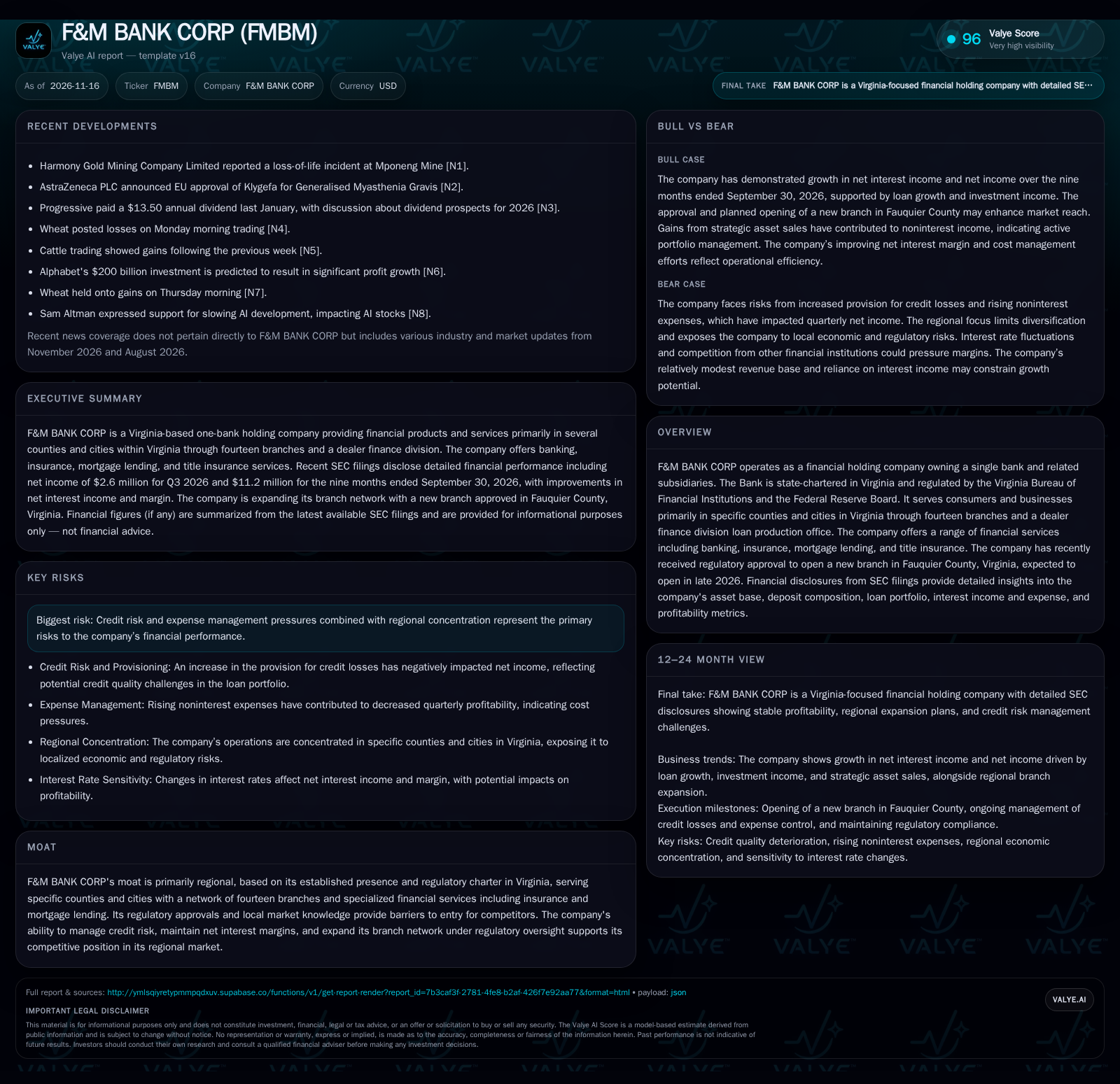
F&M Bank Corp reported improved net interest margin and year-to-date earnings, supported by loan growth and a strategic asset sale, while also facing higher credit loss provisions and noninterest expenses. The forthcoming Warrenton branch marks a key expansion step but exposes the bank to further regional concentration and execution risk. The critical question is whether margin gains and local scale can offset intensifying cost and credit pressures in a competitive, rate-sensitive environment. [S2]
F&M Bank Corp’s third quarter and year-to-date results show a community bank successfully expanding its net interest margin and growing earnings, largely on the back of loan and investment income and opportunistic asset sales. Yet, the same period brought a notable increase in provision for credit losses and a jump in noninterest expenses, tempering the bottom-line momentum. As the company prepares to open a new branch in Warrenton, Virginia, it faces both the opportunity of greater local market share and the risk of deepening its exposure to regional economic cycles. The next phase will test whether F&M’s margin gains and disciplined expansion can outpace the mounting pressures of credit risk, cost inflation, and competitive intensity. [S2]
Recent Earnings, Margin Expansion, and Strategic Moves Define the Current Backdrop
In the third quarter of 2026, F&M Bank Corp reported net income of $2.6 million ($0.74 per diluted share), with a return on average assets of 0.74% and return on average equity of 9.26%. Net interest income rose to $12.3 million, up from $10.5 million in the prior year quarter, and the net interest margin increased to 3.69%—a key signal of improved core profitability. For the first nine months of 2026, net income reached $11.2 million ($3.14 per diluted share), reflecting both loan growth and a $4.8 million gain on the sale of the company’s interest in Bearing Insurance, though partially offset by a $3.5 million loss on investment securities. Notably, the company received approval to open a new branch in Fauquier County, Virginia, expected in late 2026, marking a tangible step in geographic expansion. However, the quarter also saw a $994,000 increase in provision for credit losses and a $1.4 million rise in noninterest expenses, highlighting emerging credit and cost pressures. [S2]
Community Banking Economics: Margin Leverage, Cost Structure, and Funding Mix
F&M Bank Corp’s earnings are primarily driven by the spread between interest earned on loans and securities and interest paid on deposits and borrowings. The recent improvement in net interest margin to 3.69% suggests effective pricing discipline and possibly a favorable shift in asset mix or funding costs. The bank’s ability to reduce interest expense by shifting from higher-cost time deposits to lower-cost checking and money market accounts directly improved profitability. However, the business model remains highly sensitive to both local loan demand and the broader interest rate environment.
Noninterest income is a secondary but sometimes volatile contributor, as evidenced by the outsized gain from the sale of a non-core insurance asset. Such gains are not likely to recur regularly, and core fee income from insurance, mortgage, and title services may be limited by the regional scale. Operating leverage is challenged by rising noninterest expenses, which may reflect wage inflation, branch network costs, and technology investments typical of smaller banks seeking to remain competitive. The company’s modest long-term debt ($9.9 million at 7.71%) suggests low financial leverage but also indicates reliance on deposit funding for growth. Capital needs for new branch expansion and digital investments could increase if growth ambitions continue.
Regional Moat, Local Relationships, and the Threat of Substitution
F&M’s competitive position is anchored in its established local presence across several Virginia counties and cities, supported by regulatory approvals and community relationships. The planned Warrenton branch may deepen this moat, but also increases exposure to regional economic and demographic trends. In its core markets, F&M competes with other community banks, credit unions, and regional/national banks offering similar deposit and lending products. Larger banks may have technology and product breadth advantages, while fintechs and digital lenders increasingly offer substitutes for traditional loans and payments—potentially eroding F&M’s share of new, digitally inclined customers.
Switching costs for deposit and lending customers are generally low outside of relationship-based commercial lending and certain mortgage products, so retention depends on service quality, local knowledge, and pricing. The company’s ability to cross-sell insurance and mortgage products could support wallet share, but the effectiveness of these strategies is unclear without disclosed cross-sell or retention metrics. Regulatory oversight and a strong local reputation provide some barrier to entry for new competitors, but these advantages are not insurmountable if larger banks or digital players target the same markets.
Margin Strength and Branch Expansion Drive Sustainable Earnings Growth
A favorable scenario would see F&M leveraging its improved net interest margin, continued loan growth, and expanded product offerings to drive consistent earnings gains. The successful launch of the Warrenton branch could accelerate deposit and loan growth, especially if the bank is able to attract high-quality commercial and retail customers from less entrenched competitors. Ongoing optimization of deposit mix—further reducing reliance on high-cost time deposits—would help preserve or improve margins even if interest rates fluctuate.
Noninterest income could be supplemented by increased cross-selling of insurance and mortgage products, provided the bank can scale these offerings without significant incremental costs. If expense growth is contained—possibly by leveraging technology or achieving scale efficiencies from the expanded network—operating leverage could improve. Evidence for this scenario would include sustained net interest margin above 3.6%, above-peer loan growth, stable or declining efficiency ratio, and early profitability from the new branch. Conversely, margin compression, slow branch ramp, or continued cost inflation would challenge this thesis.
Incremental Growth Balances Margin Gains Against Rising Costs and Credit Risk
The most likely outcome is a continuation of modest earnings growth, with net interest income and margin gains partially offset by ongoing increases in noninterest expenses and periodic swings in credit provisioning. The new Fauquier County branch may contribute incrementally to deposits and loans, but is unlikely to materially shift the company’s overall growth rate or risk profile in the near term. Noninterest income will likely return to baseline levels absent further large asset sales.
The balance between loan growth, margin management, and expense control will be critical, especially in a competitive, rate-sensitive environment. Credit quality appears stable but bears watching, as recent increases in provision for credit losses suggest some emerging risk. Confirmation would come from steady net interest margin near current levels, manageable credit costs, and efficiency ratios that do not materially deteriorate. If loan growth slows, provision costs rise significantly, or expenses accelerate faster than revenue, the base case could be pressured downward.
Credit Deterioration and Cost Escalation Undermine Profitability
An adverse scenario would involve a marked deterioration in credit quality—potentially triggered by regional economic weakness or sector-specific shocks—leading to much higher provision for credit losses and possibly net charge-offs. Rising noninterest expenses, whether from wage inflation, compliance costs, or underperforming branch investments, could further compress earnings. If net interest margin contracts due to competitive pressure or adverse rate movements, profitability could erode quickly given the company’s modest scale.
Evidence for this scenario would include sharp increases in nonperforming loans, a spike in provision expense, net interest margin falling below 3.5%, and a sustained rise in the efficiency ratio. Early losses or weak performance at the new branch would further strain returns and capital. A slowdown in local economies or aggressive moves by larger banks and fintechs could accelerate these pressures.
Factors That Could Shift the F&M Bank Corp Thesis in the Coming Quarters
Net interest margin trends: Sustained expansion or contraction in margin will be a core indicator of pricing power and funding cost management.
Loan growth rates: Quarterly and annual loan origination and balance growth, especially in new and existing branches, will reveal competitive positioning and demand.
Provision for credit losses: Changes in the allowance and actual charge-off rates would signal underlying credit quality trends.
Noninterest expense trajectory: Monitoring wage, occupancy, and technology costs (if disclosed) will test whether operating leverage can be maintained.
Deposit mix evolution: Shifts between time deposits, interest-bearing checking, and money market accounts will impact funding costs and margin resilience.
New branch performance: Early deposit and loan growth, as well as profitability metrics from the Warrenton location (if disclosed), would help validate the expansion strategy.
Noninterest income composition: The level and sources of recurring versus one-time fee income, including insurance and mortgage, would clarify revenue stability.
Regional economic indicators: Local unemployment, real estate trends, and small business formation in F&M’s core counties and cities will influence loan demand and credit risk.
Disclaimer: This is research-only, informational analysis and not investment advice. It may include AI-generated interpretation and general industry context. Always verify important details using primary sources.

Comments