
Farmers & Merchants Bancshares Strengthens Credit Loss Management Amid Rising Market Rates
FMFG’s Q1 2026 report details conservative credit loss allowances on held-to-maturity securities reflecting adaptive risk management as interest rates rise.
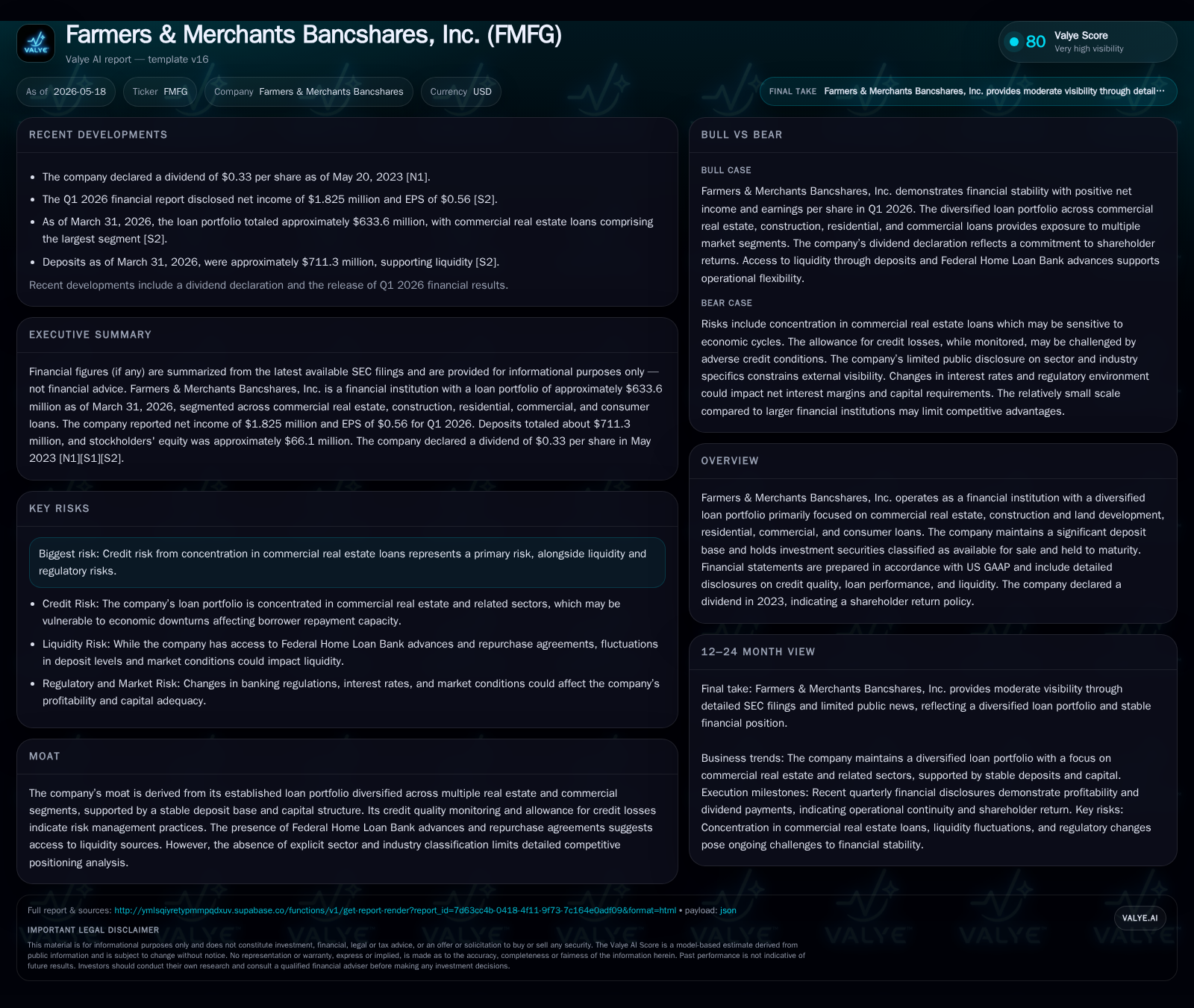
Farmers & Merchants Bancshares, Inc. reported in its May 2026 10-Q a prudent increase in allowance for credit losses on its held-to-maturity securities amid rising market interest rates, highlighting management's strategy to absorb unrealized losses without intending to sell. Its business model centers on a diversified commercial real estate and loan portfolio funded by a stable deposit base. The bank leverages robust credit monitoring, liquidity sources including Federal Home Loan Bank advances, and repurchase agreements to manage commercial real estate concentration risks. Key growth drivers include loan portfolio diversification and deposit stability while regulatory and credit concentration risks persist. Upcoming metrics to monitor include credit quality trends and capital adequacy amid evolving rate environments.
Latest Quarterly Operating Update: Adaptive Credit Loss Analytics
Farmers & Merchants Bancshares’ Q1 2026 10-Q reveals an increase in the allowance for credit losses on held-to-maturity securities from $79 thousand to $88 thousand compared to the prior year period [S2]. This contra-asset valuation accounts for expected credit losses measured collectively by security type based on historical data adjusted for current economic conditions and forward-looking forecasts. The firm explicitly states no intent to sell these securities before recovery of amortized cost despite the unrealized losses caused by rising market interest rates since purchase dates [S2]. These losses remain unrealized within equity and indicate a prudent credit loss policy designed to absorb potential mark-to-market volatility without triggering forced sales.
This disciplined approach reflects robust risk management as higher interest rates build latent impairment but do not yet translate into realized accounting losses. It underscores FMFG’s commitment to holding quality assets through economic cycles while aligning loss reserves with evolving risk profiles.
Business Model Overview: Balanced Portfolio and Risk Focus
FMFG operates primarily as a community-oriented financial institution generating revenue through net interest income on its diversified loan portfolio supported by a significant deposit franchise [S1]. The loan book totaled approximately $633.6 million at March 31, 2026 spread across commercial real estate ($432.8M), construction/land development ($32.3M), residential ($119.2M), commercial ($49.2M), and minimal consumer loans [S18]. Interest income is driven by lending spreads influenced by borrower credit risk pricing and loan volume growth.
The deposit base of over $711 million consists mostly of interest-bearing accounts with a core deposit component underpinning low-cost stable funding, critical for margin preservation in a competitive banking environment [S24]. FMFG monitors credit quality closely with segmentation allowing tailored allowance estimates across loan types, enhancing early identification of deterioration risks [S1].
Industry Context: Commercial Real Estate Lending Dynamics
The focal point of FMFG’s business—commercial real estate (CRE) lending—faces inherent cyclical risks tied to property valuation fluctuations impacted by economic conditions and interest rate environments [S27]. CRE loans carry repayment risk from tenant cash flow disruptions or property value declines diminishing collateral coverage. Construction and land development lending adds execution uncertainty relating to project timelines, budget adherence, and contractor viability.
Within this sector landscape, FMFG employs rigorous underwriting standards including loan-to-value limits generally capped at 80% for CRE loans and obtaining personal guarantees where necessary [S27]. The importance of maintaining adequate allowance for credit losses is underscored by the volatile macroeconomic climate which can stress borrower payment capacity.
Liquidity dynamics are supported partly by access to Federal Home Loan Bank advances totaling approximately $62.7 million alongside repurchase agreements near $3.5 million; these facilities provide essential flexibility amid shifting funding demands [S24]. Regulatory scrutiny over capital buffers remains a constant backdrop demanding continuous balance sheet vigilance.
Competitive Positioning and Product Quality
While detailed peer comparisons are absent, FMFG’s financial disclosures suggest a defensible position grounded in conservative capitalization, well-segmented allowances for credit risk, and diversified yet focused portfolio allocation [S1][S2][F1]. Its conservative stance towards unrealized bond portfolio losses without forced sales enhances intrinsic stability relative to banks compelled toward mark-to-market volatility realization.
Product quality appears sound given maintained underwriting discipline across CRE segments and relatively low past due levels reported as of March 2026 [S18]. The combined use of FHLB advances and repurchase agreements signals effective liquidity management consistent with community bank best practices.
Growth Drivers: Loan Portfolio Diversification and Deposit Stability
FMFG’s business growth is anchored in expanding secured lending exposures within real estate-related segments alongside sustained retention of core deposits which underpin margin resilience [S1][S2]. Diversification within the loan portfolio mitigates sector-specific downturn vulnerability; for example, construction loans correlate with local economic expansions supporting new developments.
Deposit growth—especially noninterest-bearing components—is indicative of community trust and stable funding sources aiding net interest margins despite competitive pricing pressures [S24]. Loan demand is sensitive to regional economic trends influencing commercial development activity.
Risks and Headwinds: Credit Concentration and Regulatory Pressures
Credit risk concentration in commercial real estate remains the key risk vector due to exposure size relative to total assets [S26][S27]. Economic downturns or unexpected shocks that reduce property valuations could strain collateral coverage leading to potential charge-offs if borrower payment capacity weakens.
Liquidity risks linked to repurchase agreements require ongoing prudence due to their short-term nature; unexpected withdrawal or repricing challenges could pressure funding costs [S24]. Regulatory frameworks increasingly mandate conservative capital buffers especially for community banks with concentrated portfolios subject thus far to effectively managed but watchful oversight.
Market volatility driving unrealized bond pricing losses poses a supplementary risk—while currently unrecognized in earnings due to management's hold intent policy, prolonged adverse conditions could test reserve adequacy [S2][S28]
What to Watch Next: Credit Metrics, Interest Rate Trends, and Capital Position
Key milestones ahead involve monitoring Q2 updates on delinquency ratios across segmented loan portfolios—especially commercial real estate—and any revisions to the allowance for credit losses reflective of evolving macro-financial conditions [S2][S3]
Interest rate trajectory will materially affect both unrealized security valuations and deposit beta responsiveness impacting net interest margins. Commentary on usage or repayment behavior regarding Federal Home Loan Bank advances will provide insight into liquidity strategy execution amid market fluctuations.
Management’s guidance or disclosed outlook on provision expense balances versus actual charge-offs will serve as crucial indicators of portfolio health under stress scenarios.
Financial Snapshot: Current Liquidity and Leverage Overview
As of March 31, 2026, FMFG reported total debt of approximately $12 million offset against available cash holdings resulting in net debt around negative $0.57 million indicating moderate leverage usage balanced with ample liquidity reserves [F1][S24]. Deposits totaled over $711 million underpinning asset funding alongside secured borrowings including FHLB advances ($62.7 million) and repurchase agreements ($3.5 million) providing structural funding diversity.
Allowance for credit losses on loans stood at approximately $4.46 million against the $633.6 million loan book suggesting cautious reserve coverage reflecting prevailing risk assessments [S18]. The dividend policy disclosed in prior filings implies an ongoing shareholder return focus consistent with sustainable earnings generation capacity [S1].
The financial profile shows FMFG positioned conservatively with manageable leverage ratios facilitating nimble responses to market conditions while supporting organic portfolio growth opportunities.
This analysis synthesizes the latest publicly filed disclosures from Farmers & Merchants Bancshares, Inc., focusing solely on documented operating facts without investment research views or speculative forecasts.
Disclaimer: This is research-only, informational analysis and not investment advice. It may include AI-generated interpretation and general industry context. Always verify important details using primary sources.

Comments