
FingerMotion's Telecom Revenue Decline Spurs Shift Toward Platform Solutions Amid Tight Liquidity
In fiscal 2026, FingerMotion saw a steep 32% revenue decline in its core telecommunications business, prompting strategic reallocation to technology-driven platforms alongside rigorous cost controls amid constrained cash resources.
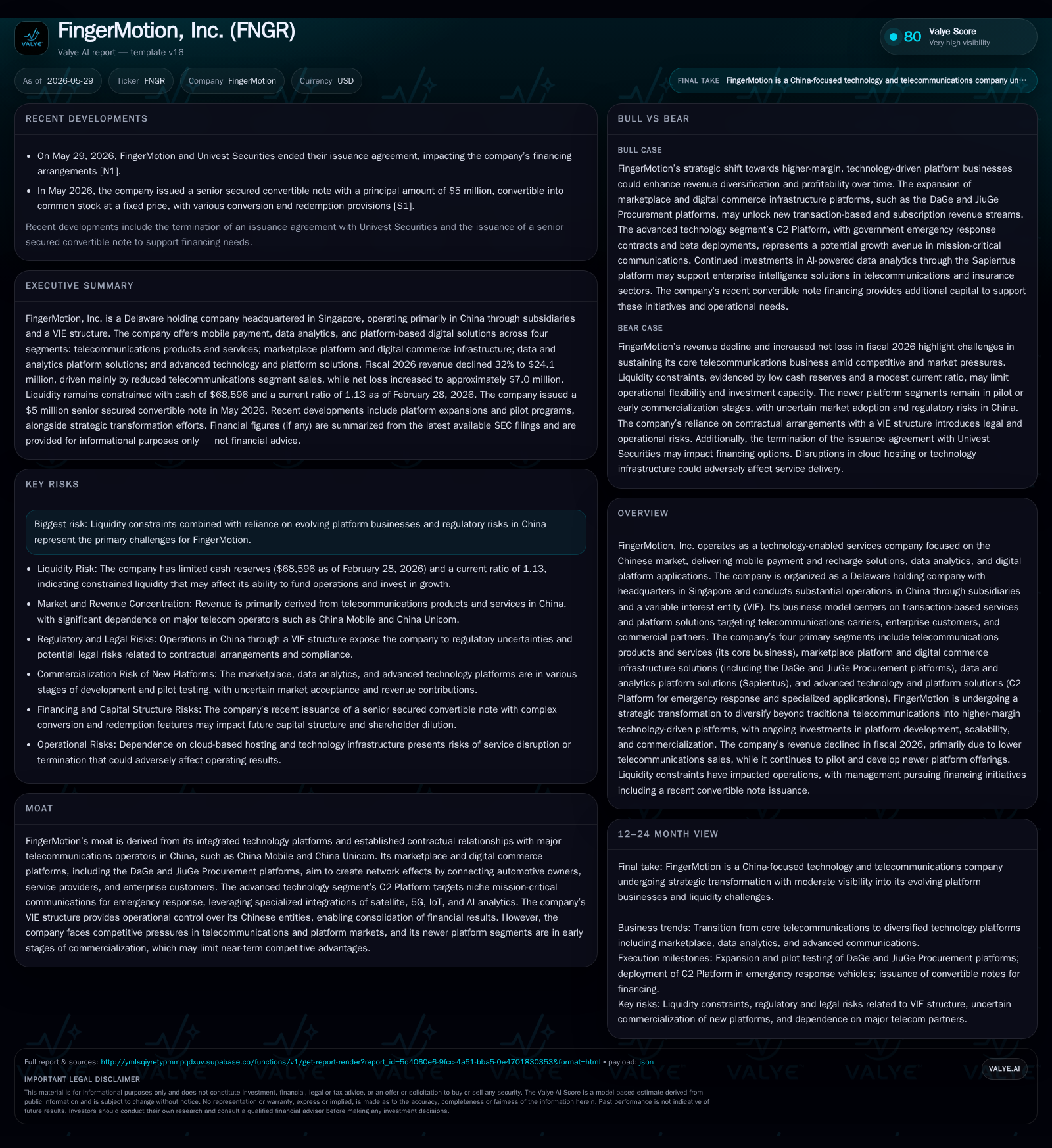
FingerMotion’s latest filings reveal a pronounced contraction in its traditional telecommunications segment, driving a pivot to higher-margin platform businesses such as marketplace solutions, data analytics, and advanced communications. Despite cost reductions, the company faces liquidity pressures with cash reserves under $70,000 at fiscal year-end 2026, requiring ongoing financing efforts. The business operates primarily in China via VIE structures with major telecom partners but must navigate competitive and regulatory challenges while scaling nascent platform initiatives.
Latest Operating Update
FingerMotion’s Q3 fiscal 2026 results (period ended November 30, 2025) alongside full fiscal year data ending February 28, 2026 demonstrate significant operating shifts. Annual revenue declined by approximately $11.48 million or 32%, driven primarily by contraction in the Telecommunications Products & Services segment due to capital constraints that limited transaction volumes on mobile recharge and related services [S3][F1]. The Q3 quarter also reflected a 32% drop in telecom revenue to $5.76 million compared to the prior year period [S16].
On expenses, the company achieved a nearly $1.08 million or 12% reduction year-over-year through disciplined cost management. General and administrative expenses decreased by 22%, marketing costs were cut by 70%, and research & development expenditures dropped by 35%, reflecting stringent liquidity controls [S3][S6]. Despite these savings, net losses increased by about 37% as revenue declines outpaced expense reductions [F1].
The company held cash and equivalents of approximately $68,600 as of February 28, 2026. The current ratio of approximately 1.13 indicates working capital sufficiency is minimal without additional funding sources [F1][S5]. To address this shortfall, FingerMotion issued convertible notes totaling $5 million with favorable conversion terms and continued equity sales via an ATM offering program [S4][S7].
Business Model Overview
FingerMotion operates as a Delaware holding company headquartered in Singapore with substantial operations in China conducted through subsidiaries and contractual arrangements with a variable interest entity (VIE). This structure enables consolidated financial reporting despite restrictions on foreign ownership within China’s telecommunications sector [S1].
The core business provides transaction-based mobile payment and recharge services primarily for major Chinese telecom operators China Mobile and China Unicom. These offerings include mobile top-ups, data plans, subscription services, and value-added messaging solutions integrated into carrier networks under long-term agreements.
Complementing this are emerging platform businesses:
- Marketplace Platform & Digital Commerce Infrastructure: Includes DaGe (an O2O automotive service marketplace) and JiuGe Procurement (a B2B procurement workflow platform). Monetization derives from transaction fees, subscriptions, advertising, and ancillary digital services.
- Data & Analytics Platforms: Branded Sapientus, offering AI-driven enterprise intelligence solutions targeting sectors like insurance and finance leveraging telecom data.
- Advanced Technology & Platform Solutions: The C2 Platform focuses on mission-critical real-time communications integrating satellite connectivity, IoT devices, AI analytics, and emerging technologies such as 5G.
This diversification aims to transition revenue mix toward higher-margin technology platforms beyond legacy telecom resale subject to pricing pressure and volume cyclicality.
Industry Context & Competitive Positioning
Operating at the nexus of telecom reseller services and digital platform innovation within China’s regulated environment presents both opportunities and challenges. FingerMotion’s competitive advantage stems from established contractual relationships with leading Chinese carriers ensuring network access critical for mobile recharge services combined with proprietary platforms fostering ecosystem effects.
Nevertheless, competition is intense from large-scale telecom aggregators focused on volume execution and emerging cloud-based unified communication providers advancing AI-powered analytics solutions within a complex regulatory landscape.
Capital intensity required for pre-funding telecom transactions imposes working capital strains while expanding platform segments require sustained investment in technology upgrades, user acquisition initiatives, regulatory compliance efforts, and ecosystem partnerships against better-capitalized rivals or vertically integrated incumbents.
Growth Drivers
- Platform Commercialization: Scaling DaGe’s O2O automotive marketplace enhances digital commerce adoption among vehicle owners; JiuGe’s procurement solution targets enterprise supply chain digitization increasing customer stickiness.
- Data Analytics Expansion: Sapientus delivers differentiated AI analytics aligned with growing demand for telecom data insights within insurance/financial verticals enabling monetization beyond pure transaction fees.
- Advanced Communications Development: The C2 Platform targets niche real-time communication markets including emergency response leveraging converged satellite/IoT connectivity.
- Strategic Acquisitions & Regional Expansion: Pursuit of acquisitions that add complementary IP or customer bases alongside market entry efforts into Southeast Asia (Indonesia/Thailand) diversify geographic risk exposures [N1][S4].
- Operational Efficiency: Cost discipline improves cash flow adaptability; enhanced collections and payment term optimization sustain transaction business capacity.
Risks & Watchpoints
- Liquidity Constraints: Sharply reduced cash reserves elevate risk of operational disruption absent access to new financing; ongoing capital market access is critical.
- Regulatory Risks: PRC oversight of VIE structures poses legal uncertainties potentially affecting operational control mechanisms and revenue recognition consistency.
- Platform Adoption Uncertainty: Early-stage platforms generate modest revenues; failure to achieve sustainable growth limits strategic diversification benefits.
- Competitive Pressures: Larger domestic players or cloud providers may erode margins or market share given FingerMotion’s relatively smaller scale.
- Revenue Concentration & Cyclicality: Heavy reliance on telecommunications contracts exposes revenues to cyclical fluctuations intensified by macroeconomic factors.
What To Monitor Next
Key indicators include:
- Trends in telecommunications transaction volumes reflecting recovery or further decline under liquidity constraints;
- Revenue progression from DaGe marketplace and JiuGe procurement signaling user engagement and monetization effectiveness;
- Expansion of Sapientus analytics deployments across targeted sectors;
- New contract wins or geographic expansion developments particularly in Southeast Asia;
- Financing activity updates evidencing improved liquidity through debt or equity issuances;
- Expense management trends balancing cost control with necessary innovation investments;
- Regulatory developments impacting VIE compliance or consolidation practices.
Financial Summary Highlights for Fiscal Year Ended February 28, 2026:
- Revenue totaled approximately $24.13 million down from $35.61 million the prior year reflecting broad weakness in core telecom operations [F1][S3].
- Operating loss widened to about $6.94 million; net loss attributable increased to roughly $7.04 million underscoring profitability pressures amid strategic transition [F1].
- Cash reserves were approximately $68,600 constraining operational flexibility; however current assets exceeded liabilities resulting in a current ratio near 1.13 indicating limited short-term solvency buffer [F1][S5].
- Total debt was modest at an estimated $66,000 based on best-effort current data without materially impacting leverage concerns relative to liquidity challenges given low net debt position [F1].
- Cost savings have partially offset revenue declines but significant operating losses persist reflecting contraction in legacy volumes compounded by slow ramp-up of platform contributions [S3][S6].
Disclaimer: This analysis is based exclusively on cited SEC filings through May 29, 2026; it is intended solely for informational purposes providing an informed perspective on FingerMotion’s recent operational developments and strategic positioning rather than investment advice.
Disclaimer: This is research-only, informational analysis and not investment advice. It may include AI-generated interpretation and general industry context. Always verify important details using primary sources.

Comments