
FOXO Technologies Confronts Capital Access Challenges While Advancing Rural Healthcare and Biospecimen Services
The company’s latest quarter highlights pressing liquidity constraints and regulatory hurdles amid expansion in rural hospital operations, behavioral health services, and biospecimen sourcing.
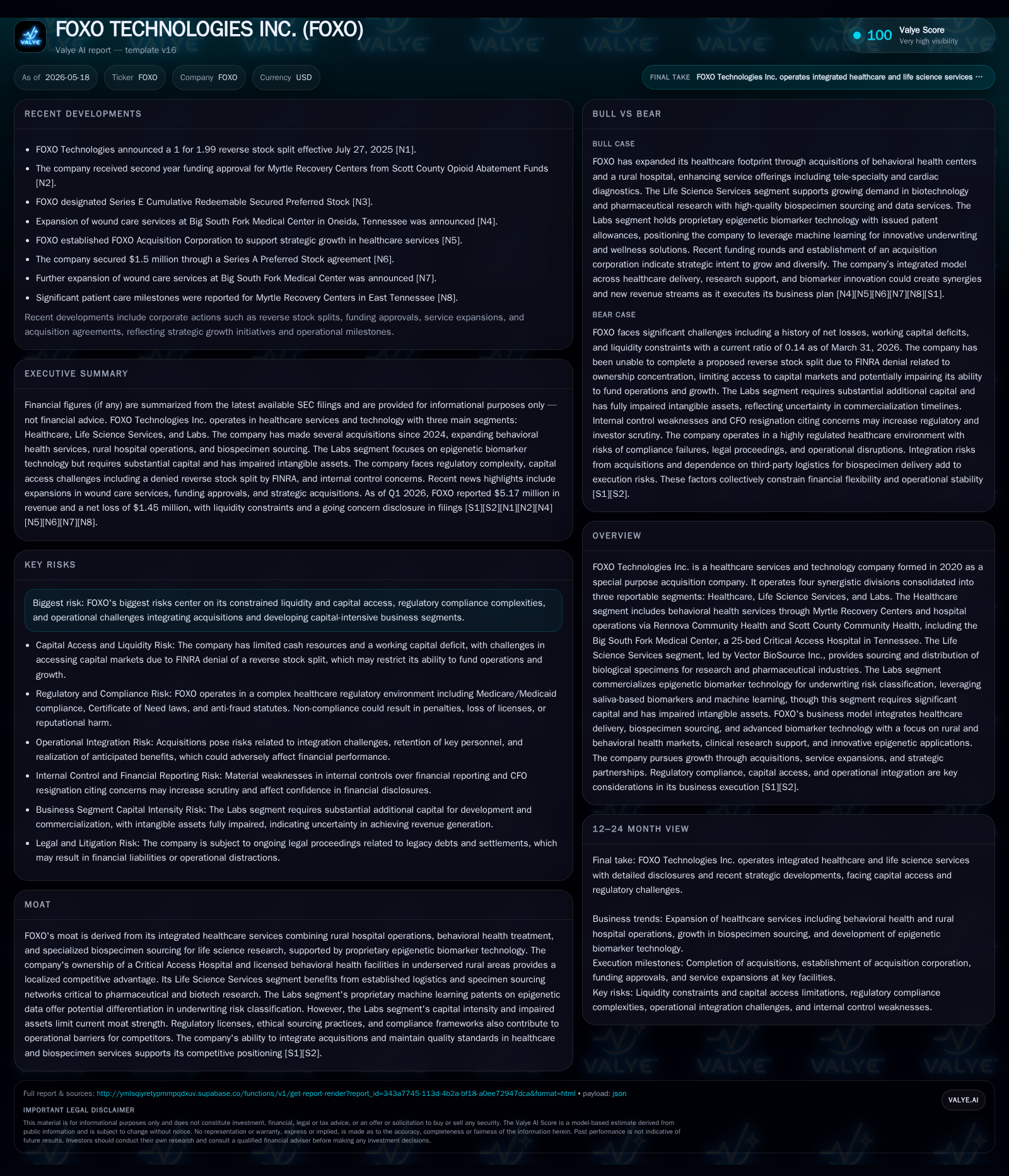
FOXO Technologies Inc. reported persistent capital access issues in its most recent quarterly filing, including FINRA’s denial of a proposed reverse stock split essential for raising additional financing. Despite these constraints, FOXO continues to develop its integrated business model comprising rural healthcare delivery, behavioral health services, life science biospecimen sourcing, and early-stage epigenetic labs. The company’s ownership of a Critical Access Hospital and established biospecimen logistics anchors a unique but capital-intensive niche in underserved markets. Major risks center on liquidity shortfalls, regulatory complexities, and integration execution risks. Upcoming milestones include resolution of the reverse split appeal and new capital raises critical for operation funding.
Recent Operating Update
FOXO Technologies’ latest quarterly 10-Q filing dated May 15, 2026 [S2] reveals critical near-term challenges centered on failed approval from FINRA regarding a proposed reverse stock split essential to raising additional capital. The Department of Market Operations denied processing citing an ongoing SEC civil action against a major institutional investor holding Series A Preferred Stock that would effectively concentrate ownership post-conversion at approximately 95%. FOXO filed an appeal with the Uniform Practice Code Committee subcommittee but received a final determination affirming the denial on April 30, 2026 [S15]. This regulatory barrier restricts FOXO’s ability to access its $5 million equity line under existing agreements, materially impacting liquidity and threatening its operational runway.
Alongside this capital challenge is executive turnover with the resignation of the CFO during Q1 2026 (citing internal control concerns), potentially heightening scrutiny on financial reporting practices [S15]. CASH & equivalents were only $65,896 as of March 31, 2026 with a stark current ratio of approximately 0.14 due to current liabilities exceeding $31 million against current assets around $4.5 million [F1]. This snapshot portrays acute working capital pressure requiring urgent financing or operational adjustments.
Operationally, FOXO advanced clinical capabilities at Big South Fork Medical Center (its critical access hospital in Tennessee) by introducing tele-specialty services and cardiac diagnostics early 2026—an initiative aimed at enhancing rural healthcare delivery [S12,S23]. The company also increased authorized common shares significantly earlier in the year (up to over 25 billion shares) reflecting efforts to improve capitalization flexibility
Business Model
FOXO Technologies is structured into three reportable segments serving interconnected yet distinct aspects of healthcare and life science innovation:
Healthcare Segment: Primarily consists of Myrtle Recovery Centers offering residential/inpatient/outpatient behavioral health services focusing on substance use disorders; Rennova Community Health holding Scott County Community Health (Big South Fork Medical Center) operating as a Critical Access Hospital with emergency services and ancillary diagnostics.
Life Science Services Segment: Led by Vector BioSource Inc., this segment sources high-quality biological specimens—including tissue samples, blood derivatives, living cells—from third-party hospitals and laboratories worldwide to supply pharmaceutical research, biotechnology firms, diagnostic developers, and clinical research organizations.
Labs Segment: Focuses on commercializing saliva-based epigenetic biomarker technology combined with machine learning models intended for life insurance underwriting risk classification. This segment offers a less invasive alternative to traditional blood or urine tests for health wellness insights.
Revenue mechanics vary by segment [S13,S20]. Healthcare generates revenue primarily through reimbursement for patient care services billed to private payers, Medicare/Medicaid programs, managed care organizations (MCOs), and third-party insurers—pricing influenced by treatment volume, payer mix shifts toward government payers (which tend to be lower reimbursing), service mix changes such as expansion into telehealth specialty consults, and patient acuity metrics
Life Science Services earns funds from specimen sales/contracts where pricing depends on specimen rarity/type bundled with logistics execution quality/turnaround time—volume fluctuates based on availability of specimens at partner institutions influenced by external testing trends and regulatory constraints governing collection protocols [S1]
Labs remains nascent with minimal current revenue; it relies on licensing or service contracts for epigenetic data analysis but must secure additional capital to fund R&D commercialization pipelines [S21]. Margins here could improve markedly if technology transitions from impaired asset stage to scalable product offerings supported by proprietary machine learning patents issued by USPTO
Industry Structure and Competitive Position
FOXO occupies a specialized position bridging rural healthcare delivery with life science specimen sourcing and emerging biotechnology diagnostics.
In the rural hospital arena, Critical Access Hospitals like Big South Fork provide essential inpatient/residential care often supported by government programs due to remote locations lacking alternatives. These facilities operate under stringent reimbursement frameworks with capped bed capacities (25 beds here) but face limited competition locally due to geographic isolation—a structural moat but one sensitive to reimbursement policy changes and staffing constraints.
Behavioral health services through Myrtle target an expanding treatment category driven by rising societal mental health awareness but characterized by high regulatory oversight around treatment standards coupled with reimbursement complexities. Behavioral health providers often compete regionally with other clinics or outpatient centers; FOXO benefits from combining inpatient/residential facilities aligned with hospitals fostering integrated care models.
Within Life Science Services, Vector benefits from established specimen sourcing networks crucial to research pipelines—competition includes large specimen banks or proprietary sample collections held by established CROs or biopharma-linked entities. VARIABILITY in specimen availability given dependence on third-party operations creates supply uncertainty acting as both barrier-to-entry for new players and risk factor here [S1].
Epigenetic Labs compete in early-stage biomarker tech targeting insurance underwriting disruption—a niche within biotech heavily reliant on IP strength (machine learning patents held), accuracy validation via clinical trials, regulatory compliance around lab certifications (e.g., CLIA), and data privacy measures. Failure limits operational continuity.
- Regulatory Setbacks Including FINRA Denial Impacting Reverse Stock Split Ability: This blocks access to critical equity lines restricting financial flexibility needed to scale Labs or expand hospital capabilities further [S15].
- Integration Complexity Across Multiple Acquisitions: Behavioral health centers & hospital operation teams require efficient consolidation; missteps could drive cost overruns or service disruptions hurting reputation & revenues [S16].
- Litigation & Compliance Exposures: Historic whistleblower suits under False Claims Act laws regarding billing procedures impose litigation risk plus increasing oversight after CFO exit possibly intensifying audit costs or financial restatements affecting market trust levels [S13,S24,S25].
- Dependency on Third-Party Partners for Specimen Collection: Vector cannot fully control specimen supply subjecting Life Science Services revenue streams to external fluctuations limiting order fulfillment reliability [S1,S18].
- Commercialization Timeline Risk in Labs Segment: Capital-intensity paired with full impairment of intangible labs assets indicates uncertainty around monetization schedules demanding strategic capital injections or partnerships/sales alternatives [S21].
What To Watch Next
- Resolution timeframe & outcome of FINRA reverse stock split appeal as it governs immediate access to equity financing channels [S15].
- Alternative recapitalization strategies announced or executed if appeal fails including possible debt restructurings or new equity issuances.
- Clinical & operational progress metrics at Big South Fork hospital monitoring inpatient volumes post tele-specialty launch plus cardiac diagnostic uptake.
- Patient census growth trends & payer mix evolution within Myrtle Recovery behavioral programs indicating sustainable revenue base development.
- Collaborations or partnership announcements related to Labs epigenetics technology commercialization as proxies for product-market fit advancements.
- Ongoing transparency improvements in financial controls responding post-CFO resignation audits aiding investor confidence rebuilding efforts.
Financial Profile Snapshot: Latest Quarter Ended March 31, 2026
FOXO exhibits strained liquidity defined by cash reserves barely above $65K amidst significant current liabilities exceeding $31 million resulting in a critically low current ratio near 0.14 illustrating acute short-term funding gaps [F1]. No explicit updated debt figures post-September 2022 are available but prior total debt approximated $2.9 million positioned alongside cash equates roughly to net debt slightly above $2.85 million implying moderate leverage though overshadowed by working capital imbalances.
Profitability remains negative reflecting accumulated operating losses exceeding $10 million annually last reported period alongside net losses above $12 million reaffirming ongoing burn rates outpacing revenue generation capacity necessitating strategic financing commitments imminently [F1]. Revenue last reported was approximately $16.4 million weighted toward healthcare service reimbursements offset partially by expenses linked to integration efforts and R&D expenditures within Labs segment.
This analysis is based exclusively on publicly filed documents as specified without reliance on unpublished or speculative information. It neither constitutes investment advice nor investment solicitation but aims to provide an informed industry perspective grounded in audited filings and verified disclosures.
Disclaimer: This is research-only, informational analysis and not investment advice. It may include AI-generated interpretation and general industry context. Always verify important details using primary sources.

Comments