
Foxx Development Holdings Charts Growth Through Strategic Market Presence and Product Innovation
Foxx's latest quarterly filing highlights operational resilience through geographic expansion and product innovation despite liquidity challenges.
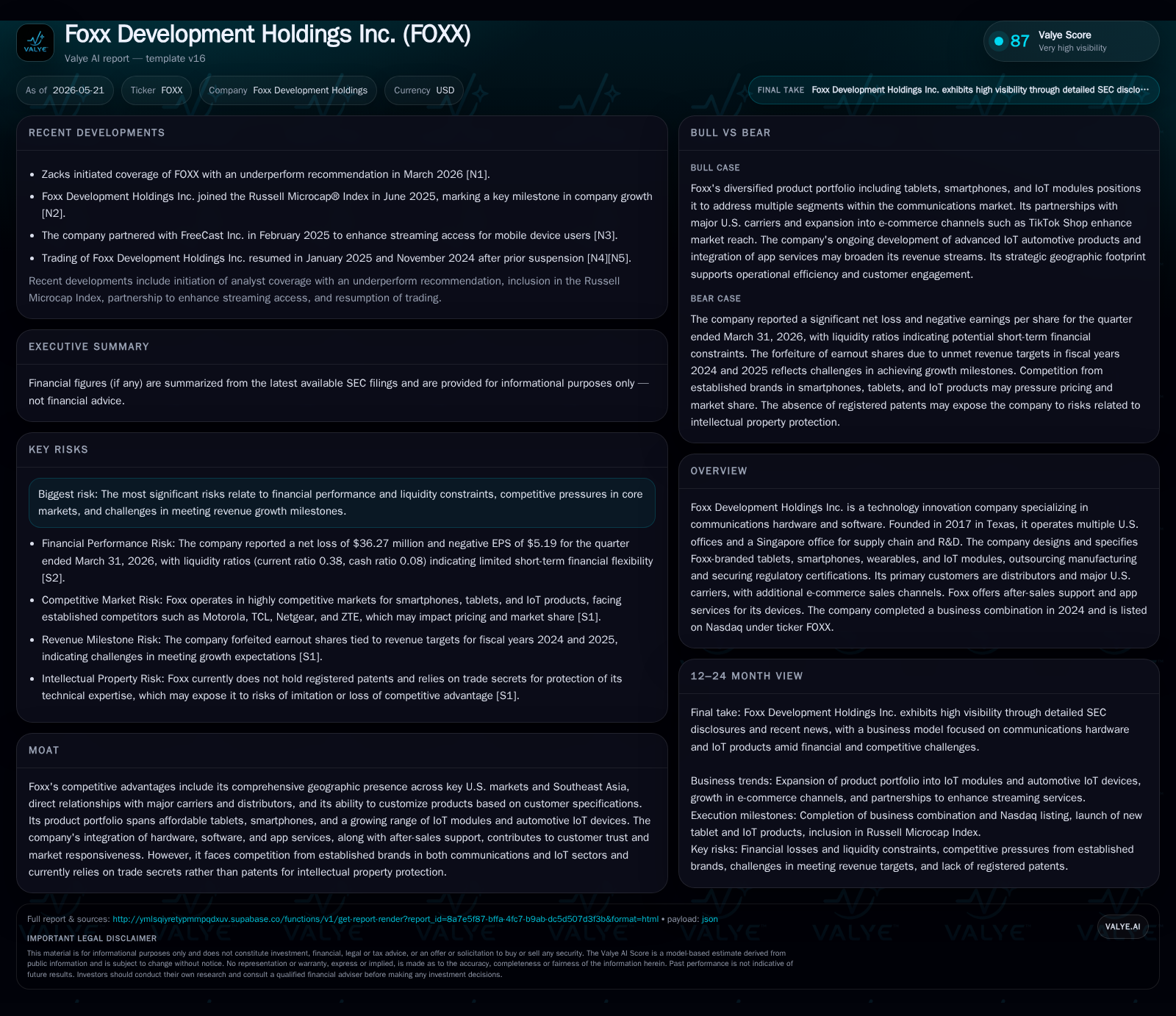
In its most recent quarterly report, Foxx Development Holdings demonstrated continued strategic focus on expanding its distribution network and product portfolio within the communications hardware sector. The company leverages a build-to-order model, strong relationships with major U.S. carriers and distributors, and diversified supply chain operations centered in Southeast Asia to maintain competitive positioning. While liquidity remains tight due to current liabilities surpassing current assets, Foxx is actively pursuing growth through increased direct-to-consumer ecommerce presence and new IoT product launches, signaling potential for recurring revenue streams. Investors should monitor execution on revenue milestones tied to earnout shares and supply chain agility as key indicators of ongoing financial health and market traction.
Latest Quarterly Operating Update Reflecting Market and Financial Dynamics
Foxx Development Holdings' latest quarterly filing dated May 20, 2026, revealed ongoing operational continuity without introducing new risk factors [S2]. The company holds approximately $3.19 million in cash and equivalents at quarter-end while maintaining a very low total debt balance near $79,000 [F1]. Nevertheless, the balance sheet shows current liabilities significantly outweighing current assets, resulting in a constrained current ratio of 0.38 [F1]. This juxtaposition suggests tight near-term liquidity despite conservative leverage metrics.
While specific revenue data for the quarter is not detailed in the filing, available historical revenue for fiscal year ended June 30, 2025 was around $65.9 million [F1]. The notably negative operating income from that period indicates ongoing investment in scaling operations or margin pressures. However, absence of new risk disclosures signals management confidence in navigating immediate financial challenges.
Business Model and Product Portfolio Quality: Integrated Communications Solutions
Foxx operates primarily as a technology innovator within the communications equipment sector by designing hardware and software specifications which it outsources to original design manufacturers (OEMs) [S3][S4]. Its core offering comprises Foxx-branded tablets, smartphones, wearables, and increasingly diversified Internet of Things (IoT) modules including cellular communication variants like LTE Cat M/NB-IoT and emerging 5G technologies [S14][S19].
The build-to-order model allows Foxx to accept bulk purchase orders from distributors—who then resell via major U.S. carriers such as Verizon, AT&T, and T-Mobile—balancing inventory costs with demand variability [S4][S5]. Products are competitively priced after factoring in costs related to R&D investments, regulatory compliance (FCC certifications), testing services, shipping logistics, and aftermarket support [S3].
Foxx also operates a direct-to-consumer E-Commerce channel launched in early 2024 through platforms like TikTok Shop alongside other digital retail outlets such as Amazon and Walmart.com [S5]. Complementing hardware sales is an App Service business line providing pre-installed applications sourced from third-party developers facilitating better end-user engagement [S3][S19]. This integration across hardware-software-service layers strengthens customer lock-in through embedded ecosystem offerings.
Geographic Footprint and Competitive Position Within Communications Hardware Sector
The company maintains a strategically dispersed domestic U.S. footprint with offices located in key metropolitan areas including Irvine (headquarters), San Francisco, Dallas, Atlanta, Los Angeles, Miami, and New York City [S3][S5]. This network underpins combined sales functions, retail presence, distribution logistics, after-sales support, as well as dedicated research & development units highly focused on customization capabilities.
Internationally, Foxx’s Singapore office plays a crucial role managing its Southeast Asian supply chain operations while also housing localized R&D resources which enhance responsiveness to regional manufacturing partners primarily based in Indonesia and neighboring countries [S5][S24]. This global presence serves as both a logistical advantage reducing lead times in production cycles and as a point of proximity to vital component suppliers.
Though the broader communication device market has entrenched incumbents like Motorola or TCL for smartphones/tablets and Netgear or ZTE for IoT products [S18], Foxx’s niche lies in tailoring solutions directly aligned to carrier specifications with agility enabled by its build-to-order approach. This contributes to incremental moat creation through customer intimacy absent among larger generic manufacturers.
Supply Chain Management and Customer Relationships Driving Operational Resilience
Foxx’s ability to balance supply-demand dynamics derives from established relationships with multiple Southeast Asian suppliers coupled with strategic logistics optimization allowing cost containment without sacrificing speed or quality controls [S24]. Stringent quality assurance processes ensure raw material sourcing to final product testing meets reliability standards critical for telecommunications devices where brand reputation is tightly linked to performance consistency.
Direct feedback loops established with distributors and carriers act as real-time market barometers informing product design iterations or launch timing adjustments [S4]. By maintaining closer-than-average touchpoints with frontline customers purchasing large volumes, Foxx can pivot new models or features promptly addressing emergent consumer preferences or regulatory shifts.
Key Growth Drivers: End-User Expansion, Product Mix Optimization, and Recurring Revenue
Growth strategies revolve around deepening penetration into end-user markets by nurturing existing distributor/carrier partnerships while incrementally adding new accounts [S4]. Simultaneously Foxx aims to expand its product mix towards higher-margin offerings such as wearables and IoT modules notable for recurring app service revenues rather than one-off device sales alone.
E-Commerce channels contribute an important incremental path widening addressable markets beyond traditional retail environments—a strategy realized through platforms like TikTok Shop since March 2024 which caters to younger demographics adept at mobile commerce [S5]. Further expansion into multi-channel digital marketplaces including Amazon supports scale efficiencies leveraging Foxx’s integrated marketing capabilities.
New launches slated for late 2025 include LTE-based outdoor security cameras alongside automotive-targeted IoT solutions like dash cams equipped with real-time LTE connectivity plus jump starters incorporating smart tracking functionalities—each aimed at capturing burgeoning demand within smart home security ecosystems and connected vehicle segments respectively [S14][S17]. These will enable cross-selling opportunities linking device sales with software-driven data services thereby boosting customer lifetime value.
Risks and Constraints: Liquidity Challenges, Competitive Pressures, and Revenue Milestone Risks
Despite diversified revenue streams, liquidity remains a critical constraint highlighted by Foxx’s low current ratio at 0.38 reflecting working capital stress where current liabilities outstrip current assets substantially [F1]. Although total debt levels are minimal ($79K), indicating limited leverage risk exposure [F1], this imbalance necessitates close monitoring given operational cash flow requirements.
Revenue milestone attainment directly impacts vesting of contingent earnout shares tied to the business combination transaction completed in September 2024—with forfeiture having already occurred for fiscal years ended June 2024 & 2025 due to missed targets [S8][S16]. Failure to meet future revenue thresholds imperils these equity incentives potentially affecting shareholder alignment with management’s growth agenda.
Externally sourced competitive threats remain present from incumbents across both communications hardware (e.g., Motorola) and IoT sectors (e.g., Netgear). Absence of patent protection limiting intellectual property defense means Foxx must rely on trade secrets combined with continuous innovation velocity plus service integration to maintain differentiation [S18].This dynamic suggests pricing pressure scenarios intact warrant ongoing investment in R&D while balancing cost structure rigorously.[/analysis]
Outlook: Milestones, Demand Signals, and Execution Priorities to Monitor
Investor attention should focus on several key execution markers that will clarify trajectory: successful commercial rollouts of automotive IoT products targeting late 2025 launch windows; scaling direct-to-consumer e-commerce sales across expanded digital retail outlets; achieving incremental increases in higher-margin portfolio share; advancement toward meet-or-exceed revenue benchmarks underpinning earnout share vesting terms; retention rates within app services business line; plus supply chain adaptation efficacy amid global component sourcing uncertainties [S14][S16][S19].Market reception of upcoming products will test Foxx’s ability to extend beyond base smartphone/tablet offerings into adjacent connected device categories that promise sustainable recurring revenues.[/analysis]
Monitoring carrier adoption patterns particularly amongst top-three U.S. wireless providers offers a proxy for broader demand acceptance given their significant distribution clout. Additionally,"newly cultivated distributor relationships represent another vector contributing incremental volume growth potential over medium term horizons.[/analysis]
Financial Overview: Balance Sheet Health and Current Liquidity Context
Although latest filings do not detail intermediate financing arrangements post-Business Combination closure during September 2024,such capital structuring flexibility alongside pipeline development progress will be instrumental in sustaining momentum.[/analysis]
This analysis is based solely on publicly filed SEC documents up through May 20, 2026 ([S1],[S2],[F1]) without speculation or investment opinion. It aims to contextualize Foxx Development Holdings’ operational profile within its industry setting highlighting strategic strengths tempered by immediate financial watchpoints.
Disclaimer: This is research-only, informational analysis and not investment advice. It may include AI-generated interpretation and general industry context. Always verify important details using primary sources.

Comments