
Frontline plc’s Fleet Renewal and Market Cyclicality Define 2025 Financial Outcomes
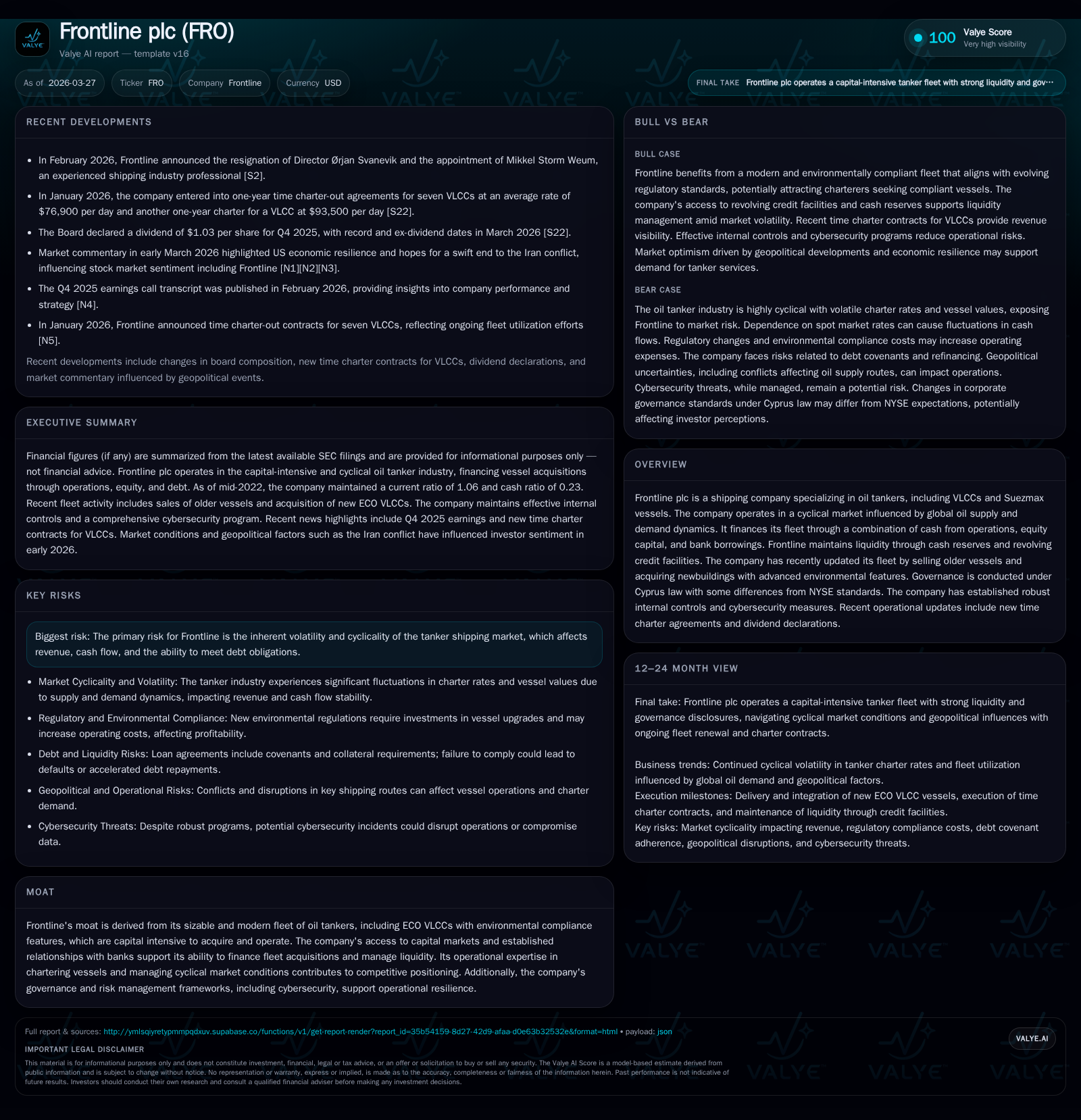
Frontline plc’s 2025 performance and strategic fleet updates illustrate the impact of cyclical tanker markets and deliberate capital management.
Frontline plc, a leading oil tanker company, faced a sharp downturn in 2021 performance compared to prior years, driven by volatile market charter rates. In 2025, the company undertook significant fleet renewal through selling older vessels and purchasing newbuildings with advanced environmental technology while maintaining liquidity through cash reserves and revolving credit. Operational earnings are influenced heavily by cyclical demand and supply in oil transportation, with time charter contracts forming a key revenue source. Capital allocation featured substantial debt repayments and dividend payments, with financial covenants met despite market volatility.
Historical Performance and Market Context
Frontline plc operates primarily in the oil tanker shipping industry with a focus on large vessels such as Very Large Crude Carriers (VLCCs) and Suezmax tankers that serve global crude oil logistics. This sector is notably cyclical, sensitive to fluctuations in oil supply-demand balances, geopolitical events affecting shipping routes, and broader economic trends impacting oil consumption.
The company recorded revenues of approximately $749 million in fiscal year 2021, marking a sharp decrease of about 38.6% from $1.22 billion in 2020 according to reported figures [F1]. Operating income followed an even steeper trajectory due to fixed costs and operational inefficiencies during lower rate environments: from $507 million operating profit in 2020 down to roughly $12 million in 2021. Net income turned negative at about -$11 million in the latest reported period after robust profitability the prior year.
Operating cash flow declined substantially by nearly 90%, from over $604 million down to approximately $63 million in the same timeframe [F1]. Notably, dividend payments ceased in 2021 after distributions totaling over $312 million paid out in 2020.
This volatility highlights the capital-intensive nature of the shipping industry where vessel utilization rates and charter hire assessments are subject to frequent shifts. The relatively young ECO-class vessels helped sustain operational resilience but were insufficient alone to counteract macroeconomic challenges in that year.
Historical performance (annual)
| FY | Rev ($mm) | Net ($mm) | CFO ($mm) | OpInc ($mm) | Rev YoY | Net YoY |
|---|---|---|---|---|---|---|
| 2021 | 749 | -11 | 63 | 12 | -38.6% | -102.7% |
| 2020 | 1221 | 413 | 604 | 508 | +27.6% | +195.0% |
| 2019 | 957 | 140 | 280 | 240 | +29.0% | +1676.3% |
| 2018 | 742 | -9 | 46 | 83 |
Source: SEC companyfacts cache [F1].
Capital returns and efficiency (annual)
| FY | Div ($mm) | ROE% |
|---|---|---|
| 2021 | 0 | -0.7 |
| 2020 | 312 | 25.6 |
| 2019 | 20 | 9.3 |
| 2018 | 0 | -0.8 |
Source: SEC companyfacts cache [F1].
Table illustrates key annual financial metrics demonstrating market cyclicality impact [F1].
Fleet Modernization as a Growth Catalyst
In late December 2025, Frontline initiated a significant fleet upgrade strategy by selling eight of its oldest first-generation ECO VLCCs built between 2015–16 for $831.5 million; net proceeds expected after commissions and debt repayments are around $477 million [S4]. This move frees capital tied to aging assets vulnerable to rising regulatory pressures on emissions and operating costs.
Simultaneously in January 2026, the company executed agreements to acquire nine new-generation scrubber-fitted ECO VLCC newbuildings from related entities affiliated with Hemen at an aggregate cost of around $1.224 billion [S4]. Deliveries are staggered through mid-2027 from Chinese shipyards Hengli and Dalian, aligning with Frontline's strategy to maintain a state-of-the-art fleet capable of meeting stringent environmental standards while optimizing fuel efficiency.
These investments are poised to underpin future revenue growth through enhanced operational flexibility and potential premium charter rates associated with greener tonnage.
Revenue Streams: Time Charter Contracts and Spot Market Exposure
Frontline’s revenue generation largely depends on daily charter rates under either spot or time-charter contracts. For example, Q4 2025 average Time Charter Equivalent (TCE) earnings demonstrated robust levels: roughly $74,200/day for VLCCs, $53,800/day for Suezmax tankers, and $33,500/day for LR2/Aframax vessels [S3]. Such rates reflect underlying resilience despite acknowledged cyclicality.
The company has strategically locked-in one-year time charter-out contracts for seven VLCCs at average rates close to those spot figures commencing early/mid-2026 [S4], ensuring near-term revenue stability against spot market fluctuations.
Liquidity Profile and Capital Structure Management
As of December 31, 2025, Frontline maintained cash and equivalents of approximately $251 million versus almost $414 million at the end of the previous year [S4][S11], indicating liquidity used partly for capex commitments but sufficient for operational needs.
Credit facilities remain robust with over $473 million undrawn against revolving credit lines as of early 2026 enabling flexible funding sources [S4]. The company maintains compliance with loan covenants mandating minimum free cash balances (59% covered by actual cash on hand) plus positive working capital and value-adjusted equity conditions [S4][S9]. These covenants mitigate refinancing risk although collateral posting could be triggered if vessel values decline materially.
Debt repayments remain substantial; net cash used for financing activities totaled nearly $870 million in calendar year 2025 including debt amortizations exceeding $2 billion offset by new borrowings totaling around $1.43 billion [S11]. Dividend payments continue but at moderated levels relative to past distributions with a declared quarterly dividend of about $1.03 per share finalized for Q4’25 [S3].
Returns Perspective
Reported net losses in recent years have limited return on equity traction; approximate ROE based on latest net income against equity equates to slightly below zero (-0.7%) given modest losses despite solid shareholder equity near $1.65 billion end-2021 [F1]. These figures emphasize that cyclical downturns heavily influence profitability metrics until market recoveries materialize or fleet utilization improves.
Risk Considerations
Frontline acknowledges that persistent tanker market volatility remains its primary business risk impacting revenue visibility, cash flow consistency and debt service capabilities [S18]. External factors such as geopolitical tensions affecting trade routes or abrupt shifts in global energy demand can exacerbate fluctuations.
Additionally, ongoing regulatory changes requiring investments into decarbonization initiatives like Exhaust Gas Cleaning Systems (EGCS) or Ballast Water Treatment Systems (BWTS) place further demands on capital expenditure budgets [S4][S7].
Operational risks also extend to cybersecurity threats targeting maritime information systems critical for vessel operations which the company actively mitigates through robust internal controls [S19].
Outlook: What to Monitor Next
Absent explicit forward guidance beyond announced fleet sales/purchases and secured charters through mid-2027 [S4], key milestones will hinge on delivery timelines of newbuilds impacting capacity; evolving spot versus contract rate dynamics particularly across VLCC segments; compliance with financial covenants amid rate cycles; and further corporate actions addressing shareholder returns policy.
From an industry perspective, sustainable tanker demand growth linked with shifts towards environmentally compliant vessels will be pivotal alongside evolving global crude trade patterns influenced by alternative energy adoption trends.
This analysis summarizes publicly available disclosures without providing investment recommendations or price targets. It is intended solely for informational purposes reflecting data up until March 27, 2026.
Disclaimer: This is research-only, informational analysis and not investment advice. It may include AI-generated interpretation and general industry context. Always verify important details using primary sources.

Comments