
FitLife Brands: Can Acquisitions and Margin Gains Offset Organic Growth Headwinds?
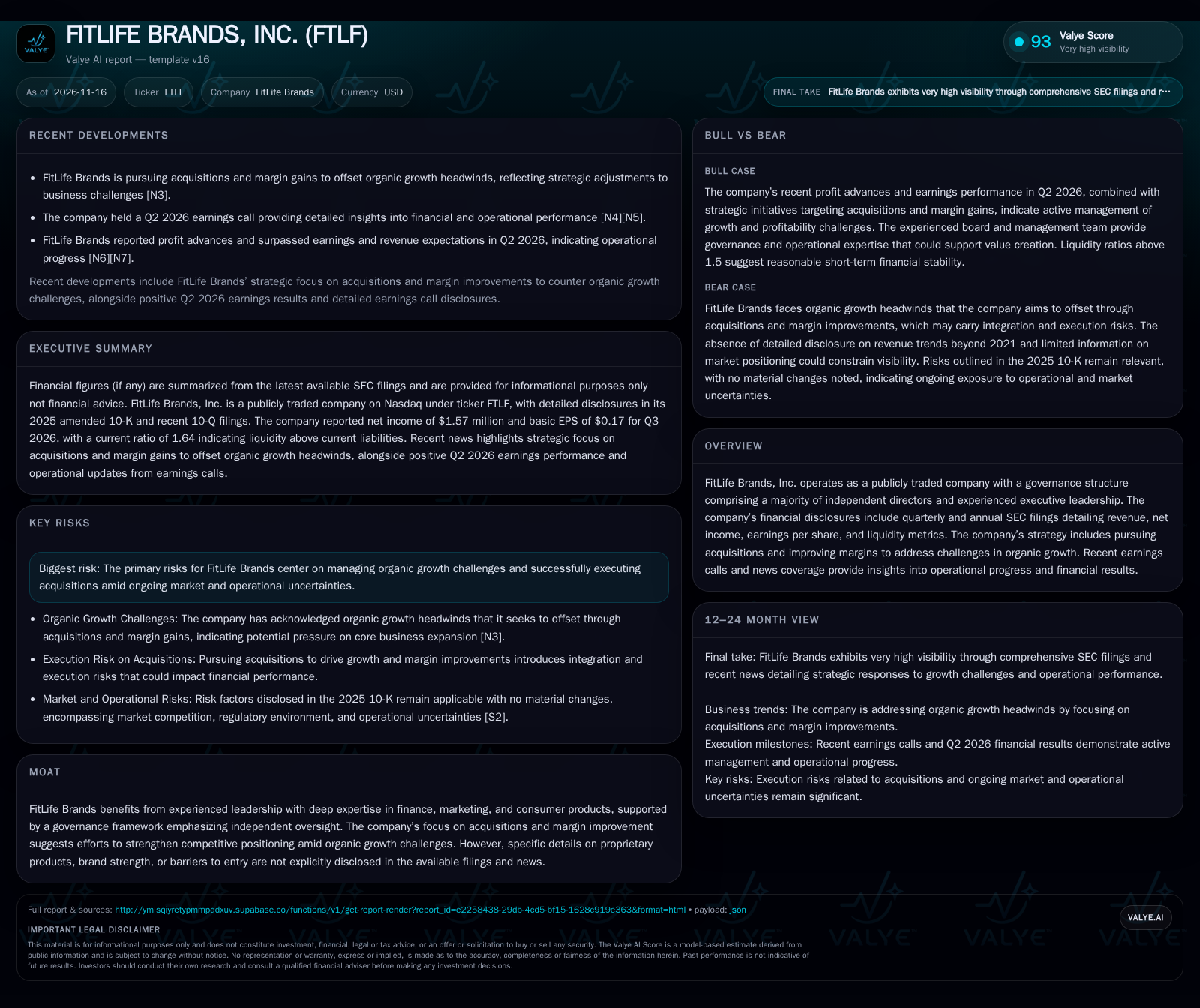
FitLife Brands is navigating a mature market with a dual-pronged strategy—pursuing acquisitions and driving margin improvements—to address slowing organic growth. Recent profit advances and positive earnings surprises highlight operational discipline, but the company’s next phase hinges on integrating acquisitions and sustaining profitability in a competitive consumer landscape.
FitLife Brands is responding to organic growth challenges by focusing on acquisitions and improving margins. Recent quarters saw profit advances and earnings outperformance, but the sustainability of these gains will depend on successful integration of new businesses and continued cost discipline. Watch for signs of organic growth stabilization, acquisition-driven revenue accretion, and further margin expansion.
FitLife Brands stands at a strategic crossroads: with organic growth slowing, the company is doubling down on acquisitions and operational improvements to maintain its trajectory. Recent financial results show that these efforts have yielded profit growth and earnings outperformance in the near term. However, the challenge is less about the last quarter than about whether FitLife can knit together acquired businesses, achieve sustainable margin gains, and spark a new phase of growth in a competitive, mature sector. The next 12 to 24 months will test whether this playbook can deliver more than short-term financial wins.
Recent Profitability and Strategic Shifts Define the Current Landscape
FitLife Brands reported net income of $1.57 million and basic EPS of $0.17 for the quarter ended September 30, 2026, marking continued profitability [S2]. In recent quarters, FitLife Brands has shifted its strategy to focus on acquisitions and margin improvements as organic growth slows, a move highlighted in both news coverage and management commentary [N3]. Q2 2026 results saw the company surpass earnings and revenue expectations, underscoring short-term operational progress [N6] [N7]. These developments set the stage for FitLife’s next phase, where acquisition execution and sustained margin gains will be the key levers.
How FitLife Brands’ Business Model Relies on Margin Expansion and M&A
FitLife Brands operates in a mature consumer products sector, where organic growth is typically limited by market saturation and intense competition. This environment often forces companies to rely on margin optimization and inorganic growth to sustain profitability. The company’s recent focus on acquisitions suggests a strategy of broadening its product portfolio, capturing new customer segments, or gaining scale advantages. However, such a strategy introduces integration risks and requires disciplined capital allocation.
The fundamental economics hinge on FitLife’s ability to maintain or improve gross and operating margins as it absorbs new businesses. Cost structure improvements—whether through supply chain efficiencies, pricing optimization, or overhead reduction—could produce operating leverage if revenue grows faster than fixed costs. However, the capital required for acquisitions can strain balance sheets, especially if synergies are delayed or fail to materialize.
A critical aspect of FitLife Brands’ margin expansion strategy involves leveraging scale economies that may arise from combining overlapping functions across acquired entities. For example, consolidating procurement could lower input costs, while integrating distribution networks might reduce logistics expenses. However, achieving these efficiencies depends heavily on the similarity of acquired businesses and the company’s ability to harmonize disparate systems and cultures. Moreover, the timing of these cost savings is often uncertain, and upfront integration expenses can temporarily depress margins. Therefore, the net margin impact hinges on both the pace and depth of integration efforts, as well as the company’s discipline in avoiding overpaying for acquisitions that offer limited synergy potential.
Assessing FitLife’s Position in a Crowded Consumer Health Market
FitLife Brands competes in a fragmented and highly competitive space, likely including nutritional supplements, fitness products, or adjacent wellness categories. The sector is characterized by low switching costs, commoditized products, and constant promotional pressure. While FitLife’s board and management bring experience in finance, marketing, and consumer products, there is no evidence of proprietary technology, protected brands, or significant barriers to entry in the current disclosures.
Acquisition-driven growth can provide temporary boosts in scale or product breadth, but without unique assets or strong direct-to-consumer relationships, such advantages are fragile. Competitors range from national brands to private-label upstarts, each vying for share in distribution channels that reward marketing spend and promotional pricing. FitLife’s success will depend on finding defendable niches, building customer loyalty, or achieving cost advantages through scale—none of which are strongly evidenced in the current filings.
In a market characterized by commoditization and low switching costs, FitLife’s ability to differentiate itself through brand positioning or product innovation is paramount. Without proprietary technology or strong intellectual property, the company’s competitive moat may rely on marketing effectiveness, distribution reach, or customer experience enhancements. The fragmented nature of the consumer health market also means that niche specialization or regional dominance can provide defensible positions. However, scaling such advantages requires balancing investment in brand-building with margin discipline. If FitLife can leverage acquisitions to fill portfolio gaps or enter underserved segments, it may create a more resilient competitive profile, but this outcome depends on successful integration and coherent brand strategy execution.
A Virtuous Cycle of Accretive Acquisitions and Margin Gains
The most favorable outcome for FitLife Brands is one in which its acquisition strategy results in revenue and profit accretion—meaning new businesses integrate smoothly, costs are rationalized, and cross-selling or supply chain synergies are realized.
Evidence that would confirm this scenario includes sustained revenue growth above organic market rates, improving gross and operating margins post-acquisition, and consistent outperformance on earnings relative to consensus. Additional markers would be public disclosure of successful integration milestones, realization of cost synergies, and positive cash flow trends. Conversely, delays in integration, margin compression, or negative cash flow would falsify this upside path.
Incremental Gains Offset by Execution Complexity
The most plausible path forward is one of modest, acquisition-driven growth offset by the realities of integration complexity and an intensely competitive market. FitLife Brands may continue to post profit gains and occasional earnings beats as it executes on margin improvements and folds in new businesses. However, organic growth is likely to remain muted, and the incremental benefits from acquisitions may be partially offset by integration costs, cultural challenges, or product overlap.
Confirmation of this scenario would include steady but unspectacular revenue and profit growth, stable but not rapidly improving margins, and a pattern of small-scale acquisitions that help maintain, but not dramatically expand, the company’s market presence. Falsification would come from either a major failed integration or, conversely, a breakthrough in core organic growth that changes the underlying economics.
Integration Stumbles and Margin Erosion Undermine the Strategy
The primary risk is that FitLife’s acquisition-led strategy fails to deliver sustainable gains. Integration difficulties—whether operational, cultural, or financial—could dilute margins, distract management, and erode the value of acquired assets. If acquisition costs escalate or synergies prove elusive, the company could see profit compression or even net losses, particularly if organic growth continues to stagnate.
Warning signs would include rising SG&A expenses as a percentage of revenue, declining gross or operating margins post-acquisition, missed earnings targets, and negative operating cash flow.
Should integration challenges prove more severe than anticipated, the company may face not only margin erosion but also operational disruptions that affect customer satisfaction and retention. Cultural clashes between legacy teams and acquired entities can undermine collaboration and slow decision-making, while legacy IT or supply chain incompatibilities can increase costs or reduce responsiveness. Additionally, if acquisitions fail to generate expected revenue synergies, the company might be forced to write down goodwill or impair assets, further pressuring earnings. In such a scenario, the firm’s potential financial flexibility could be constrained, limiting its ability to invest in organic growth initiatives or respond to competitive threats, thereby exacerbating the stagnation of the core business.
How to Track FitLife Brands’ Progress on Integration, Margins, and Growth
Organic revenue growth rates, if disclosed, would help test whether the core business is stabilizing or continuing to decline.
Gross and operating margin trends, particularly following acquisitions, will indicate whether the company is realizing synergies or suffering margin dilution.
Acquisition-related disclosures—such as purchase price multiples, integration milestones, and post-deal performance—would reveal the effectiveness of M&A execution.
Operating cash flow and free cash flow generation should be monitored to assess whether profit advances are translating into true financial health.
Any shifts in SG&A as a percentage of revenue may signal integration challenges or cost discipline lapses after acquisitions.
Management commentary on earnings calls regarding pipeline acquisitions and integration progress can provide early signals of strategic success or trouble.
Customer retention or churn rates, if disclosed, would provide insight into the stickiness of FitLife’s brands and the impact of competitive pressure.
Disclaimer: This is research-only, informational analysis and not investment advice. It may include AI-generated interpretation and general industry context. Always verify important details using primary sources.

Comments