
Genpact LTD’s Journey from Process Expertise to AI-Driven Transformation
Tracing Genpact’s evolution from operational excellence rooted in Lean Six Sigma to embedding AI-driven agentic solutions reshaping enterprise process innovation.
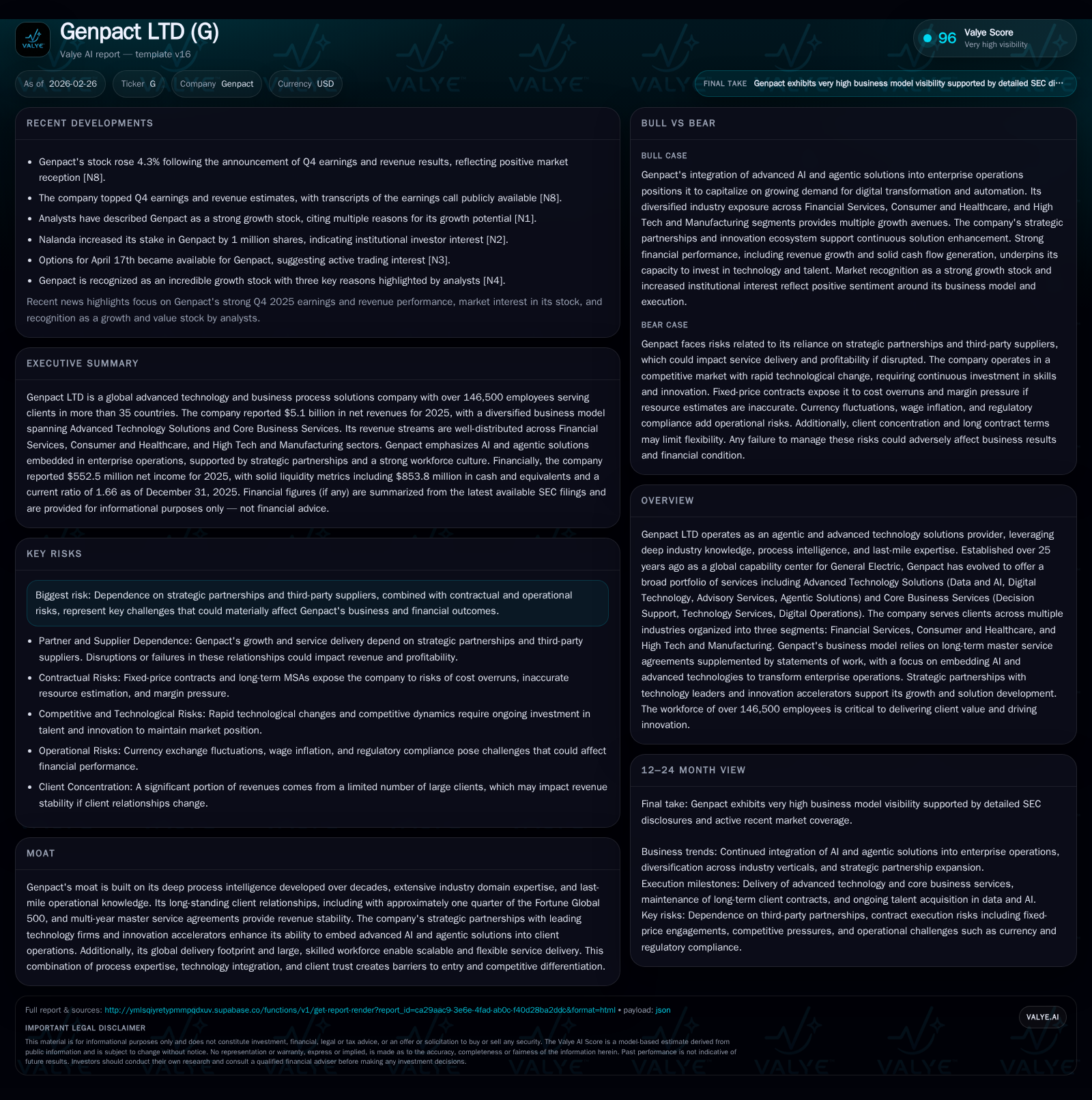
Founded over 25 years ago as General Electric’s global capability center, Genpact has transformed from a lean process specialist into a technology-forward service provider. Its historical growth, driven by enduring client relationships and process intelligence, now intersects with a strategic pivot towards AI-enabled agentic operations—accounting for nearly a quarter of revenues in 2025. Financially robust, with improving margins and strong cash flow generation, Genpact balances capital allocation amid evolving competitive pressures and regulatory complexities. Market watchers should monitor backlog trends and execution on AI integration as key determinants of growth trajectories.
From Shared Services to Industry Leader: Historical Growth and Key Drivers
Genpact’s origins trace back over two decades when it was established as the global capability center for General Electric (GE), tasked with perfecting shared business processes via Lean Six Sigma methodologies [S1]. This foundation of stringent operational discipline and comprehensive process intelligence underpins the company’s unique positioning today. Over time, Genpact has expanded beyond basic business process outsourcing to encompass deep industry domain expertise coupled with granular data benchmarking capabilities—a combination that has entrenched its role as an indispensable partner for enterprise clients.
Financially, this legacy translated into stable growth trajectories reflective of its disciplined approach and long-term client contracts frequently structured as master service agreements (MSAs) supplemented by statements of work (SOWs) [S5]. Between fiscal years 2014 and 2025, revenues rose steadily at a compound annual pace approximating 7.7% year-over-year, while operating income increased by roughly 6.9% annually over the same period [F1]. Net income followed suit with comparable gains (7.6% CAGR) underscoring effective cost management alongside revenue expansion. This consistent performance attests to the value embedded in Genpact’s deep process knowledge and its focus on last-mile execution—helping clients surmount operational complexities within their industries.
Historical performance (annual)
| FY | Net ($mm) | CFO ($mm) | OpInc ($mm) | Capex ($mm) | Net YoY |
|---|---|---|---|---|---|
| 2025 | 552 | 813 | 750 | 78 | +7.6% |
| 2024 | 514 | 615 | 702 | 83 | -18.6% |
| 2023 | 631 | 491 | 631 | 55 | +78.6% |
| 2022 | 353 | 444 | 502 | 51 |
Source: SEC companyfacts cache [F1].
Capital returns and efficiency (annual)
| FY | Buybacks ($mm) | FCF ($mm) | ROE% |
|---|---|---|---|
| 2025 | 735 | 21.7 | |
| 2024 | 253 | 533 | 21.5 |
| 2023 | 225 | 435 | 28.1 |
| 2022 | 214 | 393 | 19.4 |
Source: SEC companyfacts cache [F1].
Note: Revenue values prior to FY2014 available; detailed yearly revenue growth ytlds omitted where data incomplete [F1]
Structural Transformation: Embracing AI and Agentic Solutions to Expand Delivery
Transitioning from its traditional core services, Genpact has realigned its strategic focus toward Advanced Technology Solutions—a segment encompassing Data and AI strategy, Digital Technology services, Advisory functions, and innovative Agentic Solutions [S1]. In fiscal 2025, this segment accounted for $1.2 billion or approximately 23.7% of net revenues [S1], marking a significant elevation in contribution from emerging AI-powered offerings.
These agentic solutions operate at the intersection of human expertise and autonomous AI capabilities: "agentic operations" refers to systems designed to act and adapt alongside human operators, learning continuously to unlock transformational outcomes in enterprise settings [S1]. The company's utilization of proprietary AI tools combined with third-party generative AI reflects its practitioner-level emphasis on both data engineering rigor and last-mile operational knowledge—a specialized niche few competitors master comprehensively [N5].
Strategic partnerships with leading technology firms further underpin this evolution [S5], enabling rapid incorporation of cutting-edge digital platforms into client ecosystems. This transformation represents not just a technological upgrade but a reimagination of roles within business processes—from rule-based outsourcing toward collaborative human-AI workflows that promise enhanced agility and efficiency.
Financial Performance Spotlight: Revenue Growth, Margins, and Cash Flow Trends
Genpact's financial trajectory over the recent years confirms robust profitability advancements alongside expanding operational efficiencies. The firm’s operating income reached $750 million in FY2025 [F1], representing a healthy increase from $702 million in FY2024—an uptick consistent with ongoing margin enhancement efforts.
Simultaneously, net income grew by approximately 7.6% year-over-year to $552 million [F1], indicative not only of revenue quality but also disciplined expense controls amidst investments in new technologies. Pure cash generation gained notable momentum with operating cash flows surging by over 32% year-over-year reaching $813 million in FY2025 [F1]. This cash strength facilitates reinvestment initiatives and shareholder returns without compromising balance sheet resilience.
Capital expenditures remained controlled at $78 million in FY2025—a slight reduction from prior periods—reflecting prudent capex discipline aligned primarily toward software development and technology onboarding [F1],[S12]. Return on equity stands near an impressive ~21.7%, showcasing effective deployment of shareholder capital relative to earnings power [F1].
On the liability side, Genpact remains comfortably within its credit covenant parameters under the amended credit facilities instituted in late 2022 that impose leverage limits (<3x Net Debt/EBITDA) ensuring financial flexibility [S4]. Interest coverage ratios above threshold levels further support a favorable credit profile.
Competitive Terrain: Moat, Risks, and Market Pressures in a Rapidly Evolving Sector
Genpact’s competitive advantage is deeply rooted in decades-long process intelligence honed through Lean Six Sigma—a moat reinforced by extensive industry domain expertise combined with last-mile operational knowledge critical for effective AI integration [S6],[S7]. The company’s sustained multi-year master service agreements with marquee Fortune Global 500 clients provide revenue visibility amidst volatile market conditions.
Nevertheless, headwinds stem principally from evolving competitive dynamics marked by proliferating AI-native disruptors challenging traditional BPO models using proprietary platforms or open-source tools [S9],[S14]. Rivalries include large multinational consulting firms integrating end-to-end digital transformation services; lower-cost offshore service providers; niche regional players; and increasingly insourced Global Capability Centers formed by clients themselves seeking greater control [S6],[S7].
Pricing pressures arise due to alternative commercial constructs favored by some clients demanding risk-sharing or outcome-based frameworks rather than classical fixed- or transaction-price SOWs [S9]. Contractual dependencies on third-party technology suppliers also expose Genpact to supply chain risks that could hamper timely solution deployment or inflate costs if mitigations fail.
Furthermore, regulatory complexities across geographies—spanning data privacy mandates like GDPR and sector-specific compliance obligations—necessitate ongoing investment in controls infrastructure lest noncompliance erode client trust or precipitate penalties [S9],[S14]. Hence operational agility coupled with continuous innovation remains imperative to maintaining leadership.
Capital Allocation Framework: Returns, Dividend Policies, and Share Buybacks
Discipline governs Genpact’s capital allocation approach balancing shareholder returns against strategic reinvestments necessary for sustaining technical edge. During FY2025, share repurchases totaled approximately $283 million at weighted average prices near $46 per share—up modestly from $253 million expended the prior year [F1],[S13],[S20]. These repurchases have cumulatively retired over seventy million shares since program initiation.
Dividend policy has evolved alongside growing cash flow robustness: quarterly dividends were raised to $0.1875 per share for fiscal year 2026 constituting an approximate annualized yield increase reflective of board confidence in stable free cash flow generation estimated near $735 million after capex in FY2025 [F1],[S27]. Dividend payments remain subject to covenants within the revolving credit agreement restricting distributions if leverage exceeds defined safety thresholds—an element demonstrating conservative balance sheet stewardship [S4],[S20].
This framework indicates an explicit preference for returning cash while preserving financial flexibility vital for opportunistic acquisitions or accelerated technology investments as market dynamics dictate.
Outlook & Watchpoints: Market Expectations, Backlog Signals, and Execution Milestones
While Genpact does not provide explicit multi-year financial guidance publicly, several indicators suggest incremental optimism paired with judicious caution regarding near-term delivery execution amid broader macroeconomic uncertainties [S24],[N1],[N2],[N3]. New bookings approximated $5.5 billion during fiscal year 2025—slightly below the prior year—but remain indicative of continued demand resilience across both Advanced Technology Solutions and Core Business segments.
Key watchpoints include the pace at which expanded agentic solution capabilities translate into higher wallet share within existing client accounts alongside new client wins targeting digital transformation agendas heavily influenced by generative AI adoption trends [N5],[S24]. As projects often span multiple years under MSAs supplemented by SOWs or software-as-a-service agreements for agentic applications, backlog conversion rates will critically impact revenue visibility.
Moreover, monitoring how well Genpact navigates intensified pricing competition from AI-native entrants and manages evolving regulatory compliance landscapes will provide insight into margin sustainability [S24],[N10]. Lastly, success stories emanating from integration of proprietary advanced analytics platforms combined with human-AI collaboration models could well serve as validation points fostering accelerated growth phases ahead.
Disclaimer: This report is intended solely for informational purposes based on publicly available filings and news sources as cited. It does not constitute investment advice or an endorsement of any security mentioned herein.
Disclaimer: This is research-only, informational analysis and not investment advice. It may include AI-generated interpretation and general industry context. Always verify important details using primary sources.

Comments