
Galectin Therapeutics Advances Belapectin Development and Clinical Strategy After NAVIGATE Trial
Following the topline results of the pivotal NAVIGATE trial, Galectin Therapeutics recalibrates its clinical and regulatory approach for belapectin across fibrosis and oncology indications.
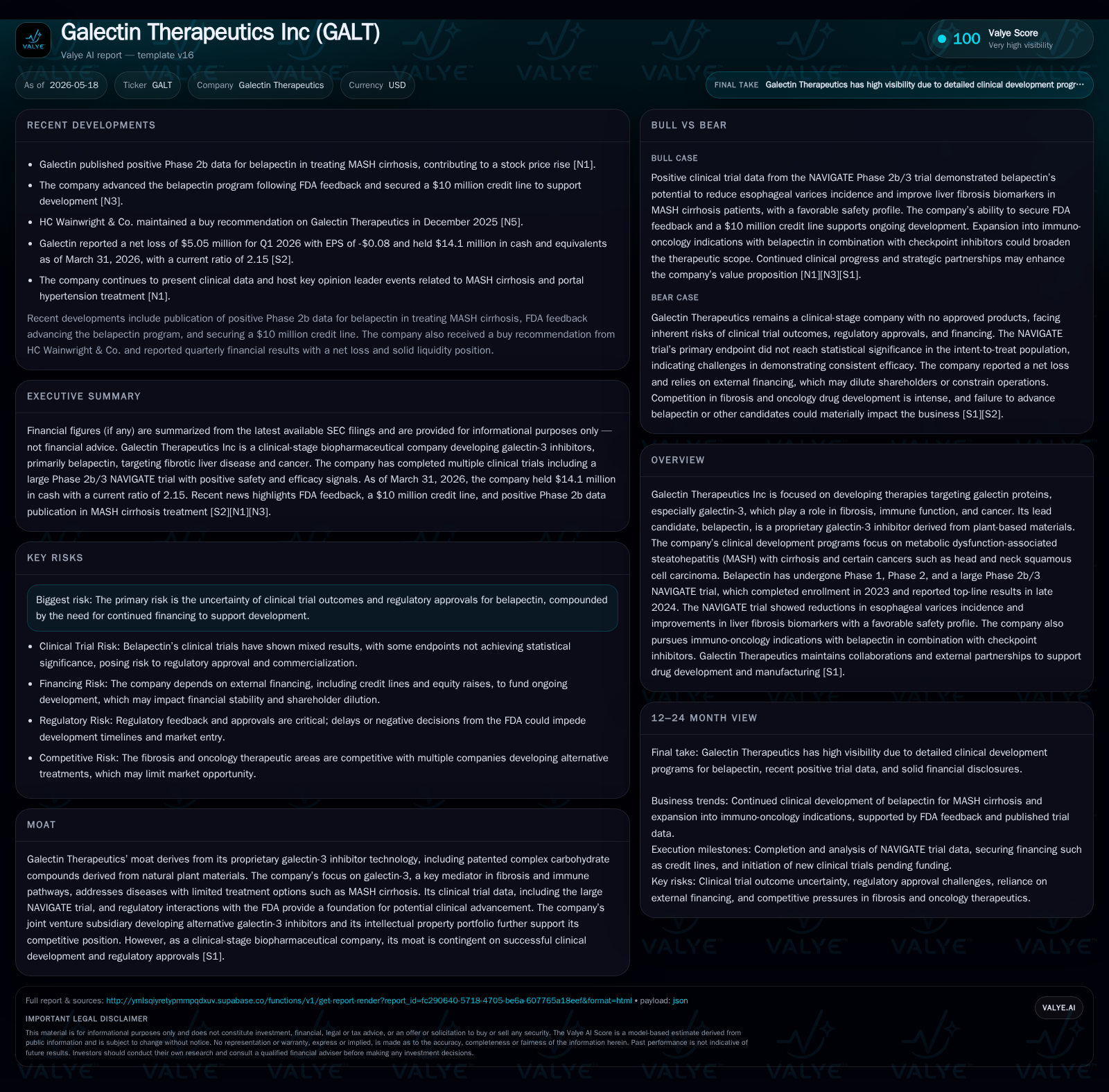
Galectin Therapeutics reported its Q1 2026 operating results spotlighting ongoing strategic planning around its lead galectin-3 inhibitor, belapectin, after completion of the large Phase 2b/3 NAVIGATE trial for MASH cirrhosis. Despite the composite endpoint not reaching statistical significance in NAVIGATE, encouraging biomarker improvements and safety signals keep belapectin relevant in fibrosis and oncology pipelines. The company is engaged with FDA to design follow-on studies while maintaining liquidity sufficient through April 2027 but dependent on additional financing. Galectin’s proprietary carbohydrate-based galectin-3 inhibition platform anchors a niche in a sparse antifibrotic market with modest competition, focused on unmet needs where current therapies are limited.
Latest Quarterly Operating Update Highlights
In its May 15, 2026 10-Q filing [S2], Galectin Therapeutics disclosed sustained operational emphasis on advancing belapectin—a proprietary galectin-3 inhibitor—following completion and topline reporting from its pivotal NAVIGATE Phase 2b/3 trial in late 2024. Although the NAVIGATE trial did not meet its composite primary endpoint statistically, secondary analyses indicated notable reductions in esophageal varices incidence and improvements in liver fibrosis biomarkers, alongside a favorable safety profile [N1]. These nuanced outcomes have shaped the current corporate strategy where no new Phase 3 study has yet been launched; rather, Galectin is engaged in preparatory dialogue with the FDA through scheduled Type C meetings to refine next-stage clinical trial parameters [S1], preserving regulatory momentum.
The company also filed an 8-K concurrently detailing these operational narratives [S3], reaffirming that belapectin's antifibrotic potential justifies ongoing investment despite setbacks. The latest quarter maintained focus exclusively on belapectin programs without initiation of new clinical assets or partnership agreements disclosed publicly.
From a capital perspective, the March-end balance sheet reflected $14.1 million in cash and equivalents with a healthy current ratio of approximately 2.15, indicating adequate short-term liquidity [F1]. This financial position aligns with prior company guidance supporting operations through roughly April 2027 before requiring fresh capital influx—a critical dependency considering continued R&D burn rates.
Business Model and Core Product Profile: Belapectin and Galectin-3 Inhibition
Galectin Therapeutics operates as a clinical-stage biopharmaceutical entity primarily focusing on drugs that inhibit galectins—carbohydrate-binding proteins integral to fibrotic processes and immune regulation [S1]. Its flagship compound, belapectin (also designated GR-MD-02), is synthesized from natural plant-derived complex carbohydrates patented for their unique molecular weights and pharmaceutical properties facilitating selective galectin-3 binding.
Biologically, galectin-3 drives fibrogenesis by promoting fibroblast activation, inflammatory cell recruitment, and extracellular matrix deposition—pathways central to diseases like metabolic dysfunction-associated steatohepatitis (MASH) complicated by cirrhosis [S1]. Belapectin aims to arrest or reverse these mechanisms as shown in preclinical animal knock-out models where absence of galectin-3 precludes fibrotic development.
The company’s development portfolio centers on MASH cirrhosis patients at risk of portal hypertension complications such as esophageal varices. Clinical progress encompasses completion of Phase 1 safety studies, Phase 2 evaluations (NASH-FX and NASH-CX trials), culminating in the large adaptive Phase 2b/3 NAVIGATE trial targeting varices prevention [S1]. Additionally, Galectin explores belapectin’s role as an adjunct in immuno-oncology leveraging galectin-3’s modulation of tumor immune evasion.
As a clinical-stage player without marketed products or revenues to date, Galectin’s business model relies heavily on external capital infusion paired with strategic partnerships slated for later-stage programs requiring scaling resources.
Competitive Landscape and Industry Structure in Fibrotic Diseases and Oncology
The antifibrotic therapeutic landscape is notably underdeveloped with relatively few agents demonstrating robust efficacy against MASH cirrhosis complications. Current standard care revolves around managing comorbidities without direct antifibrotic intervention, giving Galectin's targeted approach conceptual differentiation [S1]. Approved drugs for NASH fibrosis are scarce; thus belapectin would enter a market characterized by unmet medical need rather than intense incumbent competition.
However, weak switching costs exist since patients typically have limited options beyond monitoring or liver transplantation at terminal stages. This places pressure on demonstrating unequivocal clinical benefit to command durable pricing power post-launch.
In oncology domains where belapectin is being evaluated as combination therapy with checkpoint inhibitors, competition intensifies due to broad availability of immunotherapies from larger pharma. Here, differentiation hinges on additive efficacy or improved safety/tolerability profiles; early evidence remains investigational [S1].
Strategic Growth Drivers: Pipeline Development and Market Potential
Growth avenues hinge primarily on progressing follow-up trials post-NAVIGATE under FDA guidance. Positive secondary endpoints from NAVIGATE—such as reductions in esophageal varices incidence—are valuable signals that may calibrate endpoints or patient selection criteria for confirmatory studies [N1] [S1]. Success here would enable eventual registration filings targeting large populations afflicted by MASH cirrhosis worldwide.
Parallel expansion into immuno-oncology through combination regimens could broaden indication scope if synergistic effects emerge from ongoing early-phase studies.[S1] Further value lies in strategic partnerships that could provide development financing or commercialization capabilities when clinical data matures.
Regulatory engagement remains vital: the company's intentions to secure an FDA Type C meeting before next trial planning underscores efforts to minimize developmental risk via regulatory feedback incorporation [S2]. Additionally, leveraging intellectual property surrounding its carbohydrate-based galectin inhibitors enhances barriers to entry.
Risks and Constraints: Clinical, Regulatory, and Financing Challenges
The principal risk factor remains reliance on achieving convincing clinical efficacy after mixed results from the NAVIGATE study. The signal-to-noise ratio inherent in phase transition decisions renders subsequent trial design inherently uncertain [S1]. Failure to demonstrate statistically significant or clinically meaningful benefits would likely terminate further development pathways.
Financially, Galectin depends substantially on funding support from its board chairman who has extended credit lines alongside equity investments historically—a source neither assured nor contractually guaranteed going forward [S1]. The runway available per Q1 ending cash positions operations only through mid-2027 barring new financing; absence thereof could force drastic cutbacks or halt advancement.
Regulatory complexity beyond the US—including heterogeneous approval requirements internationally—further complicates market-entry timelines post-approval [S1]. Given these compounded uncertainties typical for clinical-stage biotech firms targeting novel mechanisms, investor risk remains high.
Upcoming Catalysts and Milestones to Watch
Critical events forecast over 2026 include outcomes from planned Type C meetings with the FDA aimed at finalizing designs for belapectin’s next pivotal trials [S2]. These discussions will concretely influence timelines for study initiation and data readouts.
Parallel monitoring of enrollment progress or interim analyses from any pilot oncology combination studies will gauge belapectin's immunotherapy synergy potential [S1][N1]
Potential partnership announcements remain key watchpoints signaling external validation or resource augmentation prospects critical to sustain development continuity beyond current internal capabilities.[S2]
Concise Financial Overview Supporting Operational Plans
As of March 31, 2026, Galectin Therapeutics held $14.1 million in cash and equivalents against current liabilities approximating $7.3 million yielding a current ratio around 2.15—indicative of reasonable near-term solvency [F1]. This capital buffer supports ongoing R&D activities including maintenance of clinical infrastructure but mandates additional financing beyond April 2027 per management commentary [S1]. Operating losses recorded prior year accentuate consistent negative cash flows typical for clinical-stage biotechnology focused solely on pipeline development without product revenue generation.[F1]
Given this context, securing external funding via equity offerings or partnerships constitutes an essential prerequisite for sustaining long-term operational viability while advancing belapectin’s commercial prospects.
This analysis synthesizes publicly available SEC filings up to May 15, 2026, offering an informed perspective on Galectin Therapeutics’ clinical progression, market positioning, risks, and financial footing without making investment research views or price assessments. Readers should consider this report as part of broader due diligence efforts encompassing scientific literature review and sector dynamics inherent to innovative biopharmaceutical development cycles.
Financial position in context
As of 2026-03-31, companyfacts shows $14mm in cash and equivalents [F1]. Current assets of $16mm and current liabilities of $7mm imply a current ratio near 2.15x for 2026-03-31 [F1].
Disclaimer: This is research-only, informational analysis and not investment advice. It may include AI-generated interpretation and general industry context. Always verify important details using primary sources.

Comments