
Global Asset Management Group Extends Portfolio with Specialized Real Estate Acquisitions and Strategic Financing
GAMG has broadened its asset base through targeted acquisitions in industrial and cannabis-related sectors, supported by structured convertible debt financing.
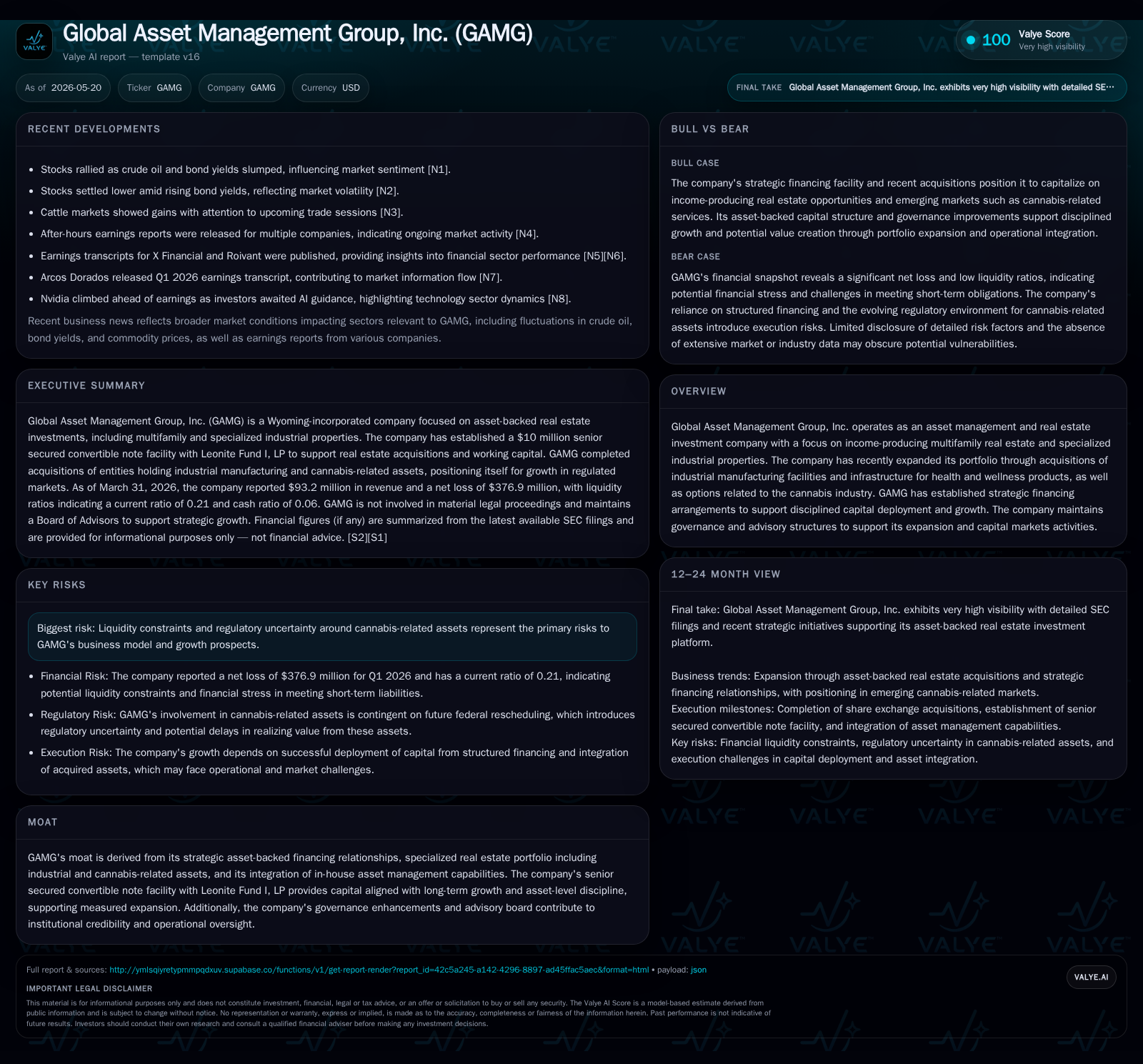
In its latest quarterly filing, Global Asset Management Group, Inc. (GAMG) reported significant portfolio expansion through acquisitions of specialized industrial and real estate assets, including multifamily housing and cannabis industry options. These moves are underpinned by a $10 million senior secured convertible note facility structured to support disciplined capital deployment and long-term growth. GAMG's business model centers on income generation from multifamily residential properties while diversifying into emerging industrial and cannabis-related niches. The firm's competitive advantage lies in its strategic financing alignment and governance infrastructure. Liquidity pressures and regulatory uncertainties related to cannabis assets represent key risks going forward.
Recent Operating Developments: Portfolio Expansion and Financing Updates
Global Asset Management Group, Inc. (GAMG) significantly expanded its holdings during the first quarter of 2026, as detailed in its May 20 10-Q filing [S2] and corroborated by recent 8-K disclosures [S3]. Key transactions completed include acquiring 100% membership interest in Memorial Real Estate Group LLC (MREG) via its wholly owned subsidiary RI Property Holdings, Inc., marking a meaningful deployment into large-scale mixed-use redevelopment projects featuring affordable and market-rate residential components [S3]. Alongside this, GAMG assimilated industrial properties through share exchanges in entities such as Sustainable Properties, LLC; notably industrial manufacturing facilities sized at approximately 33,000 sq ft edge data center and an 18,000 sq ft manufacturing site [S7].
Furthermore, the company expanded its footprint into cannabis-related real estate interests by obtaining options tied to Illinois state-licensed cannabis cultivation and processing licenses under agreements executed prior to closing but retained post-acquisition [S22]. These options position GAMG for participating in the regulated cannabis sector pending federal rescheduling.
Capitalizing on these acquisitions is a new $10 million senior secured convertible note facility with Leonite Fund I, LP established March 2026 [S10], designed to fund further income-generating real estate acquisitions while sustaining capital discipline. The notes bear 6% simple interest and mature April 6, 2027, allowing holder optional conversion starting October 6, 2026 at a discounted price formula based on a trailing average VWAP; post-maturity penalties apply if unpaid [S3]. This arrangement exemplifies structured asset-level financing aligned with long-term growth rather than short-term liquidity needs.
Business Model Overview: Niche Real Estate Asset Management and Income Generation
GAMG’s revenue model primarily relies on generating stable rental income from multifamily residential properties acquired mainly through share exchange agreements reflecting ownership interests in operating LLCs managing such portfolios [S1]. The company has integrated property management capabilities through the acquisition of AMT Management LLC to internally oversee day-to-day operations for its Washington D.C.-area multifamily assets, enhancing operational efficiency and retention potential [S27].
Beyond conventional multifamily housing—providing steady cash flow—GAMG strategically pursues income opportunities within specialized industrial real estate segments such as manufacturing infrastructure for health and wellness products alongside emerging opportunities connected to federally constrained but state-regulated cannabis real estate ventures, [S7]. This diversification supports risk mitigation across economic cycles.
The company emphasizes measured capital deployment supported by layered asset-backed financing that fosters oversight without diluting control prematurely. Non-plant-touching ancillary services within the cannabis vertical—including equipment rentals and brand development—expand margin potential without incurring direct cultivation or production risks currently encumbered by federal prohibitions [S7]. Governance enhancements via advisory board deployment further bolster strategic oversight amid portfolio diversification.
Strategic Asset Mix: Multifamily, Industrial, and Cannabis-Related Properties
The backbone of GAMG’s portfolio remains income-producing multifamily residential real estate segments characterized by relatively low volatility tenancy patterns providing predictable rents critical for cash flow stability [S24]. For example, the Memorial project targets an approximate composition of 40% affordable housing balanced with market-rate luxury units, calibrated to resilient rental demand dynamics
Industrial assets supplement this base by targeting niche markets such as health & wellness manufacturing facilities requiring redevelopment potential to meet evolving tenant specifications. These offer slightly higher operational complexity but improved upside through active asset management.
Cannabis-related assets represent an early-stage growth platform where value is largely latent pending favorable shifts in federal policy enabling license activation or transferability [S22]. Options acquired grant access to Illinois craft grower and infuser licenses facilitating entry once regulatory clarity emerges. This segment inherently carries higher risk given regulatory dependencies but could deliver outsized returns relative to other real estate segments if legalized at the federal level,
Competitive Environment: Peer Context and Market Positioning
Within the broader landscape of asset management firms focusing on real estate investments, GAMG occupies a distinct niche straddling traditional multifamily residential ownership and more specialized industrial plus ancillary cannabis-related real estate interests. Compared to standard small-cap REITs or asset managers concentrated solely on stabilized multifamily portfolios or core industrial warehouses, GAMG’s combination presents unique scale limitations but strategic differentiation grounded in specialized capital partnerships.
Its $10 million senior secured convertible note facility with Leonite Fund I reflects an atypical capital structure that aligns funding cost with underlying asset performance disciplines rather than generic unsecured borrowing lines common among small public real estate entities [S10], [S3]. This enhances both capital predictability and investor confidence amid portfolio expansion.
Operationally, internalizing property management through AMT Management LLC enables tighter integration than many peers relying exclusively on third-party operators—a competitive advantage promoting incremental margin expansion over time [S27]. However, the complex regulatory environment of cannabis-related investments limits direct peer comparables within public markets currently.
Growth Drivers: Capital Deployment, Regulatory Shifts, and Operational Expansion
The ramp-up of capital deployment enabled by the structured convertible note facility provides a clear near-term driver for controlled portfolio growth focused on acquiring income-producing real estate assets that enhance recurring revenues [S10]
Potential regulatory progress toward federal rescheduling or legalization of cannabis products constitutes a pivotal catalyst unlocking latent value embedded within acquired options for state-licensed cultivation and processing facilities—a rare opportunity not broadly accessible to pure-play real estate investment entities, [S22].
Operationally, expanding non-plant touching service lines such as equipment rental platforms tied to the cannabis industry afford scalable revenue streams less susceptible to both regulatory flux and capital intensity than direct cultivation operations while deepening client relationships within emerging sectors [S7]
Further integration of proprietary property management platforms bolsters operational scalability supporting improved tenant retention metrics in multifamily portfolios—key KPIs supporting long-cycle cash flow sustainability [S27]
Risks and Constraints: Liquidity, Regulatory Uncertainty, and Asset Complexity
A prominent risk vector is reflected in GAMG’s liquidity profile; current ratio stands at an approximate 0.21 due primarily to elevated current liabilities relative to current assets including cash reserves around $27.4 million against total debt roughly $21.8 million nearing maturity within twelve months creating near-term refinancing or cash flow pressures [F1], [S2].
Deployed convertible promissory notes carry post-maturity penalties if not prepaid or converted by April 2027 adding financial stress potential should capital markets access deteriorate or operational cash generation fall short [S3]
Regulatory ambiguity around federal classification of cannabis remains a significant constraint on realizing full value from licensed asset options; delays or unfavorable rulings could impair valuation materially while potentially raising compliance costs significantly across the portfolio’s emerging segments, [S16].
The multi-faceted nature of integrating newly acquired subsidiaries spanning diverse geographies, asset types (industrial vs residential vs cannabis licenses), and operational emphases introduces execution complexity with attendant risks around achieving envisioned synergies timely or at projected cost basis.
Looking Ahead: Milestones and Key Catalysts on the Horizon
The next pivotal date is October 6, 2026 when holders of the senior secured convertible notes may elect conversion at a discount relative to recent stock trading prices—a critical juncture that will test investor confidence amidst ongoing portfolio integration efforts [S3]. Monitoring any initiations of these conversions will also provide insight into equity market perceptions regarding GAMG’s growth prospects.
Potential advancements or setbacks on federal cannabis policy reform will materially influence valuation trajectories for related license options held indirectly through newly acquired subsidiaries; these developments should be closely tracked for impact analysis, [S22].
Further scheduled acquisitions or expansions disclosed in subsequent quarters will serve as indicators of management’s ability to prudently leverage capital markets relationships towards sustainable growth frameworks consistent with stated asset-backed strategy [S2], [S3].
Financial Overview: Capital Structure, Liquidity, and Debt Insights
As of March 31, 2026 quarter end per the latest SEC filings and company facts data exhibits available cash & equivalents totaling approximately $27.4 million juxtaposed against total recorded debt around $21.8 million as of September 2025 create a modestly negative net debt position roughly -$5.6 million implying manageable gross leverage levels despite liquidity tightness indicated by an acute current ratio near 0.21 reflecting significant current liabilities on the balance sheet likely driven by payables associated with recent acquisitions or financing structures [F1], [S2].
The senior secured convertible promissory notes constitute core short-term debt obligations bearing simple 6% interest due April 6, 2027 with provisions permitting early conversion starting October 6 at discounted pricing formulas designed to incentivize equity participation thereby balancing debt load reduction objectives alongside shareholder dilution risks inherent in conversion features [S3]
This raises important considerations regarding future refinancing flexibility dependent on equity market conditions coupled with operating cash generation sufficiency to service ongoing commitments while maintaining adequate working capital buffers amid ongoing portfolio integration activities.
Disclaimer: This analysis is provided for informational purposes only without any investment advice or research views.
Disclaimer: This is research-only, informational analysis and not investment advice. It may include AI-generated interpretation and general industry context. Always verify important details using primary sources.

Comments