
GAP INC (GAP) Company Analysis: Navigating Apparel Retail Complexity with Multi-Brand Scale and Operational Leverage
GAP INC operates a diversified portfolio of apparel brands across physical retail and e-commerce, demonstrating solid profitability and liquidity in Q2 FY2026. The company’s business model balances volume-driven retail with brand segmentation, while facing persistent industry risks including consumer trends, supply chain, and competitive pressure. This analysis explores GAP’s economic mechanics, competitive positioning, and plausible growth trajectories.
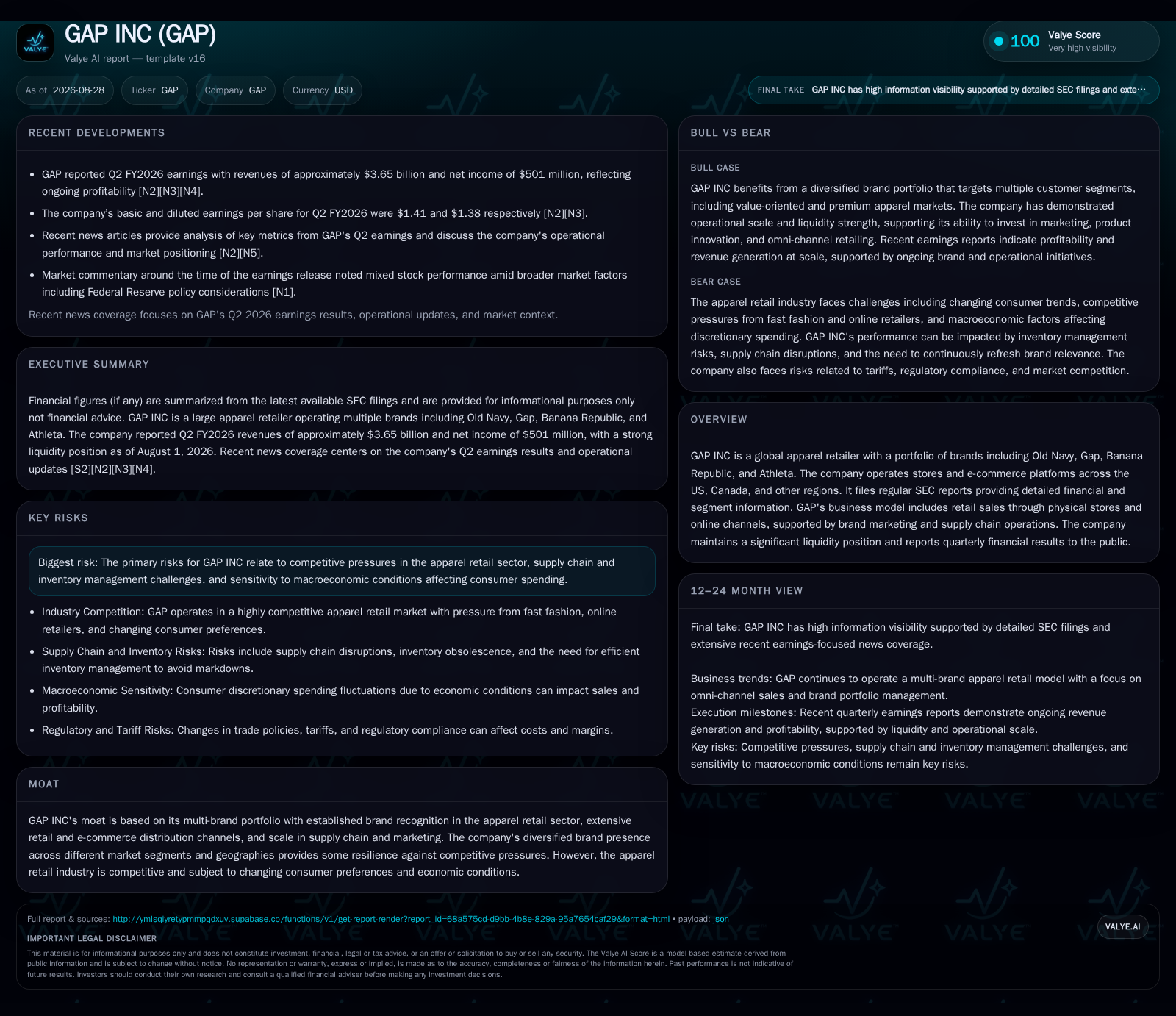
GAP INC reported Q2 FY2026 revenue of $3.65 billion and net income of $501 million, supported by a reported liquidity position position and diversified brand portfolio. Its multi-brand strategy provides resilience through targeting distinct customer segments, but the apparel retail sector’s rapid consumer preference shifts and supply chain volatility impose ongoing risks. Operating leverage potential exists through cost-efficient omni-channel integration and inventory management, but competitive fast-fashion and online disruptors challenge market share retention. Key future outcomes hinge on GAP’s ability to innovate product mix, optimize inventory, and sustain customer relevance amid economic fluctuations.
GAP INC, a large apparel retailer operating globally under multiple brands including Old Navy, Gap, Banana Republic, and Athleta, reported robust Q2 FY2026 financial results with revenues of approximately $3.65 billion and net income of $501 million. Its substantial liquidity position underpins operational agility amid a competitive apparel industry characterized by fast-changing consumer tastes and supply chain complexities. This report delves into the company’s business model economics, competitive dynamics, and strategic outlook, emphasizing how GAP’s multi-brand approach and omni-channel capabilities could drive sustained profitability or be challenged by evolving retail landscapes.
Latest Operating Snapshot
In Q2 FY2026, GAP INC generated revenues of approximately $3.65 billion and net income of $501 million, reflecting ongoing profitability and operational scale. The company’s basic and diluted earnings per share stood at $1.41 and $1.38 respectively, underscoring reasonable earnings quality relative to share count reduction from buybacks [S2][N2][N3].
Financial liquidity remains a strength with cash and cash equivalents around $2.1 billion and a current ratio of 1.82 as of August 1, 2026, providing a cushion for investment and navigating supply chain or inventory risks [S2]. Recent market commentary around the earnings release highlighted mixed stock performance influenced by broader macroeconomic factors such as Federal Reserve policy, reflecting investor sensitivity to economic conditions impacting discretionary retail spending [N1].
Business Model and Unit Economics
GAP INC’s business model centers on multi-brand apparel retail with revenue derived primarily through physical stores and e-commerce channels. Each brand targets distinct consumer segments: Old Navy focuses on value-oriented customers, Gap on casual mid-market apparel, Banana Republic on premium lifestyle, and Athleta on activewear. This segmentation allows GAP to capture a broad spectrum of price points and fashion preferences, diversifying revenue streams and mitigating brand-specific volatility.
Pricing power varies by brand and channel, with volume and mix influenced by seasonal fashion cycles and promotions. The retail model incurs significant fixed costs related to store leases, supply chain infrastructure, and marketing, alongside variable costs such as inventory procurement and fulfillment. Operating leverage can emerge if fixed costs are spread over higher sales volume, especially through scalable e-commerce operations. However, capital intensity remains moderate as GAP balances owned stores with wholesale and online distribution. Inventory management is critical to avoid markdowns that compress margins, requiring sophisticated demand forecasting and supply chain agility.
Moat, Competition and Counterforces
GAP’s moat is rooted in its multi-brand portfolio with established consumer recognition and extensive omni-channel distribution encompassing both physical stores and digital platforms. Scale in supply chain and marketing confers cost advantages and broad customer access. Diversification across brands and geographies reduces dependency on any single segment and enhances resilience against shifts in consumer preferences or economic cycles.
However, the apparel retail industry is intensely competitive, with fast fashion retailers and digital-native brands exerting significant pressure on pricing, speed to market, and trend responsiveness. Consumer preferences are rapidly evolving, and switching costs remain low, meaning GAP must continuously innovate product offerings and customer experience to retain relevance. Supply chain disruptions and inventory risks also pose counterforces that could erode margins and operational efficiency if not managed proactively.
Bull Case
In a favorable scenario, GAP leverages its brand portfolio and omni-channel capabilities to capture growing consumer segments across value and premium apparel markets. Operational scale combined with reported liquidity position supports targeted investments in marketing, technology, and supply chain innovation, enabling faster product cycles and personalized customer engagement. Effective inventory management reduces markdown risk, improving margins and cash flow.
Confirmation would come from sustained revenue growth outpacing industry peers, margin expansion due to improved mix and operating efficiencies, and positive customer retention metrics. Falsification would be visible if sales plateau or decline despite marketing spend, inventory write-downs increase, or e-commerce growth stalls relative to competitors.
Base Case
GAP maintains steady revenue and profitability by effectively managing its diverse brand portfolio and balancing physical and online retail channels. The company navigates competitive pressures through moderate product innovation and prudent cost controls, preserving margins in line with historical averages. Liquidity remains adequate to absorb supply chain shocks and fund incremental investments without overleveraging.
Evidence supporting this view includes stable quarterly earnings with consistent margins and cash flow, alongside measured inventory turnover rates. Risks include episodic markdowns in slower brands or regions and modest growth in digital sales. The base case assumes no major disruption in consumer spending patterns or regulatory environment.
Bear Case
Downside risk emerges if GAP fails to adapt swiftly to evolving consumer trends or digital shopping preferences, resulting in declining traffic and sales in both stores and online. Increased competition from fast fashion and direct-to-consumer brands could erode market share, pressuring pricing and compressing margins. Supply chain disruptions or inventory mismanagement could lead to elevated markdowns and cash flow constraints.
Confirmation of this scenario would be evident from consecutive quarters of declining comparable store sales, margin deterioration, cash burn, or inventory write-down spikes. Conversely, early signs of stabilizing sales, improved inventory metrics, or successful brand refresh initiatives would falsify this downside trajectory.
What Matters Next
Key performance indicators to watch include: 1) Comparable sales growth per brand and channel to assess consumer demand and brand health; 2) Gross margin trends reflecting pricing power and inventory efficiency; 3) E-commerce penetration and growth rates as a proxy for digital transformation success; 4) Inventory turnover ratios signaling supply chain effectiveness; 5) Operating cash flow generation to gauge potential financial flexibility; 6) Capital expenditures and marketing spend levels indicating strategic investments; 7) Share count changes from buybacks affecting shareholder value; and 8) Macroeconomic indicators such as consumer discretionary spending trends that influence retail demand.
Monitoring these metrics over the next several quarters will provide insight into GAP’s ability to sustain growth, manage costs, and respond to competitive and economic headwinds.
Disclaimer: This is research-only, informational analysis and not investment advice. It may include AI-generated interpretation and general industry context. Always verify important details using primary sources.

Comments