
Golub Capital BDC: Proprietary Deal Flow, Credit Discipline, and the Middle-Market Lending Equation
Golub Capital BDC (GBDC) leverages its affiliation with a leading private credit platform to target senior secured and one stop loans in recession-resistant sectors, but faces structural credit risks, competitive yield compression, and dependency on its external manager. The durability of its income engine hinges on credit vigilance and the evolving dynamics of the middle-market lending landscape.
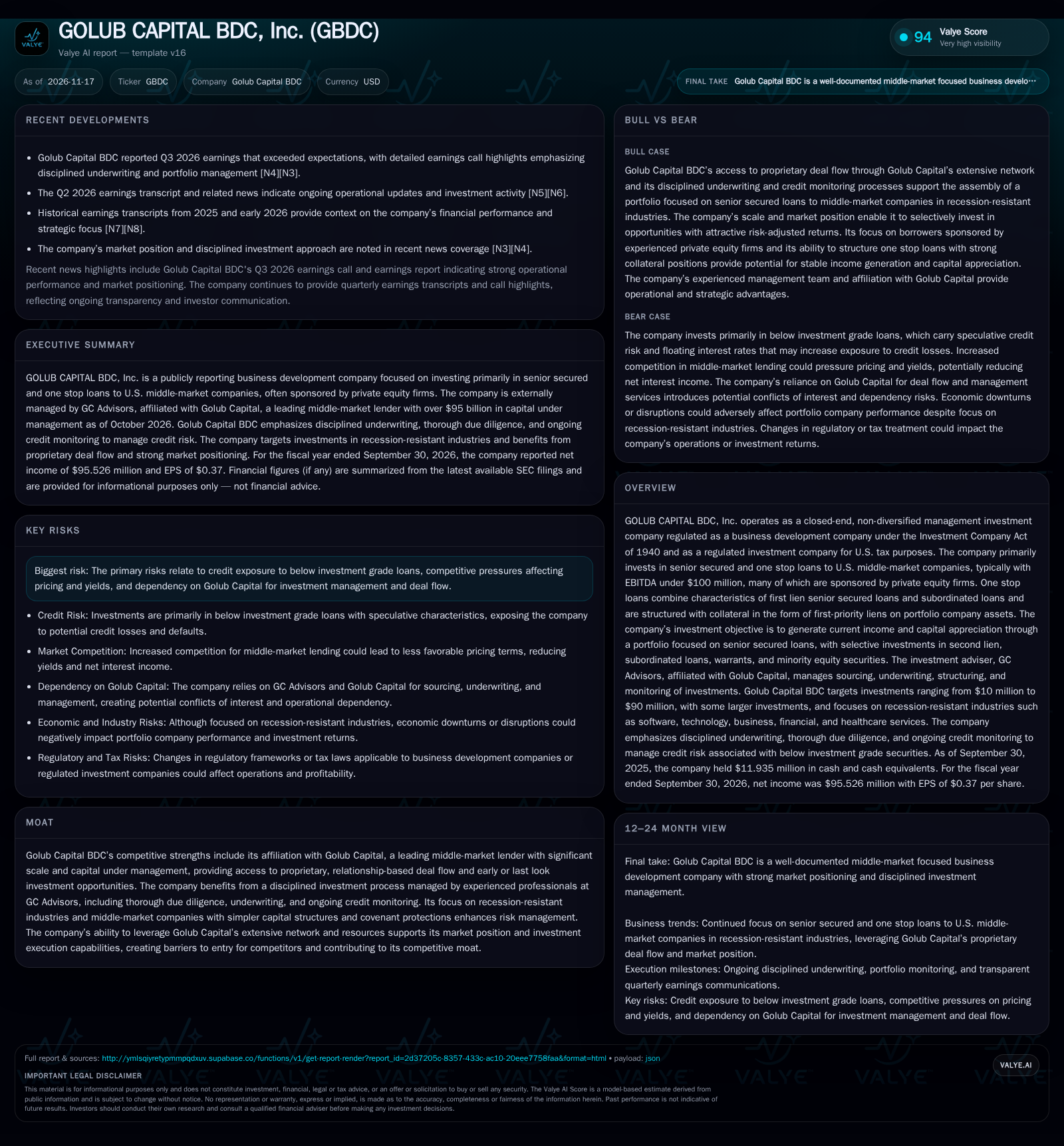
GBDC reported $95.5 million in net income for fiscal 2026 and beat Q3 earnings expectations, reflecting disciplined underwriting and proprietary deal sourcing via Golub Capital. Its focus on senior secured and one stop loans to private-equity-backed, middle-market companies offers yield and downside protection, but exposes the BDC to below investment grade credit risk and competition-driven margin pressure. The company’s competitive moat rests on its manager's scale, network, and process rigor, though dependency and regulatory risks remain persistent watchpoints. [S1] [N4]
Golub Capital BDC (GBDC) exemplifies the modern business development company model: externally managed, focused on senior secured and one stop loans to private-equity-backed, middle-market U.S. firms, and structurally reliant on the sourcing and underwriting engine of an affiliated private credit giant. Its latest fiscal year saw net income of $95.5 million and a Q3 earnings beat, highlighting the power of disciplined credit selection and proprietary deal flow in a crowded landscape. Yet, the fundamental economics of this model—yielding income from below investment grade, floating-rate loans—are tightly linked to credit cycles, competitive pressures, and the strategic execution of its external adviser. The question is whether GBDC’s structural advantages and rigorous investment process can consistently offset these inherent risks and sustain attractive returns through the cycle. [S1] [N4]
Recent Performance Anchored by Credit Discipline and Platform Sourcing
Golub Capital BDC reported net income of $95.526 million and basic and diluted EPS of $0.37 for the fiscal year ended September 30, 2026. The company’s Q3 2026 earnings exceeded expectations, with management emphasizing disciplined underwriting and portfolio management in both news coverage and earnings call highlights. This financial snapshot underscores the company’s ability to generate income from its core lending activities despite a competitive and evolving credit environment. The company’s $11.935 million in cash and cash equivalents as of September 30, 2025, provides a balance-sheet reference but does not itself establish operating flexibility or financial runway. [S1] [N4]
Access to proprietary deal flow through the Golub Capital platform—boasting over $95 billion in capital under management and a network of more than 37,000 investment professionals—remains a defining feature. This sourcing advantage, coupled with a focus on recession-resistant industries, has supported the company’s recent operational results, as highlighted in multiple recent news reports. [S1] [N3] [N4]
How the Lending Model Drives Yield, Risk, and Operating Leverage
GBDC’s core business model is to generate current income and capital appreciation by investing primarily in senior secured and one stop loans to middle-market U.S. companies. These loans are typically structured with first-priority liens on borrower assets, providing collateral protection, and are often floating-rate, which can help offset interest rate risk in rising rate environments. The company targets investment sizes from $10 million to $90 million, with the ability to take larger positions proportional to its capital base. [S1]
Revenue is primarily driven by interest income on these below investment grade loans, with the spread over funding costs representing the core margin. Fees, equity kickers (warrants/minority stakes), and prepayment penalties can provide additional upside, but the majority of returns are interest-driven. Operating leverage is achieved through the externally managed structure: GBDC leverages the sourcing, underwriting, and monitoring infrastructure of Golub Capital, which allows it to scale assets without a commensurate increase in fixed costs. However, this also means management fees are a persistent expense and can reduce net returns to shareholders in periods of lower asset growth or portfolio stress.
Because the company invests in non-investment grade credits, realized returns are highly sensitive to credit losses, recoveries, and default rates. Floating-rate structures can support income in a rising rate environment, but also raise debt service burdens for portfolio companies, potentially elevating default risk in downturns. The balance between yield and credit quality—along with disciplined risk management—remains the central economic lever.
Platform Scale, Network Effects, and the Battle for Yield
GBDC’s competitive positioning is anchored in its affiliation with Golub Capital, a top-tier private credit manager with deep relationships in the private equity and middle-market lending ecosystem. This connection provides access to proprietary, relationship-driven deal flow, including early or last-look opportunities and co-investment options that are not broadly available to smaller or less-connected BDCs. [S1]
The company’s disciplined investment process—encompassing rigorous due diligence, underwriting, and ongoing monitoring—supports credit outcomes and helps differentiate it from less selective market participants. Its focus on recession-resistant sectors (such as software, technology, business, financial, and healthcare services) further mitigates cyclical risk, though sector crowding is a persistent challenge.
However, the U.S. middle-market lending landscape remains highly competitive, with other BDCs, private credit funds, and direct lenders all competing for the same pool of leveraged loans. This competition can compress spreads, weaken covenant protections, and drive up leverage, potentially eroding the risk/return profile. The question is whether Golub’s sourcing advantage and process discipline can continue to support superior economics as new entrants and capital flows intensify competition.
When Proprietary Sourcing and Credit Vigilance Compound Returns
The bull case for GBDC hinges on its ability to consistently access high-quality, proprietary deal flow via Golub Capital’s platform, enabling it to selectively deploy capital into attractively priced senior secured and one stop loans, especially in pockets of market dislocation. If credit discipline remains robust and portfolio companies in recession-resistant sectors continue to perform, GBDC could sustain elevated net interest margins and low credit losses, driving strong income and potential NAV appreciation.
Confirmation of this scenario would include continued earnings beats, below-peer default and non-accrual rates (if disclosed), stable or rising net asset value per share, and evidence that GBDC is able to originate new loans at attractive spreads even as competition intensifies. Additionally, successful realization of equity kickers or capital gains from secondary loan sales would further validate the company’s ability to capture upside beyond basic interest income.
Sustaining Income Through Competitive and Credit Cycles
The most plausible trajectory for GBDC is continued generation of steady income from its diversified portfolio of senior secured and one stop loans, supported by disciplined underwriting and the sourcing engine of Golub Capital. Net interest margins may experience gradual compression as competition persists, but the company’s focus on recession-resistant industries and covenant-heavy structures should help contain credit losses to manageable levels.
Falsification would be signaled by a sustained increase in credit losses, pronounced NAV erosion, or an inability to deploy capital at attractive risk-adjusted yields.
Credit Deterioration, Yield Compression, and Structural Frictions
The bear case materializes if credit conditions in the middle market deteriorate, leading to rising defaults and loss severities in GBDC’s below investment grade loan portfolio. Yield compression due to heightened competition—coupled with potential weakening of loan covenants—could further erode net interest income, especially if the company is unable to offset losses with new, higher-yielding investments.
Additional risk factors include a breakdown in the alignment or performance of the external manager (Golub Capital), regulatory or tax changes impacting BDC structures, or a liquidity crunch at the portfolio company level. Confirmation of this scenario would be evident in rising non-accrual rates, declining net investment income, NAV declines, or negative surprises in quarterly earnings.
Testing the Resilience of the GBDC Investment Thesis
Quarterly trends in non-accrual and default rates across the loan portfolio, if disclosed, as a direct indicator of credit health and underwriting effectiveness.
Net asset value (NAV) per share trajectory over time, tracking realized/unrealized losses and portfolio mark-to-market adjustments.
Spread between portfolio yield and funding costs, indicating the company’s ability to preserve net interest margins amid competitive pressures.
New loan origination volumes and average spreads on new investments, as evidence of continued access to attractive proprietary deal flow.
Portfolio company sector mix and concentration, with particular attention to exposure outside of recession-resistant industries.
Management fee levels and the ratio of operating expenses to net investment income, to assess the impact of the external management structure on shareholder returns.
Regulatory or tax developments affecting BDCs and RICs, particularly changes that could alter leverage limits, tax treatment, or reporting requirements.
Disclaimer: This is research-only, informational analysis and not investment advice. It may include AI-generated interpretation and general industry context. Always verify important details using primary sources.

Comments