
IRIDEX Corp: Recurring Revenue Ambitions and Margin Headwinds in Ophthalmic Laser Markets
IRIDEX is executing a recurring revenue strategy anchored in proprietary laser technologies for glaucoma and retinal diseases. While recent results show operational improvement and clinical validation, gross margin pressures and capital equipment market dynamics pose persistent challenges to sustained profitability.
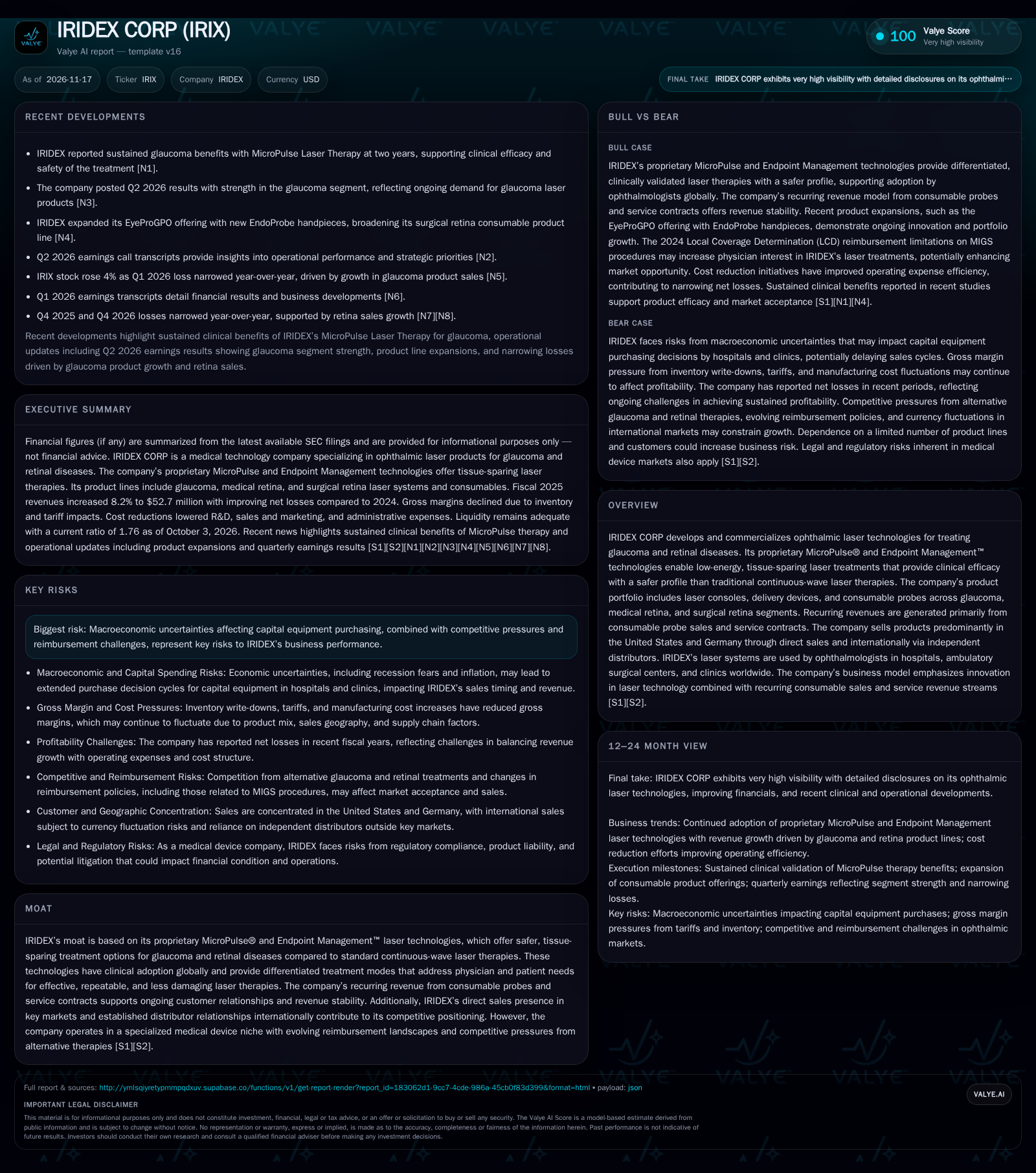
IRIDEX’s revenue rose 8.2% to $52.7 million in fiscal 2025, driven by gains in glaucoma and retina products, plus an extra selling week. Net losses narrowed to $4.4 million, but gross margin declined to 36.5% due to inventory write-downs and tariff costs. The business depends on recurring consumable probe sales and service contracts, with recent clinical evidence supporting its MicroPulse technology. Margin recovery, capital equipment demand, and competitive positioning remain central to future outcomes. [S1] [S2] [N1] [N3] [N5] [N7]
IRIDEX Corp’s current operating profile spotlights the tension between innovation-driven adoption in ophthalmic laser therapy and the structural challenges of achieving robust profitability in medical device markets. The company’s proprietary MicroPulse and Endpoint Management technologies, focused on safer, tissue-sparing treatments for glaucoma and retina diseases, underpin a business model built around recurring sales of consumable probes and service contracts. While recent results point to revenue growth, narrowing losses, and positive clinical validation, persistent gross margin compression and exposure to capital equipment buying cycles raise questions about the durability of operating leverage and the pace of long-term value creation.
Recent Performance: Revenue Gains Meet Margin Compression
In fiscal 2025, IRIDEX reported revenue of $52.7 million, an 8.2% increase over the prior year, with net losses narrowing to $4.4 million from $8.9 million in 2024. The revenue uptick was attributed to higher sales of retina systems (notably Pascal), increased glaucoma probe volumes, and an extra selling week, reflecting ongoing demand for the company’s core technologies. However, gross margin declined to 36.5%—down from 40.1%—primarily due to inventory write-downs, increased product costs from tariffs, and lower capitalization of manufacturing overhead. On the cost side, operating expenses fell, driven by workforce reductions, decreased R&D investment, and lower legal/consulting spend. As of October 3, 2026, liquidity stood at $3.67 million in cash and cash equivalents, with a current ratio of 1.76. These developments highlight a business in operational transition: growing top-line and improving losses, but with unresolved margin and cash flow questions. [S1] [S2]
Recurring Revenue Mechanics and the Anatomy of Profitability
IRIDEX’s core economic model combines one-time sales of laser consoles with recurring sales of single-use consumable probes and service contracts. The recurring component is critical: once a laser platform is installed in a clinic or hospital, ongoing procedures require proprietary probes, creating a potential annuity-like revenue stream. This model can produce attractive gross margins in theory—especially if installed base and procedure volumes increase—since consumable production typically scales with relatively low incremental cost.
However, the company’s actual gross margin trajectory has been negative, affected by inventory write-downs, tariff-driven cost inflation, and manufacturing overhead absorption issues. While cost reductions in R&D, sales, and G&A have improved operating leverage, there is a risk these cuts could eventually constrain commercial and product development momentum if not carefully managed. Capital needs are moderate by medtech standards, as the business is not heavily dependent on large production facilities or high working capital, but sustained negative cash flow could eventually pressure the company’s ability to invest in growth or weather external shocks.
Differentiation in a Crowded Ophthalmic Landscape
IRIDEX’s competitive edge centers on its proprietary MicroPulse and Endpoint Management technologies, which are positioned as safer, tissue-sparing alternatives to conventional continuous-wave laser therapies. Recent clinical data—such as sustained glaucoma benefits at two years—may support deeper adoption among ophthalmologists seeking repeatable, less damaging treatment options. The company’s recurring revenue model, direct sales in the U.S. and Germany, and global distributor network provide some insulation from pure commoditization, while the exemption from new MIGS reimbursement restrictions could redirect procedural volume toward IRIDEX’s solutions.
Still, the market for glaucoma and retinal therapies is highly competitive, with alternatives ranging from pharmaceuticals to surgical implants and other laser platforms. Larger medtech incumbents may have greater resources for R&D, sales coverage, or bundling, and reimbursement policy changes can quickly shift physician incentives. The company’s concentration in a few geographic markets and product lines heightens exposure to local competitive and regulatory shocks.
How Clinical Validation and Reimbursement Tailwinds Could Unlock Recurring Growth
A favorable outcome for IRIDEX would see continued clinical validation of MicroPulse and Endpoint Management technologies translating into broader adoption among ophthalmologists, particularly as reimbursement headwinds for alternative MIGS procedures persist. If more clinics and hospitals adopt IRIDEX’s laser systems, this would expand the installed base, amplifying consumable probe and service contract sales. As procedure volumes rise, manufacturing scale could recover lost gross margin, especially if inventory and tariff issues are resolved.
Confirmation of this scenario would include: accelerating probe sales growth, improvement in gross margin back toward or above 40%, expanded clinical guideline endorsements, and evidence of new customer wins or increased market share in glaucoma and retina segments. Sustained positive clinical data—especially long-term safety and efficacy—would reinforce physician confidence and payor willingness to reimburse. Falsification would occur if probe sales stall, margin pressure persists, or new competitive modalities erode IRIDEX’s value proposition.
Recurring Revenue Grows, but Margin Recovery Is Incremental
The most plausible outlook is one of gradual expansion: IRIDEX continues to grow recurring consumable and service revenues from its installed base, supported by ongoing adoption of its laser systems in core markets. Clinical evidence sustains physician interest, and the company leverages recent cost reductions to narrow operating losses. However, gross margin recovery is slow, as tariff impacts and periodic inventory adjustments continue to offset operational gains. New product launches and expansion into adjacent segments are limited by constrained R&D spend.
This scenario would be confirmed by steady—if unspectacular—growth in probe/service revenue, stabilization of gross margin in the mid- to high-30% range, and ongoing reduction in annual net losses. Falsification would be apparent if margin deterioration accelerates, recurring sales plateau, or cost cuts lead to commercial setbacks.
Margin Erosion and Capital Equipment Headwinds Threaten the Model
Adverse outcomes could materialize if macroeconomic uncertainty leads hospitals and clinics to delay or cancel capital equipment purchases, shrinking the installed base growth critical to IRIDEX’s recurring revenue. Simultaneously, persistent or worsening gross margin compression—due to tariffs, unfavorable product mix, or further inventory write-downs—could push the company back into deeper losses, especially if consumable volumes do not offset fixed manufacturing and SG&A costs.
Further downside risks include a competitive breakthrough in alternative therapies (pharmaceutical, surgical, or device-based) that makes IRIDEX’s approach less attractive, or a negative regulatory/reimbursement development that restricts coverage for its procedures. This scenario would be confirmed by declining probe sales, further margin contraction, renewed increases in net losses, or disclosure of customer or channel losses.
Milestones and Metrics That Will Define IRIDEX’s Value Trajectory
Sustained growth rate in consumable probe sales by segment (glaucoma, medical retina, surgical retina); a useful metric would be segment-level volume and ASP trends if disclosed.
Quarterly and annual gross margin progression, with attention to the impact of tariffs, inventory write-downs, and product mix changes.
New customer wins or expansion contracts, especially in geographies outside the U.S. and Germany, to test market penetration and diversification.
Updates on capital equipment (laser console) placements, as a leading indicator for future consumable/service revenue.
Clinical study results and published real-world evidence supporting MicroPulse and Endpoint Management efficacy and safety.
Reimbursement policy shifts for glaucoma and retina procedures in key markets, including any changes to LCD or payor guidelines.
R&D or commercial investment levels, particularly as cost cuts may impact long-term innovation or salesforce effectiveness.
Cash flow from operations and changes in cash and equivalents, as ongoing losses could eventually constrain strategic flexibility.
Disclaimer: This is research-only, informational analysis and not investment advice. It may include AI-generated interpretation and general industry context. Always verify important details using primary sources.

Comments