
Frazier Life Sciences Acquisition Corp. II: Blank Check Mechanics and the Wait for a Defining Transaction
Frazier Life Sciences Acquisition Corp. II (FLSC) is a newly listed SPAC targeting the life sciences sector, with no operating business, no target identified, and a post-IPO capital base.
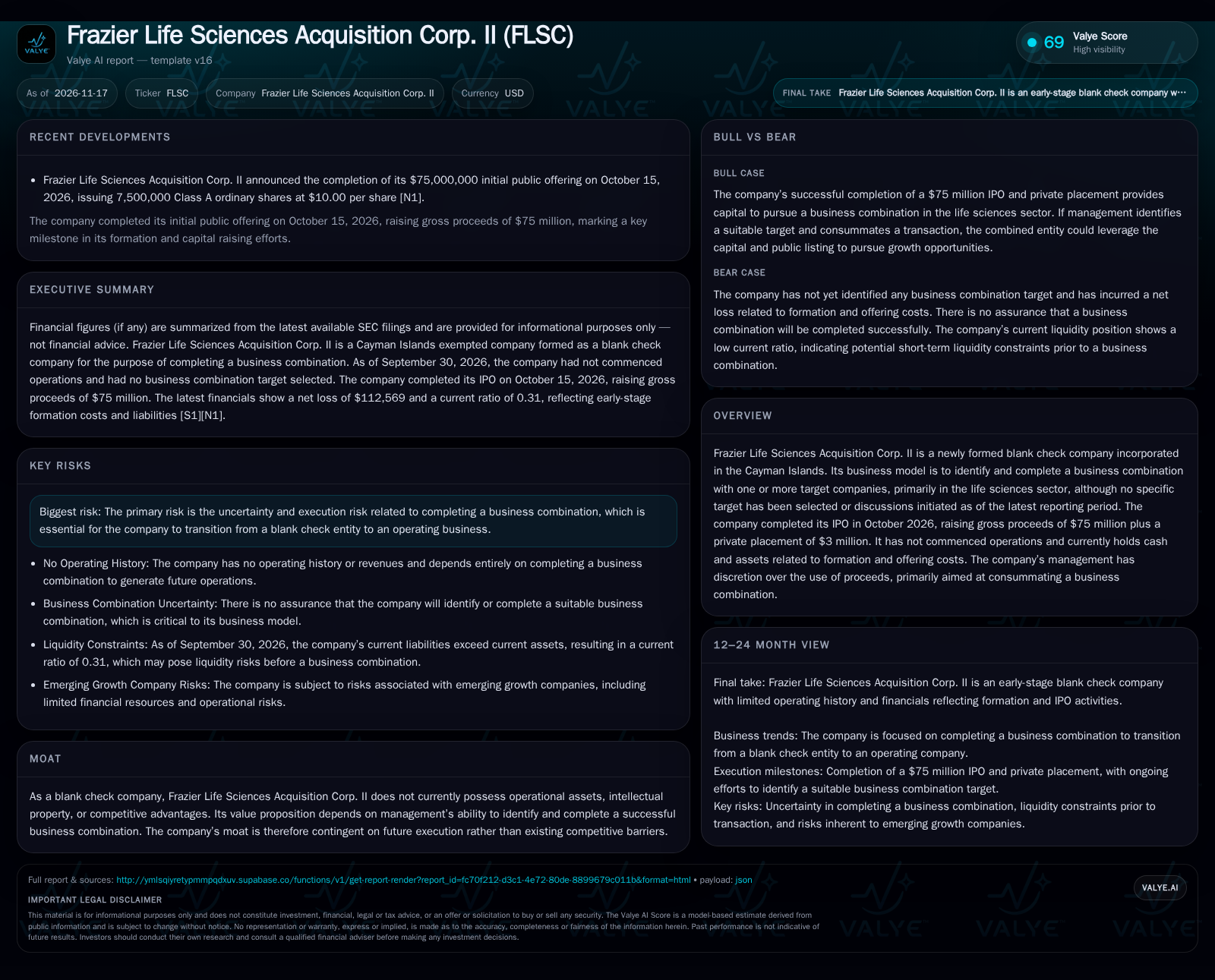
FLSC is a Cayman Islands-based SPAC that raised $75 million in October 2026, but has not identified a merger target and reported a net loss from formation costs.
Frazier Life Sciences Acquisition Corp. II (FLSC) exemplifies the risks and potential rewards embedded in the current SPAC model. Having raised $75 million in its October 2026 IPO, the company now sits as a blank check entity—no revenue, no operating assets, and no target identified. Its only activities to date have been formation and public listing efforts, and its financial statements reflect the costs of getting to this point, rather than ongoing business operations. The entire thesis rests on whether management can identify and consummate a business combination that justifies the trust investors have placed in them, before liquidity pressures or market sentiment turn adverse [S1] [N1].
IPO Proceeds, Early Losses, and the Absence of a Target: Defining the Starting Point
FLSC closed its $75 million IPO on October 15, 2026, but as of September 30, 2026, none of these funds appeared on the balance sheet, which instead reflected only $162,393 in current assets against $524,661 in current liabilities, resulting in a working capital deficit and a reported current ratio of 0.31 [S1] [N1]. The company reported a net loss of $112,569 for the period since inception, entirely attributable to formation and administrative expenses rather than failed commercial activity. Importantly, no business combination target has been identified, and there have been no discussions with potential targets. This means FLSC remains a shell entity, with its future entirely dependent on its ability to source, negotiate, and execute a transaction in the life sciences sector [S1].
SPAC Economics: Capital Structure, Incentives, and the Clock
As a SPAC, FLSC’s revenue model is entirely contingent. Until a merger is completed, it generates only nominal interest income on IPO proceeds. The economics are shaped by the capital raised—$75 million from public investors and a further $3 million from a private placement—offset by deferred and upfront underwriting fees, legal, and administrative costs [S1] [N1]. The operating structure is highly fixed-cost at this stage: recurring public company expenses and due diligence costs will steadily erode cash unless a transaction is completed. The capital structure typically includes founder shares (Class B), which convert to a significant stake in the post-merger entity if a deal is consummated, creating alignment but also an incentive to complete a deal regardless of quality. If no business combination is completed within the standard SPAC timeframe (often 18-24 months), the company would be required to return funds to shareholders, minus expenses, further pressuring management to find a suitable target quickly.
The interplay between the SPAC's capital structure and sponsor incentives is critical in shaping deal outcomes. Founders typically receive a significant equity stake at a nominal cost, aligning their interests with successful deal completion but potentially encouraging risk-taking or the pursuit of suboptimal targets to avoid liquidation. This misalignment can be mitigated if the sponsor has a strong reputation and sector expertise, which increases the likelihood of disciplined target selection. Additionally, the timing pressure imposed by the SPAC’s limited lifespan intensifies the urgency to transact, potentially compressing due diligence and negotiation phases. This dynamic underscores the importance of evaluating how the sponsor balances speed with quality to preserve value for public shareholders.
SPACs in the Life Sciences Arena: What Sets One Apart?
FLSC currently possesses no operating assets, intellectual property, or established relationships that could confer a competitive moat [S1]. In the SPAC landscape, differentiation depends on sponsor reputation, sector expertise, and the structure of any eventual deal. The life sciences SPAC market is crowded, with many blank check companies competing for a finite pool of credible private targets. FLSC’s competitive position will ultimately be determined by its network, the credibility of its sponsor (Frazier Life Sciences Holdings II, LLC), and its ability to source a target that is both high-quality and willing to go public via merger rather than direct IPO. Counterforces include increased competition for attractive targets, higher regulatory scrutiny, and growing skepticism among public investors about the post-merger performance of de-SPACed entities. Substitutes for targets include traditional IPOs, private equity buyouts, or remaining private longer, all of which can siphon away the most promising candidates.
The crowded nature of the life sciences SPAC market elevates the importance of differentiated sourcing strategies and value-creation capabilities. Sponsors with deep domain knowledge and extensive networks can access proprietary deal flow, reducing competition and increasing the probability of securing high-quality targets. Moreover, the ability to structure transactions that address the unique capital and regulatory needs of life sciences companies—such as accommodating long development timelines and complex intellectual property considerations—can provide a competitive edge. Conversely, sponsors lacking these capabilities risk pursuing commoditized targets or encountering integration challenges post-merger, which can erode investor confidence and share price performance.
How a High-Quality Business Combination Could Unlock Value
If FLSC’s management secures an attractive life sciences target with substantial growth prospects and executes a smooth merger, the resulting public company could benefit from a strengthened balance sheet, access to additional capital, and public market visibility. This scenario requires not just the identification of a target, but also successful negotiation, regulatory clearance, and integration. Confirmation would come from the announcement of a definitive merger agreement with a credible, growth-stage life sciences business, accompanied by clear strategic rationale and favorable investor reception. Further evidence would include PIPE (private investment in public equity) commitments, signaling third-party validation of the deal’s quality. Falsification would occur if the company announces a low-quality or controversial target, faces significant redemptions, or struggles to close the merger due to regulatory or operational hurdles.
The Most Likely Course: Prolonged Search and Rising Costs
The most plausible scenario is a protracted search for a suitable merger candidate, with administrative and due diligence costs steadily eroding the capital base. This is consistent with the broader SPAC market, where timelines frequently stretch as sponsors compete for a shrinking pool of viable targets. Confirmation would come from ongoing regulatory filings showing continued losses without merger progress, or the announcement of non-binding letters of intent that do not convert into definitive deals. Falsification would occur if the company quickly identifies and signs a definitive agreement with a credible target, or if it announces a liquidation and return of capital to shareholders after failing to find a suitable business.
Failure to Find a Target and the Erosion of Trust and Capital
In the adverse scenario, FLSC is unable to secure a business combination within the required timeframe, resulting in liquidation and the return of remaining IPO proceeds to shareholders, net of expenses. This would likely be accompanied by significant value leakage—offering and ongoing costs would reduce the amount returned to investors. Evidence confirming this scenario would be a lack of merger announcements as the SPAC’s deadline approaches, continued working capital deficits, and perhaps an eventual 8-K filing announcing liquidation. Additional risks include potential lawsuits from investors if the SPAC is perceived to have failed in its fiduciary duties, or regulatory action if disclosures or processes are found lacking.
Beyond the direct financial consequences of failing to complete a merger, reputational damage to the sponsor and management team can have lasting implications for future capital-raising endeavors. Investors may become wary of engaging with SPACs led by sponsors perceived as unable to execute, thereby reducing access to favorable deal terms or quality targets. Furthermore, the SPAC model’s inherent dilution and cost structure can exacerbate losses in a liquidation scenario, as expenses incurred during the search phase are unrecoverable. This scenario also highlights the systemic risk that regulatory scrutiny and evolving market sentiment pose to SPACs, particularly if investor protections or disclosure requirements tighten, potentially increasing operational complexity and costs for all participants.
Milestones That Will Determine Whether FLSC Can Execute Its SPAC Mandate
Announcement of a definitive merger agreement, including details on the target’s sector, financials, and growth prospects.
Disclosure of PIPE financing or additional capital commitments to support the proposed business combination, if disclosed.
Updates on working capital, cash burn, and remaining trust account funds available for a transaction.
Changes in the status or composition of the sponsor and management team, which could affect deal-sourcing capability.
SEC filings detailing any extension of the SPAC deadline or amendments to the original trust agreement.
Levels of shareholder redemptions at the time of business combination announcement, if disclosed, as these can materially impact deal economics.
Regulatory or market developments affecting the viability or attractiveness of life sciences SPAC transactions.
Disclaimer: This is research-only, informational analysis and not investment advice. It may include AI-generated interpretation and general industry context. Always verify important details using primary sources.

Comments