
Spire Inc.: Profitability, Liquidity Strains, and Strategic Transitions in a Regulated Utility Landscape
Spire Inc. posts solid net income but faces acute short-term liquidity pressure and operational headwinds, as evidenced by widened Q4 losses and reduced earnings guidance. Recent asset sales and regulatory adjustments highlight both opportunity and risk as the company manages its portfolio and navigates a changing utility sector.
Despite beating revenue estimates in Q4 2026, the company posted a widened loss and lowered its earnings guidance for FY27, while introducing guidance for FY28. Asset reclassification and impairment charges signal active portfolio management but add complexity to the near-term outlook. The interplay between regulated returns, capital allocation, and potential financial flexibility will be critical to Spire’s next phase.
Spire Inc. stands at a crossroads: while the company’s latest quarterly results show solid net income, its liquidity ratios are deeply underwater, with cash covering only a sliver of current liabilities. The company’s operational landscape is further complicated by a widened Q4 loss, downward-revised earnings guidance, and an active approach to managing its asset base, including the planned sale of Spire Mississippi and associated impairment charges. As a regulated utility with legacy infrastructure and dividend commitments, Spire’s ability to balance capital needs, regulatory returns, and evolving market pressures will define its resilience and future growth trajectory.
Recent Results Reveal Profitability Amid Mounting Liquidity and Operational Pressures
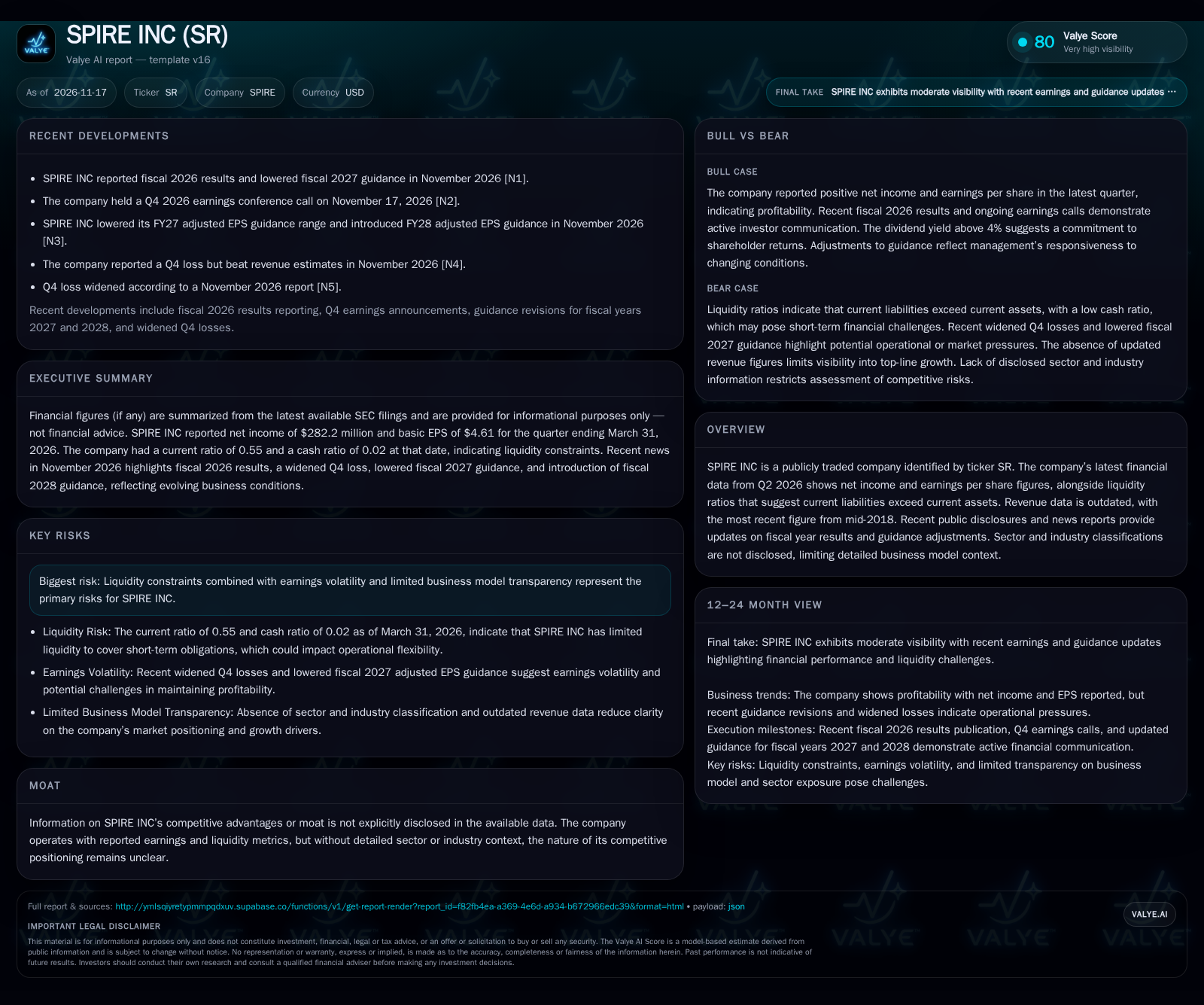
Spire Inc. reported net income of $282.2 million and basic EPS of $4.61 for the quarter ending March 31, 2026, indicating continued profitability at the operating level [S1]. However, liquidity is notably strained: the company’s current assets of $1.59 billion are dwarfed by current liabilities of $2.91 billion, resulting in a current ratio of just 0.55 and a cash ratio of 0.02 [S1]. This profile flags potential short-term financial stress if operating cash flows or external financing are disrupted.
Operationally, Spire’s Q4 2026 loss widened even as it beat revenue estimates, highlighting cost or margin pressures that may be structural rather than transient [N4] [N5]. The company responded by lowering its FY27 adjusted EPS guidance and rolling out FY28 guidance, signaling a recalibration of expectations in the face of ongoing headwinds [N3].
Strategically, Spire has classified its Spire Mississippi operations as held for sale, recording an $18.1 million goodwill reclassification and a $3.9 million impairment charge during Q2 2026 [S2]. This reflects a willingness to reshape the asset portfolio to focus on core or higher-return segments, but also introduces execution risk and possible transitional drag.
The cited source reports dividend-related activity; that disclosure alone does not establish dividend-policy continuity, management confidence, or a material constraint on capital flexibility. [N7]
How Regulated Returns, Capital Intensity, and Cash Flow Shape Spire’s Economic Model
As a regulated utility, Spire’s revenue model is anchored in cost-of-service ratemaking—a structure that typically allows for the recovery of operating expenses plus a regulated return on invested capital. This mechanism can provide stability, but it also imposes constraints: capital expenditures must align with regulator-approved projects, and recovery lags or disallowed costs can erode margins.
The company’s fixed cost base is likely substantial, given the capital intensity of utility infrastructure and the need for ongoing maintenance, upgrades, and regulatory compliance. While this enables operating leverage when volumes or rates rise, it can magnify downside risk if demand softens, costs spike, or regulatory lag occurs.
Liquidity constraints, as evidenced by the low current and cash ratios, may force Spire to rely on external debt or equity markets to bridge working capital gaps or fund investments. In a rising rate or tighter credit environment, this could increase interest costs or dilute shareholders, especially if cash generation from operations is pressured by margin compression or adverse regulatory outcomes.
The cited source reports dividend-related activity; that disclosure alone does not establish dividend-policy continuity, management confidence, or a material constraint on capital flexibility. Maintaining a yield above 4% requires ongoing cash outflows, limiting retained earnings available for reinvestment or debt reduction. The company reported cash and liquidity metrics for the period; these figures do not by themselves establish operating runway, investment capacity, financial flexibility, or financing capacity.
Positioning Within the Utility Sector: Regulatory Environment, Asset Quality, and Substitution Threats
Spire’s competitive position is shaped by the characteristics of the regulated utility sector. Geographic monopolies, regulatory oversight, and long asset lives typically limit direct competition for core gas distribution services. However, the strength of Spire’s position depends on the quality and location of its assets, the favorability of its regulatory relationships, and the efficiency of its operations relative to regional peers.
Recent asset sales, such as the plan to divest Spire Mississippi, suggest a focus on portfolio optimization—potentially shedding lower-margin or less strategically aligned regions to concentrate on higher-return or more defensible markets. This could improve average returns and regulatory alignment but may also reduce scale or diversification if not executed carefully.
Technology and policy shifts pose a long-term threat. The ongoing electrification of heating, decarbonization mandates, and efficiency improvements could gradually erode natural gas demand, especially in regions with aggressive climate policies or high renewable penetration. While this transition is likely to be gradual, it highlights the need for utilities like Spire to plan for a changing energy mix and possibly invest in new services or infrastructure adaptations.
Peer competition is less about market share and more about regulatory relationships, cost efficiency, and the ability to win approval for capital investment. Utilities with superior regulatory track records, lower cost structures, or more flexible capital allocation strategies could outperform in a period of sector transition.
Unlocking Value Through Regulatory Alignment and Strategic Portfolio Management
A favorable scenario for Spire would see regulatory bodies approve timely and sufficient rate increases, allowing the company to recover increased costs and maintain or expand margins even amid broader sector headwinds. Successful divestiture of non-core assets, such as Spire Mississippi, at attractive valuations would generate cash, reduce leverage, and enable reinvestment in higher-return opportunities.
If Spire can demonstrate improved operational efficiency—reducing controllable costs or optimizing capital expenditures—incremental margin expansion could follow. Additionally, if management’s guidance proves conservative and economic or weather-driven demand outperforms, near-term earnings could surprise to the upside.
Evidence that would confirm this scenario includes: upward revisions to EPS guidance, narrowing or reversing Q4 losses in subsequent quarters, successful asset sales with minimal impairment, and positive regulatory outcomes that lock in higher allowed returns or accelerated cost recovery.
Managing Through Tight Liquidity and Margin Pressures While Navigating Asset Transitions
The most plausible path for Spire is a period of flat to modestly declining earnings as the company manages through liquidity constraints, margin compression, and asset sales.
Transitional friction from the Spire Mississippi sale and related goodwill impairment may weigh on reported earnings for several quarters, but over time portfolio concentration could yield more predictable regulatory outcomes and operational focus. Regulatory lag and cost inflation could continue to pressure margins, especially if rate cases are contested or delayed.
Persistent liquidity ratios below 1.0 and ongoing reliance on external financing would further support this view.
Liquidity Crunch, Regulatory Setbacks, and Dividend Strain Threaten Stability
The adverse scenario for Spire is a combination of liquidity tightening and regulatory or operational setbacks. If working capital needs spike or access to debt markets becomes more costly or restricted, the company could struggle to meet short-term obligations without asset sales at distressed values or dividend cuts.
A failure to secure timely or adequate rate relief—due to regulatory pushback, political opposition, or adverse public sentiment—could leave Spire unable to recover rising costs, compressing margins and risking covenant breaches or credit downgrades.
If the sale of Spire Mississippi is delayed, fails to close, or results in larger-than-expected impairments, both balance sheet and reported earnings could suffer.
Evidence supporting this scenario would include: further reductions in EPS or guidance, additional impairment charges, delayed or failed asset sales, negative regulatory rulings, or a dividend cut.
Signals That Will Shape Spire’s Resilience and Value Creation Prospects
Progress and terms of the Spire Mississippi asset sale, including realized proceeds and any additional impairment charges, would help clarify near-term capital flexibility and portfolio focus.
Updates to liquidity ratios and short-term debt levels in subsequent filings—if disclosed—will be critical in assessing ongoing financial resilience.
Regulatory outcomes, especially in major rate case proceedings or cost recovery applications, could swing margins and cash flow forecasts.
Quarterly trends in operating cash flow and capital expenditure—if disclosed—would illuminate the company’s ability to self-fund investments versus reliance on external financing.
EPS guidance revisions and management commentary on margin drivers will signal whether cost or demand pressures are easing or worsening.
Evidence of successful cost containment or operational efficiency improvements—such as reductions in O&M expense per customer—would help test the potential for margin stabilization.
Disclaimer: This is research-only, informational analysis and not investment advice. It may include AI-generated interpretation and general industry context. Always verify important details using primary sources.

Comments