
Energizer Holdings: Margin Headwinds, Tax Credit Levers, and the Battle for Durable Battery Profits
Energizer Holdings faces a complex mix of inflation, tariffs, and shifting consumer demand, even as it integrates new assets and leverages U.S. battery tax credits. The company’s ability to offset cost pressures, defend market share, and extract integration synergies will define its medium-term trajectory.
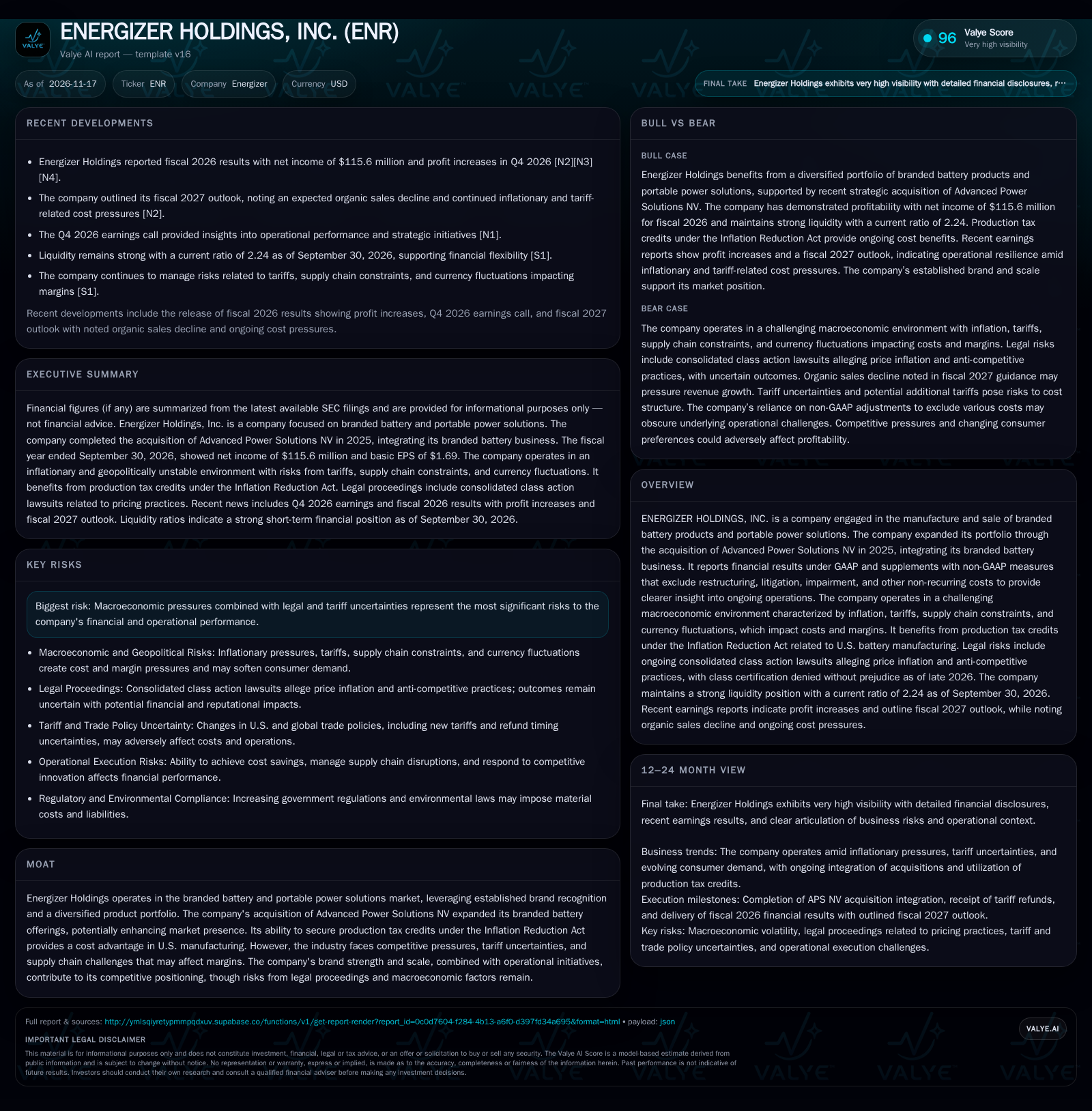
Energizer Holdings continues to navigate a challenging operating environment marked by inflation, tariffs, and supply chain issues, while integrating Advanced Power Solutions NV and benefiting from U.S. production tax credits. The outcome of ongoing legal proceedings and Energizer’s ability to realize acquisition synergies and cost savings are critical factors for future profitability and market positioning. [S1] [N2]
Energizer Holdings, a global leader in branded batteries and portable power, is at a strategic crossroads. The company’s recent acquisition of Advanced Power Solutions NV positions it for broader reach and potential scale benefits, but persistent macroeconomic pressures—ranging from inflation and tariffs to supply chain volatility—continue to squeeze margins and challenge growth. With U.S. production tax credits offering only partial relief, Energizer’s ability to offset cost increases, realize integration synergies, and navigate ongoing legal and regulatory risks will shape its prospects in an increasingly competitive consumer products landscape.
Recent Developments Define Energizer’s Operating Crosswinds
Energizer Holdings completed the acquisition of Advanced Power Solutions NV in May 2025, integrating its branded battery operations and expanding its product portfolio [S1] [N2]. This move was intended to strengthen market position and capture synergies in both cost and distribution. However, the company’s fiscal 2027 outlook points to an expected organic sales decline and continued cost pressures from inflation and tariffs [N2]. While Energizer benefits from production tax credits under the Inflation Reduction Act, which are recognized as reductions in cost of goods sold, these advantages are being offset by persistent macroeconomic headwinds. The company reported cash and liquidity metrics for the period; these figures do not by themselves establish operating runway, investment capacity, financial flexibility, or financing capacity. [S1]
How Energizer Earns: Portfolio Mix, Margin Levers, and Cost Pressures
Energizer’s core economics are shaped by the high-volume, branded battery and portable power market, where scale and brand recognition underpin pricing. The recent acquisition of Advanced Power Solutions NV brings potential for improved purchasing power, supply chain efficiency, and expanded distribution channels, but also integration costs and execution risk. Revenue is primarily driven by battery sales—alkaline, lithium, specialty chemistries—and related accessories, supplemented by auto care products. Pricing power is historically limited in commoditized battery segments, with promotional activity and retailer bargaining power acting as constraints. Volume trends are susceptible to consumer confidence and discretionary demand, while mix can shift toward higher-margin lithium or specialty products if adoption increases.
Production tax credits under the Inflation Reduction Act provide a meaningful, albeit finite, offset to U.S. manufacturing costs, directly reducing cost of goods sold [S1]. However, this lever is counterbalanced by ongoing inflation in raw materials, transportation, and labor, as well as tariff exposure that can quickly erode realized margin gains. Fixed costs—particularly for manufacturing and brand marketing—create operating leverage, so volume declines can have an outsized impact on profitability. While the company reports non-GAAP results to separate out restructuring and other one-time items, persistent macro pressures threaten to expose underlying margin fragility if not offset by cost discipline or top-line recovery.
Brand Recognition and Scale: Durable Advantage or Eroding Moat?
Energizer’s long-standing brands (Energizer, Eveready, Rayovac) provide shelf presence and consumer trust, which historically supported premium pricing and retailer relationships. The acquisition of Advanced Power Solutions NV further expands brand offerings and may help defend share against private label and low-cost imports. However, battery products are increasingly commoditized, and retailer consolidation increases bargaining power, reducing the company’s ability to dictate terms. Competing categories include other global battery manufacturers, private label brands, and emerging rechargeable and alternative power solutions. Substitution risk is rising as consumers adopt rechargeable batteries and integrated device power solutions, which can gradually erode the replaceable battery market.
Energizer’s scale should allow for some procurement and distribution efficiencies, but any cost advantage is fragile in the face of commodity input volatility and tariff unpredictability. Brand strength and U.S. manufacturing (supported by tax credits) are partial moats, but the company remains vulnerable to shifts in consumer preference, retailer power, and regulatory change. Legal and regulatory scrutiny over pricing practices could also threaten margin structure if outcomes are unfavorable or lead to mandated changes in commercial behavior.
Efficiency Gains and Tax Credits Drive Margin Rebound
A favorable scenario for Energizer would see the company successfully extracting cost synergies from the Advanced Power Solutions NV integration, streamlining operations, and leveraging enhanced scale to negotiate better raw material and logistics contracts. If inflation and tariff pressures stabilize or recede, the benefit from U.S. production tax credits could flow more directly to the bottom line, enabling margin recovery even in a flat-to-down revenue environment.
Evidence confirming this scenario would include: stabilization or improvement in gross and operating margins despite weak organic sales; clear disclosure of integration cost savings; and sustained tax credit benefits reflected in reduced cost of goods sold. Additional signs would be management commentary pointing to a reversal of inflationary trends, or a regulatory environment that limits further tariff escalation.
Margin Compression Continues as Cost Pressures Offset Integration
The most plausible near-term outcome is that Energizer continues to experience margin pressure as inflation, tariffs, and supply chain volatility persist into fiscal 2027. While some integration benefits from the APS NV acquisition may be realized, they are likely to be incremental and insufficient to fully offset external cost headwinds. Organic sales are expected to decline, and any pricing actions may be constrained by retailer resistance and price-sensitive consumers.
This scenario would be confirmed by continued modest declines in organic revenue and flat-to-down margins, with tax credits and cost savings only partially mitigating the impact. Ongoing legal uncertainty around pricing practices could further limit management flexibility. Signs of this scenario would include cautious forward guidance, additional cost-cutting initiatives, and a continued focus on liquidity preservation rather than aggressive capital deployment.
Legal or Regulatory Shocks Compound Margin Erosion
A more adverse scenario would involve a combination of further macroeconomic deterioration (higher input costs, new tariffs, or weakening consumer demand) and unfavorable legal or regulatory outcomes. If class action lawsuits alleging price inflation and anti-competitive practices gain traction—either via eventual class certification or settlements—Energizer could face material financial penalties and be forced to alter pricing or contracting practices. This, combined with continued cost inflation and sluggish top-line demand, could drive margins and profitability below sustainable levels.
Evidence for this scenario would include resumed class certification or adverse legal rulings, new or higher tariffs, accelerated raw material inflation, or significant declines in gross and operating profit. Early warning signs might be sharp guidance cuts, increased legal reserves, or management disclosing new cost or pricing constraints tied to regulatory developments.
What Could Shift Energizer’s Trajectory in the Next Year
Gross and operating margin trends: Sustained improvement or further compression would help confirm the direction of integration benefits versus cost headwinds.
Realized tax credit impact: Clear disclosure of the dollar value and timing of production tax credits recognized as cost-of-goods-sold reductions (if disclosed) would help gauge their effectiveness as a margin lever.
Organic sales performance: Stabilization or reversal of the expected decline would signal improved demand or pricing power.
Integration cost savings: Quantified synergy realization from the Advanced Power Solutions NV acquisition (if disclosed) would indicate execution strength or weakness.
Legal proceedings updates: Any change in class action lawsuit status, including renewed class certification or settlements, could materially affect outlook.
Tariff and input cost environment: Monitoring for new tariffs, refund timing, or raw material price spikes as external margin drivers.
Channel and product mix shifts: Movement toward higher-margin products or away from commoditized SKUs would support margin resilience (if disclosed).
Disclaimer: This is research-only, informational analysis and not investment advice. It may include AI-generated interpretation and general industry context. Always verify important details using primary sources.

Comments