
Sanmina’s Post-Acquisition Shift: AI Infrastructure Momentum and Customer Concentration Risk
Sanmina’s acquisition of ZT Systems’ data center business and robust Q4 AI-driven revenue mark an inflection in its manufacturing mix and geographic exposure—but concentrated customer reliance and cyclical dynamics complicate the durability of its recent momentum.
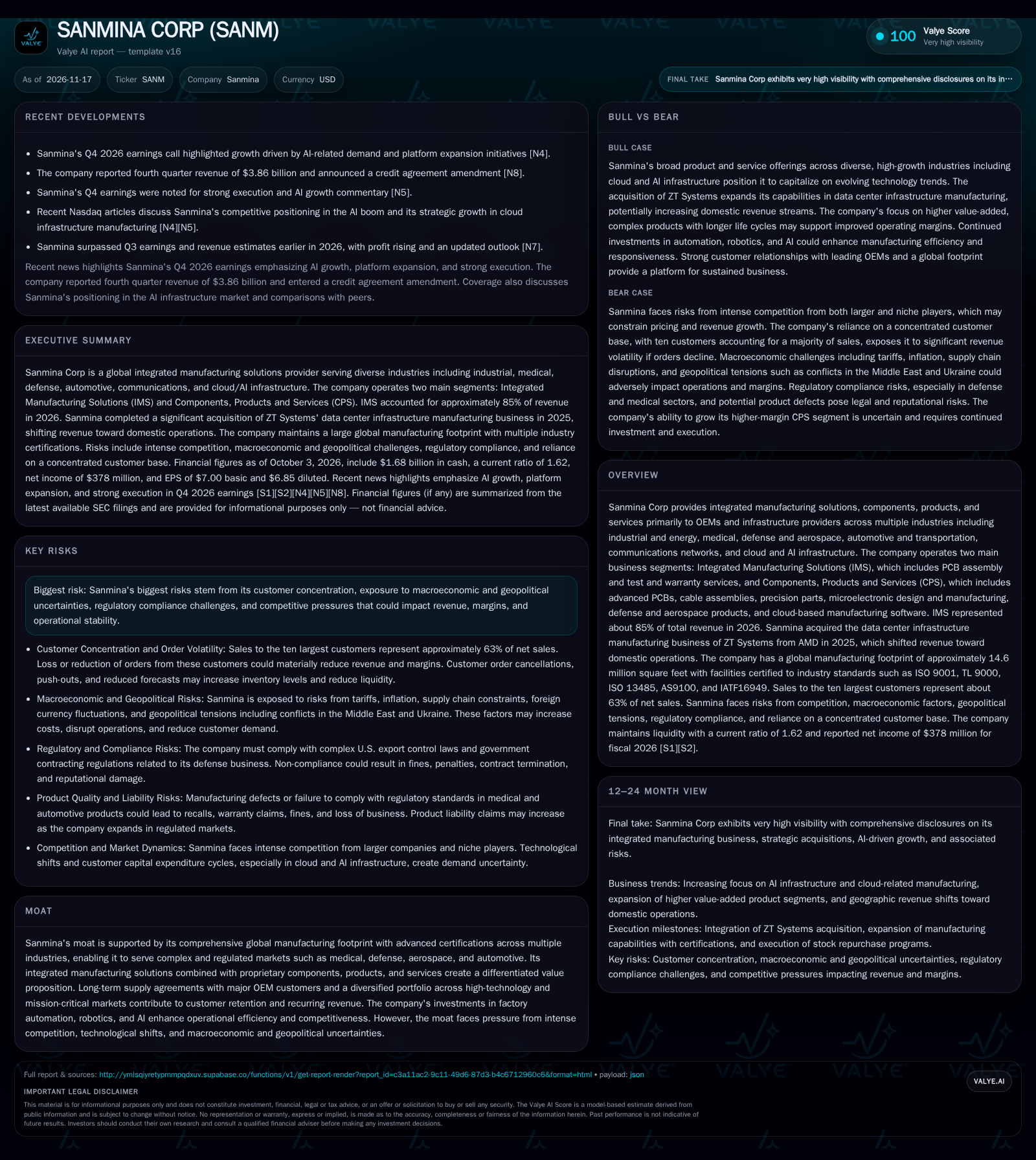
Sanmina’s 2025 acquisition of ZT Systems’ data center infrastructure business has propelled its Americas revenue mix to 72%, with U.S. and Mexico now dominating sales. Q4 2026 results highlighted $3.86 billion in revenue and management’s focus on AI-related platform expansion. With 63% of net sales tied to its ten largest customers, Sanmina’s upside is tightly linked to hyperscale demand and capital cycles. The company’s global manufacturing footprint, industry certifications, and investments in automation may support margin resilience, but intense competition, macro shocks, and volatile customer orders remain structural challenges. Monitoring integration progress, AI/cloud pipeline, and customer concentration will be critical in assessing the sustainability of recent gains. [S1] [N4] [N5] [N8]
Sanmina Corp’s business model has undergone a notable transformation since its $1.62 billion acquisition of ZT Systems’ data center infrastructure business from AMD in late 2025. The most recent quarter’s $3.86 billion revenue and management’s AI-centric commentary underscore a pivot toward serving hyperscale cloud and AI infrastructure clients. Yet, this momentum is underpinned by a highly concentrated customer base and exposure to capital expenditure cycles, making the durability of recent gains a function of both operational execution and external demand volatility. Sanmina’s global reach, advanced certifications, and automation investments provide some insulation—but the company’s next phase will hinge on its ability to balance risk and scale opportunity in the evolving electronics manufacturing landscape. [S1] [N4] [N5] [N8]
ZT Systems Acquisition and AI Demand Redefine Sanmina’s Revenue Landscape
Sanmina’s $1.62 billion acquisition of ZT Systems’ data center infrastructure manufacturing business in October 2025 has fundamentally reshaped its revenue mix and geographic exposure. In fiscal 2026, 72% of consolidated net sales originated in the Americas, with the U.S. and Mexico accounting for the majority—a significant shift from the company’s historic international orientation. Q4 2026 revenue reached $3.86 billion, and management commentary emphasized growth driven by AI-related platform expansion. However, the company’s reliance on its ten largest customers, which account for approximately 63% of net sales, remains a central structural risk. Liquidity measures as of October 2026 included $1.68 billion in cash and a current ratio of 1.62. [S1] [N4] [N5] [N8]
Manufacturing Scale, Margin Levers, and Capital Requirements in a Shifting Mix
Sanmina generates revenue primarily through long-term supply agreements with major OEMs, typically spanning 3–5 years but generally lacking minimum purchase commitments. The company’s economics are driven by scale manufacturing—especially in its Integrated Manufacturing Solutions (IMS) segment, which comprises about 85% of revenue—and by value-added work in the Components, Products and Services (CPS) segment. High fixed costs for facilities, automation, and regulatory compliance create operating leverage: incremental volume can drive margin expansion if capacity utilization remains high. However, the lack of minimum volume guarantees means revenue can be volatile, especially given customer concentration.
The ZT Systems acquisition increased Sanmina’s exposure to data center and AI infrastructure, which tend to be large-ticket, cyclical, and sometimes lower-margin compared to highly specialized medical or aerospace work. Capital requirements are significant, with ongoing investments needed for automation, robotics, AI-enabled manufacturing, and compliance with industry-specific certifications. The company reported cash and liquidity metrics for the period; these figures do not by themselves establish operating runway, investment capacity, financial flexibility, or financing capacity. [S1]
Differentiation Hinges on Certifications, Vertical Integration, and Responsiveness
Sanmina’s competitive positioning is built on its ability to deliver complex, highly certified manufacturing solutions across diverse end-markets. Its global footprint and certifications—spanning ISO, TL 9000, AS9100, and others—enable access to regulated markets such as medical, defense, and automotive. Vertical integration across the value chain (from advanced PCBs to cable assemblies and cloud-based manufacturing software) allows Sanmina to offer bundled solutions, potentially increasing switching costs for OEMs seeking single-source providers.
However, the electronics manufacturing services (EMS) sector is intensely competitive, with larger diversified players and nimble regional specialists pressuring pricing and margins. In cloud and AI infrastructure, Sanmina faces competition from both traditional EMS peers and contract manufacturers that have rapidly scaled to capture hyperscale demand. The ZT Systems acquisition may have expanded Sanmina’s capabilities, but also increases its exposure to the volatility and bargaining power of hyperscale customers—who often drive hard pricing and service terms. The durability of Sanmina’s competitive edge will depend on its ability to maintain industry certifications, execute on automation, and deepen integration with fast-evolving customer needs.
If AI and Cloud Infrastructure Demand Sustains, Operating Leverage Could Drive Margin Expansion
A favorable scenario for Sanmina depends on continued robust investment in AI and cloud infrastructure by hyperscale customers. Should demand sustain or accelerate, Sanmina’s expanded domestic manufacturing footprint and advanced automation could enable it to capture greater share of high-value, complex infrastructure builds. Higher utilization of existing facilities would amplify operating leverage, potentially driving margin expansion as fixed costs are spread over a larger revenue base.
Confirmation of this scenario would come from sustained or growing AI/cloud-related order flow, successful integration of ZT Systems with minimal disruption, and evidence that Sanmina is winning incremental business from both existing and new hyperscale customers. Additional signals would include expanding backlog (if disclosed), improvement in gross and operating margins, and management commentary pointing to a diversified pipeline beyond the top ten customers. Falsification would be indicated by stalled or declining AI/cloud orders, integration setbacks, or margin compression despite revenue growth.
Balancing Growth in High-Opportunity Segments with Enduring Cyclical and Concentration Risks
The most plausible trajectory is that Sanmina maintains elevated revenue from cloud and AI infrastructure manufacturing, but experiences continued volatility tied to capital expenditure cycles and customer concentration. The company’s broad industry reach—spanning industrial, medical, defense, and automotive—provides some diversification, but hyperscale/cloud customers remain dominant and are themselves exposed to macroeconomic and technology adoption swings.
Under this scenario, Sanmina’s operating margins remain stable to modestly improving as automation and scale offset pricing pressure. Integration of ZT Systems proceeds without major disruption, and the company leverages its certifications and vertical integration to defend share in regulated and complex markets. However, margin expansion is constrained by competitive intensity and the absence of minimum purchase commitments in major contracts. Evidence for this scenario would include stable gross margins, continued high facility utilization, and limited customer churn. Falsification would be a sharp drop in revenue from top customers, margin erosion, or significant integration missteps.
Demand Shock or Customer Loss Could Expose Volatility and Margin Compression
The principal risk is that a downturn in hyperscale/cloud capital spending, or the loss of a major customer, leads to revenue and margin compression. With 63% of net sales tied to its top ten customers, Sanmina is vulnerable to sudden order reductions, cancellations, or unfavorable renegotiations—especially as contracts generally lack minimum purchase obligations. A broader macroeconomic slowdown, geopolitical shock, or sector-specific disruption (such as regulatory changes or large-scale product recalls) could exacerbate these effects.
Evidence confirming the downside would include abrupt revenue declines, rising inventory levels, or negative operating leverage as fixed costs are spread over diminished volume. Warnings would also come from management guidance, customer order push-outs, or increased warranty and regulatory compliance costs. Falsification of the downside would require demonstration of resilient demand, diversification of the customer base, and stable or improving margins despite external shocks.
Benchmarks to Test Sanmina’s AI-Driven Manufacturing Thesis
Revenue concentration: Track the proportion of net sales attributed to the top ten customers each quarter; a decrease would suggest improving diversification.
Gross and operating margin trends: Sustained or rising margins would indicate success in leveraging scale and automation, while declines could signal pricing pressure or operational setbacks.
AI/cloud order pipeline: If disclosed, watch for growth or contraction in new orders tied to AI and cloud infrastructure, as a leading indicator of demand sustainability.
ZT Systems integration progress: Management updates on synergies, cost savings, and customer retention from the acquisition would help assess execution risk.
Capacity utilization: Higher utilization rates in U.S. and Mexico facilities would confirm demand strength and operating leverage; underutilization would raise red flags.
Backlog and contract duration: If disclosed, trends in backlog and average contract length would clarify revenue visibility and risk of sudden order swings.
Customer churn or order cancellations: Any material customer loss or large-scale order reduction should be closely monitored as a leading risk signal.
Capital expenditure and automation investment pace: Ongoing investment levels would indicate Sanmina’s commitment to staying technologically competitive and responsive to customer needs.
Disclaimer: This is research-only, informational analysis and not investment advice. It may include AI-generated interpretation and general industry context. Always verify important details using primary sources.

Comments