
Innovative Payment Solutions, Inc.: Legal Overhangs, Liquidity Strains, and the Search for a Sustainable Business Model
The absence of operational clarity and ongoing financing via convertible notes add risk, making the sustainability of recent profits and the company’s core business strategy difficult to assess.
The absence of operational clarity and ongoing financing via convertible notes add risk, making the sustainability of recent profits and the company’s core business strategy difficult to assess. Near-term outcomes hinge on legal settlements, access to new funding, and whether the company can articulate and execute a credible business plan.
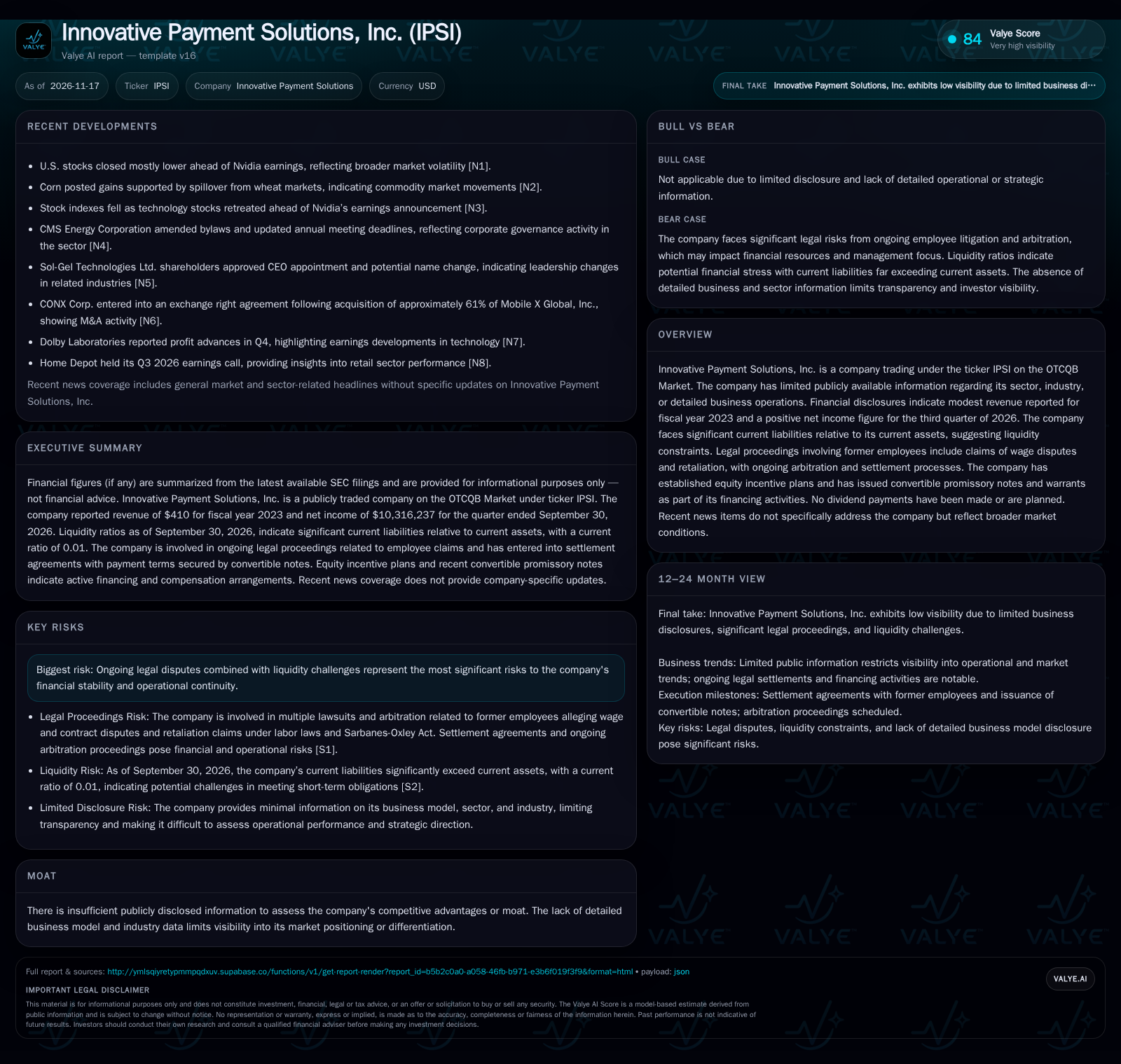
Innovative Payment Solutions, Inc. (OTCQB: IPSI) presents a striking disconnect between reported quarterly profitability and its precarious liquidity position. With a mere $4,442 in cash and over $12 million in current liabilities as of September 2026, the company’s ability to meet obligations is in serious doubt. Layered atop these financial strains are persistent legal battles with former employees, settlements secured by convertible notes, and a near-total lack of operational transparency. For investors and stakeholders, the central questions are whether the recent profit swing is repeatable, if the company can secure fresh funding, and—most critically—what the underlying business model actually is.
Recent Profitability Masks Acute Liquidity and Legal Pressures
The headline financial result for Innovative Payment Solutions, Inc. is a reported net income of $10,316,237 for the quarter ending September 30, 2026, and basic earnings per share of $0.01 [S2]. However, this profitability is overshadowed by a striking liquidity mismatch: the company held only $4,442 in cash and cash equivalents against $12,798,995 in current liabilities, resulting in a current ratio of 0.01 and a cash ratio of 0 [S2]. This imbalance signals a near-term risk of being unable to meet obligations without additional financing or asset monetization.
The company’s revenue base remains negligible, with just $410 reported for the entire 2023 fiscal year [S1]. At the same time, multiple legal proceedings—including wage, contract, and retaliation claims by former employees—are ongoing, with at least one settlement agreement requiring payments secured by convertible notes [S1]. The company continues to rely on convertible promissory notes and warrants for financing, further diluting existing shareholders and reflecting ongoing capital needs [S1].
Unclear Business Model Undermines Economic Assessment
The company’s commercial mechanics remain opaque: there is no disclosed sector, industry, or operational detail, making it impossible to verify how revenue is generated, what products or services are offered, or the nature of customer relationships. The reported $410 in 2023 revenue suggests minimal commercial activity, raising the possibility that the business is pre-revenue, dormant, or operating at a negligible scale [S1].
The company reported cash and liquidity metrics for the period; these figures do not by themselves establish operating runway, investment capacity, financial flexibility, or financing capacity. Without disclosure of cost structure, gross margins, or recurring versus one-time income components, it is impossible to analyze pricing power, operating leverage, or capital intensity. The pattern of ongoing convertible note issuance suggests a structurally negative cash flow profile, with equity and debt financing used to bridge persistent funding gaps rather than to scale a validated business model.
In addition to the absence of disclosed financial metrics, understanding the company’s capital allocation priorities would be critical for assessing long-term viability. If the firm is channeling funds primarily toward legal settlements and financing costs rather than product development or market expansion, this could indicate a defensive posture rather than growth orientation. Conversely, a shift toward investment in scalable infrastructure or technology platforms, if disclosed, would suggest an intent to build sustainable competitive advantages. Without clarity on these allocations, it is difficult to differentiate between a transient financial engineering exercise and a foundational business transformation.
Market Positioning and Differentiation Remain Undefined
With no sector or industry classification and no public details on products, technology, or customer focus, it is not possible to assess the company’s competitive positioning. In the absence of disclosed commercial activities, Innovative Payment Solutions, Inc. does not present evidence of a durable moat, brand strength, proprietary technology, or any other source of sustainable advantage.
If the company is attempting to compete in the payment solutions or fintech sector—implied by its name—it would face intense competition from both established financial services incumbents and a crowded field of technology-driven startups. These sectors typically require significant investment in compliance, technology, and customer acquisition, as well as robust risk management. The lack of disclosed partnerships, client wins, or product launches suggests the company may struggle to articulate a clear value proposition or to achieve meaningful market penetration.
Moreover, the competitive landscape in payment solutions demands not only technological innovation but also regulatory compliance and trust-building with key stakeholders such as banks, merchants, and consumers. If the company lacks a clear compliance framework or risk management protocols, it may face barriers to market entry or scaling. Additionally, network effects are often critical in fintech, where platform usage grows value exponentially. The absence of disclosed user metrics or partner ecosystems raises questions about the company’s ability to establish these network effects, which are essential for defensibility and long-term profitability.
Unlocking Hidden Value: What a Turnaround Would Require
A favorable scenario would involve the company resolving its outstanding legal disputes, successfully restructuring its balance sheet, and articulating a credible growth strategy. This could occur if the recent net income result is underpinned by a genuine improvement in business fundamentals—such as a new revenue stream, product launch, or strategic partnership—that is not yet visible in public disclosures.
Confirmation of this scenario would require the company to provide detailed updates on its business operations, customer traction, and revenue sources, as well as evidence of positive cash flow from operations. Additional signs would include new commercial contracts, the retirement of legacy liabilities, and a halt to dilutive financing. Falsification would come from continued negligible revenue, persistent legal overhangs, and further reliance on convertible debt to fund operations.
Opaque Operations and Legal/Financial Overhangs Persist
The most plausible near-term outcome is that Innovative Payment Solutions, Inc. continues to operate with minimal commercial activity, ongoing legal settlements, and a reliance on dilutive capital raises. The lack of operational disclosure means investors are left without visibility into the sustainability of recent profits or the path to recurring revenue.
This scenario would be confirmed by continued low revenue, further convertible note issuances, and a lack of substantive business updates. It would be challenged if the company were to announce a new, credible business initiative or demonstrate a reversal in liquidity trends through asset sales, capital infusions, or a meaningful uptick in operating cash flow.
Under this scenario, continued reliance on convertible notes could exacerbate shareholder dilution and increase financial leverage, potentially impairing the company’s ability to attract strategic investors or partners. The persistence of legal disputes could also divert management attention and resources away from operational improvements or market development. If the company cannot demonstrate progress in resolving these issues or generating meaningful revenues, it risks becoming trapped in a cycle of financing to cover obligations rather than to fund growth, which could erode investor confidence and limit future capital access.
Liquidity Crisis and Legal Judgments Could Trigger Insolvency
In a bearish scenario, the combination of acute liquidity shortfalls and adverse legal outcomes could force the company into bankruptcy or a fire sale of assets. If the company is unable to secure new funding or restructure its obligations, it may default on settlements and other payables, triggering creditor actions and further legal complications.
Evidence for this scenario would include missed settlement payments, acceleration of debt obligations, or formal bankruptcy filings.
Milestones That Could Redefine IPSI’s Trajectory
Disclosure of substantive business operations, including sector, products/services, and customer base, would help test the viability of the company’s underlying model.
Resolution or escalation of legal proceedings—especially settlements and arbitration outcomes—will directly impact potential financial flexibility and management bandwidth.
Evidence of recurring revenue growth (if disclosed) would indicate a transition from dormant to active commercial operations.
Updates on settlement payments and obligations under convertible notes would clarify near-term solvency risk.
Issuance of additional convertible debt or equity would signal ongoing liquidity needs and potential shareholder dilution.
Any announcement of new partnerships, product launches, or customer contracts would be a catalyst for reassessing the company’s commercial prospects.
Material changes in cash position, current liabilities, or operating cash flow would provide early warning of either recovery or distress.
Disclaimer: This is research-only, informational analysis and not investment advice. It may include AI-generated interpretation and general industry context. Always verify important details using primary sources.

Comments