
Midera Food Processing: Post-Spin-Off Operating Momentum Meets Disclosure Gaps in Global Food Equipment
Midera Food Processing, Inc., newly spun off from Middleby, is showing early signs of profitable growth and operational confidence, underpinned by a raised sales outlook and rising Q3 profits. However, incomplete financial disclosure—particularly on revenue and cash flow—limits visibility into the sustainability of its post-spin-off trajectory and the quality of its competitive positioning in the global food processing equipment market.
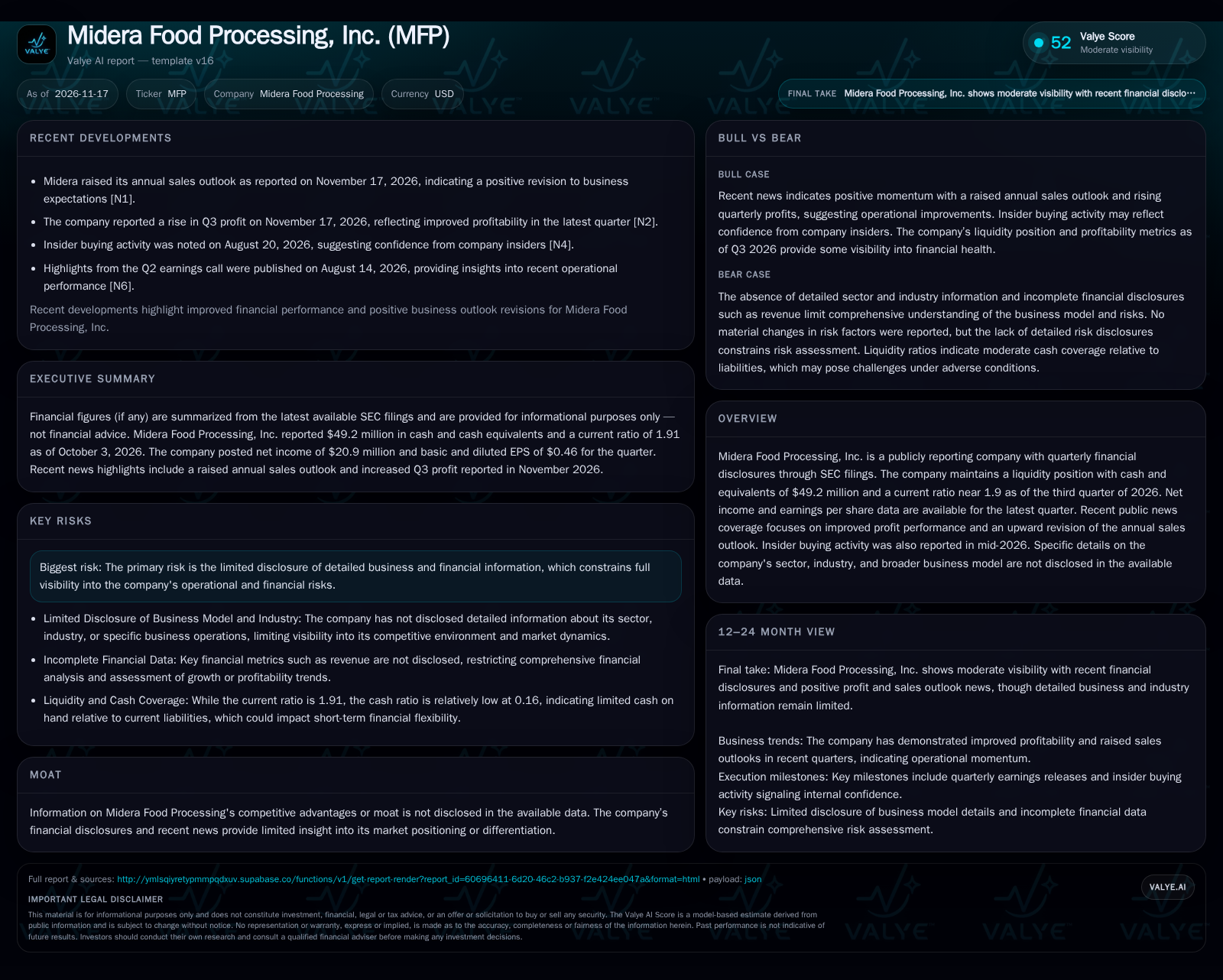
Midera Food Processing, Inc. is a recent spin-off from Middleby focused on equipment and solutions for industrial protein, bakery, and snack food processors. The company reported increased Q3 profit and raised its annual sales outlook in late 2026, with net income of $20.9 million and EPS of $0.46 for the quarter. While these results suggest operational momentum and insider confidence, incomplete financial and segment disclosure constrains full assessment of its business model durability and competitive edge. Key watchpoints include revenue growth sustainability, margin trends, and the ability to convert sales momentum into long-term shareholder value.
Midera Food Processing, Inc. has emerged from its parent, Middleby, as a newly independent player in the global food processing equipment sector, targeting industrial customers across the protein, bakery, and snack categories.Insider transaction activity was reported in the cited source; this activity does not by itself establish insider confidence. However, the lack of detailed revenue and segment disclosures—combined with modest cash coverage—means that investors must navigate significant information gaps to assess the quality and durability of Midera’s business model and competitive position.
Spin-Off, Profit Growth, and Sales Outlook Shape the Near-Term Landscape
Midera Food Processing became an independent public company in July 2026 following its spin-off from Middleby. Shortly after, the company reported net income of $20.9 million and basic and diluted earnings per share of $0.46 for the quarter ending October 3, 2026 [S1]. These results coincided with a public upward revision of its annual sales outlook and a rise in Q3 profit, as reported in November 2026 [N1] [N2]. Insider buying activity in August 2026 further suggests that key stakeholders see potential in the company’s post-spin-off trajectory [N4]. As of the third quarter, Midera reported $49.2 million in cash and equivalents, with a current ratio of 1.91 and a cash ratio of 0.16 [S1]. The company reported cash and liquidity metrics for the period; these figures do not by themselves establish operating runway, investment capacity, financial flexibility, or financing capacity.
How Midera Could Monetize Equipment, Solutions, and Aftermarket Services
Midera’s business model centers on designing, manufacturing, and servicing equipment for industrial food processors across protein, bakery, and snack segments [S1]. Revenue likely comes from a mix of capital equipment sales—potentially lumpy and subject to customer CapEx cycles—and recurring aftermarket service and parts. The company’s focus on integrated line solutions and automation may enable it to capture higher-margin projects and lock in longer-term service relationships, which can stabilize cash flows between major equipment orders.
Operating leverage in this sector tends to be significant: once fixed manufacturing, R&D, and sales infrastructure are in place, incremental sales—especially of service or consumables—can drive margin expansion. [S1]
Without specific segment or product-line data, it is not possible to determine the mix between equipment sales and aftermarket revenue, nor to assess the sustainability of recent profit improvements. If Midera’s raised sales outlook is driven by new project wins or expansion into automation and total-line solutions, there may be an opportunity for sustained higher margins and cash conversion. Conversely, if growth is tied to one-off customer orders or post-spin-off cost cutting, improvement could prove fleeting.
Assessing Midera’s Strategic Position in a Fragmented Global Market
Midera’s customer base includes major international food processors in protein and bakery, suggesting a position in the upper echelon of global equipment suppliers [S1]. The company’s portfolio spans a broad range of solutions, from food preparation and thermal processing to automation and sanitation. This breadth, combined with a global reach and local operating teams, could provide competitive advantages in customization, responsiveness, and cross-selling opportunities.
However, the industrial food processing equipment sector is highly competitive, with established multinational peers, regional specialists, and low-cost importers all vying for share. Barriers to entry include technological know-how, installed base, and the ability to service customers locally, but pricing pressure is common, especially in commoditized equipment categories. Midera’s history as part of Middleby and its stated M&A track record hint at scale and integration capabilities, but the durability of any competitive moat is unclear without evidence of proprietary technology, exclusive customer relationships, or demonstrable pricing power.
A key differentiator in this sector is the ability to bundle capital equipment with high-margin aftermarket services and to help customers achieve operational efficiencies through automation and integration. If Midera can deepen these relationships, switching costs and customer retention may rise, but this has not been established in current disclosures.
If Integrated Solutions and Aftermarket Expansion Drive Durable Growth
The most favorable scenario for Midera is that its raised sales outlook and profit growth reflect not just cyclical recovery or post-spin-off cost discipline, but a deeper shift toward higher-value, more integrated solutions. If the company is able to leverage its global reach and portfolio breadth to win large-scale automation projects and lock in multi-year aftermarket service contracts, it could achieve more stable, higher-margin revenue streams.
Evidence that would confirm this scenario includes: sustained sequential increases in revenue and gross margin; disclosure of growing backlog or multi-year project awards; rising service and aftermarket revenue mix; and customer wins in automation or end-to-end processing lines. Announcements of new technology launches, strategic partnerships, or expansion into fast-growing segments (such as alternative proteins or pet food) would further support the case for durable, above-market growth.
A falsification would be if revenue growth stalls after the post-spin-off period, margin gains reverse, or the company reports customer or geographic concentration risk. A drop in aftermarket attachment rates or loss of major accounts would also undermine the thesis.
Post-Spin-Off Normalization and Cyclical Growth Characterize the Likely Path
The most plausible path for Midera is a period of normalization following its separation from Middleby, with operating performance reflecting a blend of cyclical demand in global food processing, incremental margin improvement from cost actions, and gradual expansion of its installed base. The company’s recent profit growth and raised sales outlook suggest some momentum, but without more granular disclosure, it is likely that results are driven by a combination of catch-up CapEx from customers, selective project wins, and internal cost management.
Confirmation of this scenario would come from continued, but moderate, revenue and earnings growth in subsequent quarters, stable or slightly improved margins, and steady aftermarket/service revenue. The company might report occasional large equipment orders, but overall results would track the broader food processing equipment cycle. Falsification would involve either a sharp reacceleration (implying upside scenario) or a rapid deterioration in profitability or liquidity (implying downside).
Adverse Cycles, Disclosure Gaps, and Liquidity Constraints Could Derail Momentum
The primary risk for Midera is that its post-spin-off profit and sales momentum prove short-lived, either because of a cyclical downturn in customer CapEx, aggressive price competition, or execution missteps.
A lack of transparency on segment performance, customer concentration, or order backlog could further erode investor confidence. Evidence of rising receivables, shrinking margins, missed project milestones, or negative operating cash flow would confirm this scenario. A credit rating downgrade or need for external capital would be further red flags.
Signals That Will Test Midera’s Ability to Build a Durable Post-Spin-Off Franchise
Sustained sequential revenue growth, if disclosed, would indicate that the raised annual sales outlook is translating into real market share gains rather than one-off wins or accounting effects.
Disclosure of gross and operating margin trends, especially in relation to equipment versus service/aftermarket mix, would help assess whether recent profit improvements are cyclical or structural.
Evidence of rising backlog, large project awards, or multi-year customer contracts would support the case for revenue visibility and durable growth.
Any breakdown of segment or geographic revenue, if provided, would clarify exposure to specific end-markets, customer concentration, or regional demand cycles.
Trends in operating cash flow and working capital management would be critical for evaluating liquidity resilience and the ability to self-fund growth.
Updates on technology launches, automation projects, or new market entries (such as alternative proteins or pet food) would indicate the company’s ability to innovate and capture new profit pools.
Management commentary or investor disclosures on pricing power, competitive positioning, or customer retention would shed light on potential sources of moat or vulnerability.
Insider transaction activity was reported in the cited source; this activity does not by itself establish insider confidence.
Disclaimer: This is research-only, informational analysis and not investment advice. It may include AI-generated interpretation and general industry context. Always verify important details using primary sources.

Comments