
United Health Products: Regulatory Uncertainty and Financial Fragility Shape the Path for CelluSTAT
The interplay between FDA approval prospects, competitive industry dynamics, and urgent funding needs will determine whether CelluSTAT progresses from regulatory limbo to commercial relevance—or if strategic alternatives become the only viable path.
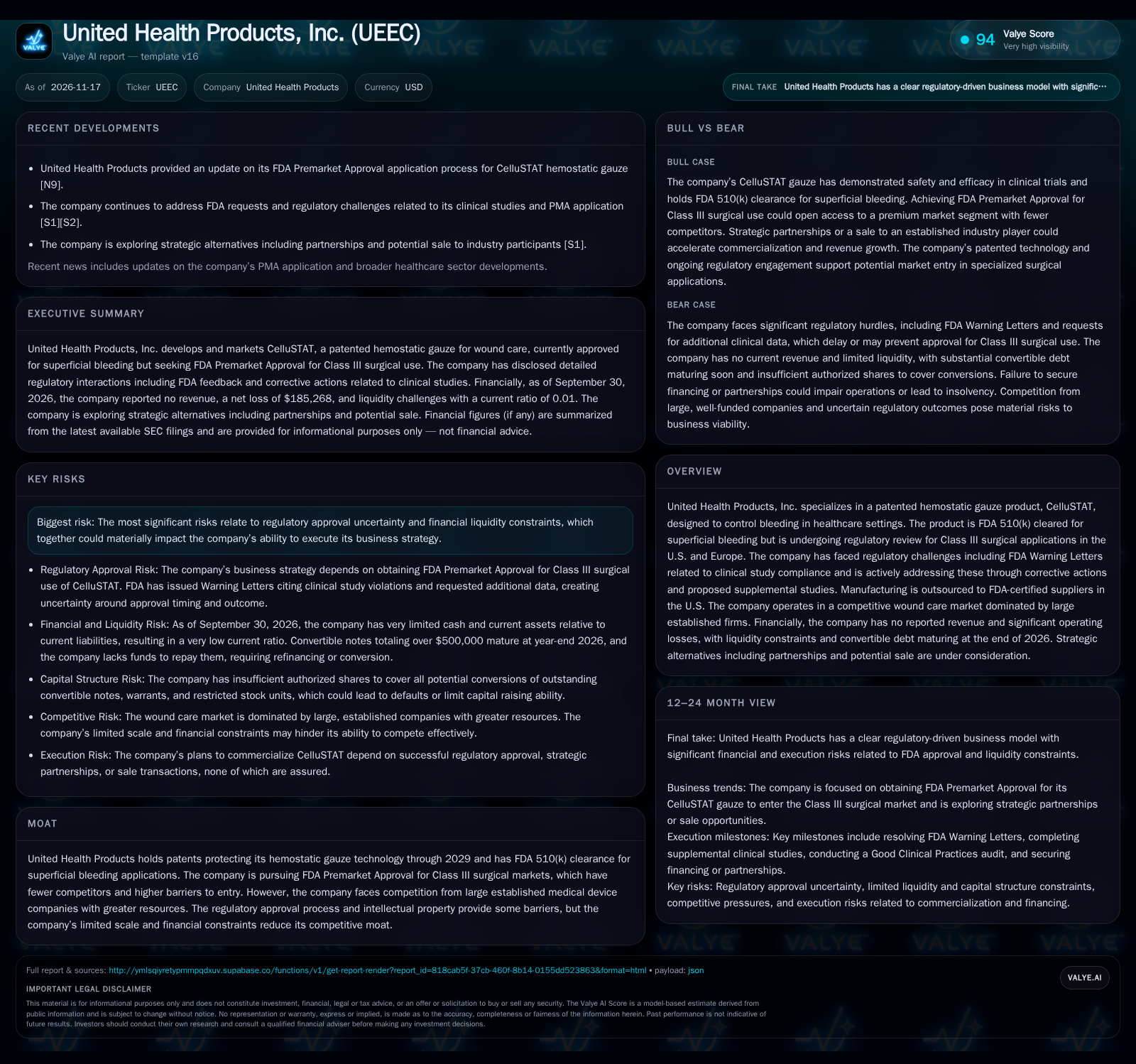
United Health Products remains pre-commercial, with its patented CelluSTAT gauze still seeking regulatory clearance for surgical markets. Its future hinges on resolving regulatory setbacks, securing a partner or buyer, and withstanding entrenched competition from industry giants.[S1] [S2]
United Health Products, Inc. stands at a precarious crossroads. Its patented CelluSTAT hemostatic gauze, designed for both superficial and (pending approval) surgical bleeding control, is mired in regulatory delays following FDA Warning Letters and demands for additional clinical data. With nearly depleted cash, mounting losses, and convertible debt maturing at the end of 2026, the company’s survival depends on its ability to resolve compliance issues, secure new funding, and potentially strike a strategic deal in a fiercely competitive wound care market. The coming quarters will reveal whether CelluSTAT can transition from regulatory purgatory to commercial viability—or whether United Health Products is forced into a more defensive maneuver.
Acute Liquidity Crunch and Regulatory Setbacks Define the Present Moment
The company reported cash and liquidity metrics for the period; these figures do not by themselves establish operating runway, investment capacity, financial flexibility, or financing capacity. [S2] [S1]
CelluSTAT’s Path to Profitability Hinges on Regulatory Progress and Commercial Execution
United Health Products’ business model is built around commercializing CelluSTAT, a patented hemostatic gauze derived from cotton and designed to address both superficial and surgical bleeding.[S1] The economics of the hemostatic wound care sector are typically attractive for approved products, with high gross margins due to premium pricing and relatively low variable production costs—especially when manufacturing is outsourced, as in United Health Products’ case. However, the company’s economics are currently theoretical: without FDA approval for Class III surgical indications, CelluSTAT is limited to lower-value markets, and the company has reported zero revenue.[S2]
If regulatory approval is eventually secured, the company could potentially benefit from substantial operating leverage—incremental sales would be expected to drop through at high margins, given the fixed cost base is relatively small and manufacturing is outsourced. However, the need for ongoing clinical studies, regulatory compliance investments, and the costs associated with commercialization, distribution, and selling in a market dominated by entrenched players could quickly absorb these potential gains. The company’s acute liquidity crisis and convertible debt overhang further constrain its ability to invest in launch activities or scale production, making external financing or a strategic transaction essential for any revenue realization.[S1] [S2]
Navigating a Market Dominated by Established Medtech Giants
United Health Products operates in a wound care market characterized by entrenched competition from major medtech firms such as Baxter, Becton Dickinson, Johnson & Johnson, Teleflex, and 3M.[S1] These companies possess substantial resources, established sales networks, broad product portfolios, and deep regulatory expertise. While CelluSTAT’s patented technology provides some protection through 2029, this intellectual property does not guarantee commercial traction—especially if larger competitors can leverage scale, bundling, or hospital relationships to defend share.
The potential for CelluSTAT to carve out a niche may depend on demonstrating clear clinical advantages, cost-effectiveness, or superior ease of use compared to incumbent products. However, United Health Products’ limited financial resources and lack of commercial infrastructure constrain its ability to conduct large-scale clinical trials, invest in marketing, or negotiate favorable purchasing agreements. Without a strategic partner or acquirer, the company may struggle to achieve the visibility and credibility required to gain hospital adoption, particularly in the high-barrier surgical segment.
Successful Regulatory Remediation and a Strategic Partner Catalyze Commercial Entry
The most favorable outcome for United Health Products would involve successfully addressing the FDA’s deficiencies and clinical study violations, leading to eventual approval for Class III surgical use. In this scenario, the company’s ongoing discussions with both the FDA and potential corporate partners bear fruit: a strategic partnership or licensing agreement provides the capital and commercial infrastructure needed to launch CelluSTAT in higher-value surgical settings.[S1]
A credible upside chain would see the company completing supplemental studies, passing a Good Clinical Practices audit, and receiving positive FDA feedback, which in turn unlocks a partnership with a larger medtech firm. This partner could rapidly scale distribution, leverage established hospital relationships, and absorb the fixed costs of commercialization. The company’s patent protection through 2029 could support premium pricing in select niches, with operating leverage driving profitability as volumes grow.
Evidence that would confirm this scenario includes FDA acceptance of supplemental data, a public partnership announcement with a major industry player, and a subsequent increase in authorized shares or new capital raised to support commercialization.
Prolonged Regulatory Limbo and Ongoing Financial Distress Force Strategic Decision
The most plausible near-term outcome is a continuation of regulatory uncertainty and financial strain. The company may make incremental progress in addressing FDA concerns, but the process could drag on, with additional requests for data or further remediation needed. In this scenario, United Health Products continues to operate with minimal resources, deferring or scaling back clinical activities due to lack of funding, while seeking buyers or partners from a position of weakness.
A strategic transaction—such as a distressed sale or licensing deal at modest terms—becomes increasingly likely as debt maturities approach and liquidity remains near zero. The company’s ability to attract interest will hinge on the perceived value of its intellectual property and the likelihood of eventual regulatory approval. Evidence for this scenario would be continued delays in regulatory milestones, additional going-concern warnings in filings, and announcements of restructuring efforts or asset sales.
Insolvency or Delisting as Regulatory and Funding Options Close Off
The adverse scenario is one in which United Health Products fails to resolve regulatory deficiencies in time, faces further FDA setbacks, and is unable to secure either financing or a strategic transaction before the convertible notes mature. With cash nearly exhausted and no revenue, the company could default on its obligations, triggering creditor action, legal proceedings, or delisting from public markets.
In this situation, CelluSTAT remains unapproved for surgical use, and the company’s intellectual property may be sold at a discount or lost entirely. Confirmation of this scenario would include public notices of default, bankruptcy filings, or announcements of asset liquidation. Signs of inability to refinance, continued inability to increase authorized shares, or breakdown in regulatory negotiations would further support this downside pathway.
Milestones That Will Determine CelluSTAT’s Fate and United Health Products’ Survival
Progress in addressing FDA Warning Letters and evidence of acceptance of supplemental clinical data or remediation plans.
Announcements or regulatory filings regarding new financing, equity raises, or successful conversion/refinancing of convertible notes.
Disclosure of strategic partnership, licensing, sale, or merger agreements with established industry players.
Updates on the company’s ability to increase authorized shares to facilitate capital raising and debt conversion.
Completion and public reporting of supplemental clinical studies or Good Clinical Practices audit results.
Any revenue generation from product sales or new commercial contracts, if disclosed.
Changes in management commentary or filings that indicate going-concern risks, asset sales, or restructuring plans.
Regulatory communications suggesting either acceleration or further delays in the PMA approval process for Class III indications.
Disclaimer: This is research-only, informational analysis and not investment advice. It may include AI-generated interpretation and general industry context. Always verify important details using primary sources.

Comments