
Grayscale Bitcoin Trust ETF's Transition to Redemption Program Reshapes Market Dynamics and Financial Outcomes
The shift to an exchange-listed redemption model in early 2024 marked a pivotal evolution for the Trust, influencing its valuation alignment and capital flows.
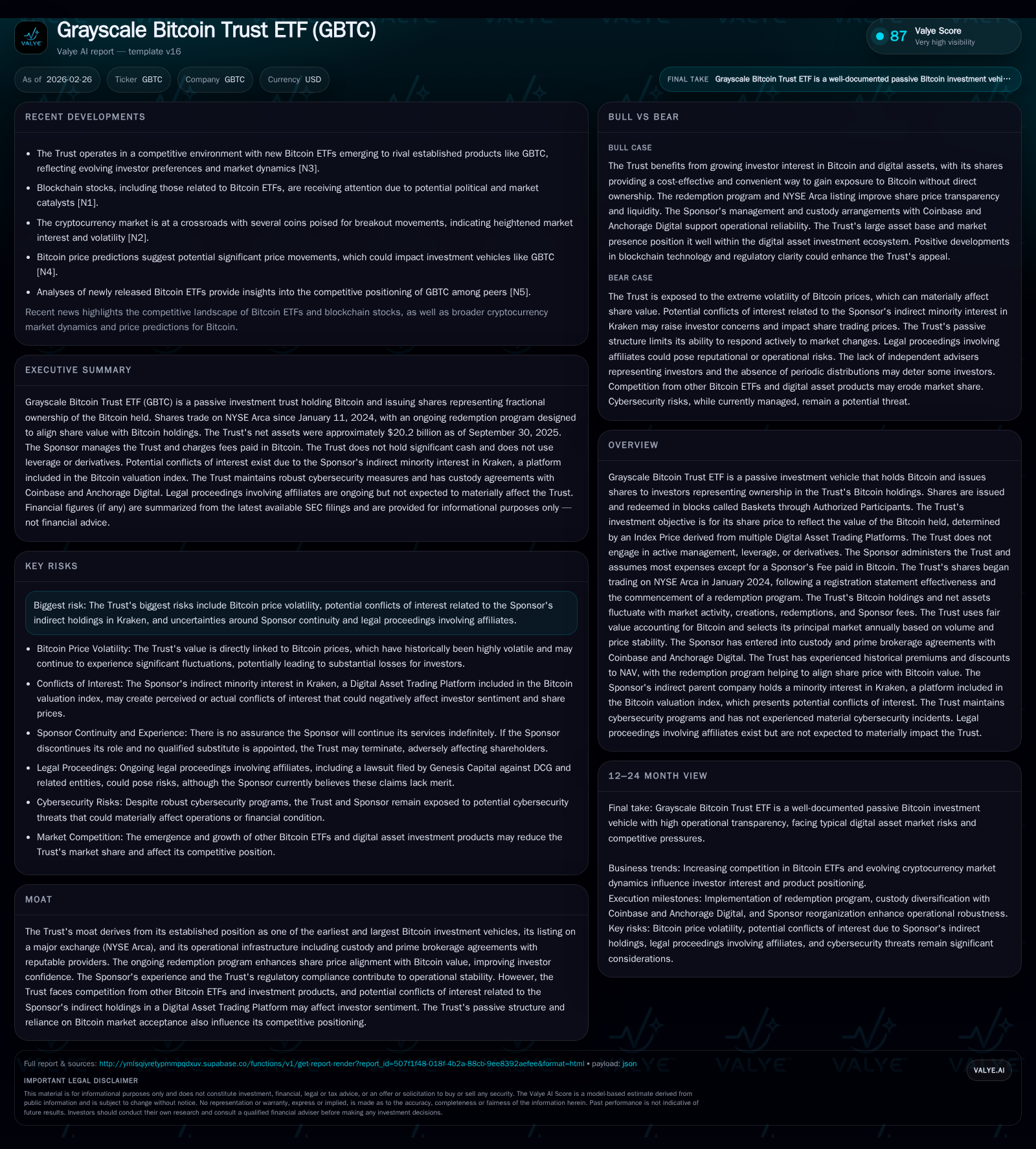
Grayscale Bitcoin Trust ETF (GBTC), historically known for trading at wide premiums and discounts relative to its Bitcoin holdings, began trading as an ETF on NYSE Arca in January 2024, introducing an ongoing redemption program that has improved NAV alignment. Despite substantial volatility driven by Bitcoin price fluctuations and regulatory uncertainties, GBTC remains one of the largest passive Bitcoin investment vehicles backed by significant infrastructure. Capital allocation reflects active management by the parent group through share repurchases, although net income swung sharply negative in 2025 due to market factors. Investors should monitor the Sponsor's ongoing relationship with digital asset platforms and legal developments as key risks.
Overview and Historical Performance
Grayscale Bitcoin Trust ETF (GBTC) operates as a passive investment vehicle holding Bitcoin and issuing shares that represent proportional ownership interests. The Trust does not engage in active management strategies, leverage, or derivatives; rather, it tracks Bitcoin prices via an Index Price derived from major digital asset trading platforms including Kraken, Coinbase, and Crypto.com [S1,S24].
Historically, GBTC shares traded on OTCQX at substantive premiums or discounts relative to NAV due to a lack of redemption capability for many years. This disparity allowed market inefficiencies but also undermined direct price alignment with Bitcoin values held by the Trust.
In January 2024, GBTC shares uplisted to NYSE Arca and implemented an ongoing redemption program allowing Authorized Participants to redeem shares directly against Bitcoin baskets. This structural shift marked a critical inflection point, tightening premium/discount spreads and enabling more efficient arbitrage relative to underlying asset values [S2,S7].
A key driver of valuation variance prior to the redemption program was limited liquidity and absent in-kind redemptions. Since launch on NYSE Arca, that dynamic has improved significantly though premiums/discounts are still occasionally present due to trading hour differences between stock markets and cryptocurrency exchanges [S19].
Summary Financials
Historical performance (annual)
| FY | Net ($bn) | CFO ($bn) | Net YoY |
|---|---|---|---|
| 2025 | -1.0 | 3.7 | -106.2% |
| 2024 | 16.1 | 21.5 |
Source: SEC companyfacts cache [F1].
Capital returns and efficiency (annual)
| FY | Buybacks ($bn) |
|---|---|
| 2025 | 4.3 |
| 2024 | 22.3 |
Source: SEC companyfacts cache [F1].
Net income plunged into negative territory in fiscal year 2025 following a very profitable year in 2024 driven primarily by Bitcoin price appreciation impacts recognized on investment holdings [F1]. Operating cash flow declined sharply but remained positive reflecting realized cash receipts from BTC transactions and sponsor fee payments settled in Bitcoin.
Capital allocation highlights included material share repurchases executed by DCG (the indirect parent company of the Sponsor), authorized up to $1 billion historically with incremental expansions; $771.8 million had been deployed under this authorization as of late 2025 [S10,S6].
The lack of dividends or distributions corroborates the Trust’s role as an accumulation vehicle focused on appreciation of underlying assets rather than income generation [S4,S5].
Growth Drivers and Constraints
Growth Opportunities
- ETF Status and Redemption Program: Since initiation of NYSE Arca listing coupled with open-ended redemption capabilities in early 2024, share price behavior has better matched Bitcoin’s underlying value compared to OTCQX trading periods. This structural reform can expand investor base via improved confidence in pricing integrity.
- Bitcoin Market Trends: The Trust’s intrinsic growth prospects are intrinsically tied to broader acceptance and adoption trends of Bitcoin itself. Any future mainstreaming or institutional adoption phases would materially benefit GBTC’s NAV through appreciation.
- Operational Infrastructure: Robust custody arrangements with qualified custodians licensed under New York Banking Law fortify the safety profile of digital asset holdings—an increasingly critical moat in volatile markets [S1,S15].
Key Limitations
- Bitcoin Price Volatility: Extreme price swings remain a significant risk factor materially impacting NAV per share as well as trading prices causing both upside opportunities and downside risks [S1,S15,S19].
- Regulatory Uncertainty: Ongoing ambiguities concerning classification of digital assets as securities vs commodities persist across U.S. regulatory bodies with potential implications for compliance costs or operational viability [S15,S26].
- Potential Conflicts of Interest: Parent company DCG holds a minority stake (<1%) in Kraken exchange whose pricing data feeds into the Index Price used by GBTC; this structural nexus raises concerns over potential conflicts that may affect price setting or perception thereof among investors [S24].
- Sponsor Continuity Risks: The Sponsor’s discontinuance could trigger termination of the Trust unless replacement arrangements are viable—a nontrivial risk given specialized expertise involved [S1,S24].
- Liquidity Dependency: Liquidity provided by Authorized Participants is essential; any failure or withdrawal could impair creation/redemption processes tightening market access [S19].
Guidance and Milestones to Watch
While no explicit numerical guidance is provided beyond regular regulatory filings, market participants should monitor:
- Evolution of premium/discount spreads post uplisting to NYSE Arca.
- Regulatory developments impacting classification or operational compliance costs.
- Legal disputes involving DCG affiliates such as Genesis Global Capital bankruptcy claims may indirectly influence perceptions.
- Sponsor stability measures including cybersecurity readiness updates given growing digital asset cybersecurity event frequency globally.
- Bitcoin market adoption metrics that drive underlying asset valuations.
Returns and Capital Allocation Analysis
The table above illustrates notable contraction in net income from fiscal year 2024’s $16 billion net income—which largely reflects unrealized gains via accounting for rising BTC prices—to a nearly $1 billion net loss for calendar year ending December 31, 2025 [F1]. Such swings highlight how sensitive GBTC’s P&L is to underlying cryptocurrency price cycles rather than traditional business operations.
Operating cash flows dropped over 80% year-over-year yet remained positive at nearly $3.7 billion due largely to realized gains from redemptions or fee settlements transacted in Bitcoin rather than cash flows typical for operating businesses [F1,S25,S28].
Buyback activity declined but remained substantial at just over $4 billion spent repurchasing shares versus over $22 billion outlayed in prior year periods—this underscores parent company commitment towards supporting share prices amid crypto volatility swings [F1,S10].
No dividends have been declared or distributed consistent with its structure focused solely on capital appreciation exposure via holding BTC rather than generating periodic income streams for shareholders [S4,S5].
Strategic Moat & Competitive Positioning
GBTC remains one of the earliest large-scale publicly traded vehicles offering institutional-like access to Bitcoin investment exposure within regulated U.S.-listed securities frameworks. Its listing on NYSE Arca combined with operational infrastructure including fully qualified custodians, prime brokerage agreements, and automated creation/redemption mechanisms constitute meaningful competitive moats.
However, competition continues intensifying from competing Bitcoin ETFs launched by other firms offering potentially lower fees or different structures that may attract retail/institutional flows away from GBTC.
Concerns around the indirect exposure through DCG's stake in Kraken—the latter being included within the basket of Digital Asset Trading Platforms feeding into their Index Price—represent reputational vulnerabilities that may temper some demand especially among highly risk-conscious investors who prefer fully independent pricing sources.[S24]
Risk Factors Summary
Principal risks revolve around market volatility; regulatory uncertainty including potential classification shifts of cryptocurrencies as securities; reliance on third-party providers for custody; legal exposures particular with affiliated entities involved in bankruptcy proceedings; redemption program suspension risks which could result in discount widening; absence of dividend payments limiting income appeal; and susceptibility stemming from Sponsor discontinuance risk.
Cybersecurity controls have been robust with no material incidents reported till end of FY25 despite industry-wide threat escalation[S20]. Yet vigilance remains paramount given increasing attack sophistication on digital financial infrastructures.
Conclusion
GBTC's transformation into an exchange-listed product with an ongoing redemption program has materially enhanced its structural integrity relative to NAV pricing distortions experienced historically. The Trust remains a dominant player offering convenient exposure to Bitcoin though returns continue closely tied to underlying asset volatility.
Continued monitoring of regulatory developments, legal proceedings involving affiliated entities like DCG, evolving competitive landscape among crypto ETFs, sponsor continuity assurances, and premium/discount dynamics will inform assessments about future performance prospects.
This report is based exclusively on publicly available SEC filings up to February 26, 2026 ([F1],[S1]–[S28]) without providing investment advice.
Disclaimer: This is research-only, informational analysis and not investment advice. It may include AI-generated interpretation and general industry context. Always verify important details using primary sources.

Comments