
Glucotrack Faces Nasdaq Delisting While Advancing Implantable Glucose Monitor Trials
Glucotrack shifts clinical focus to U.S. FDA pathway for its implantable CBGM amid continued financial challenges and impending stock delisting.
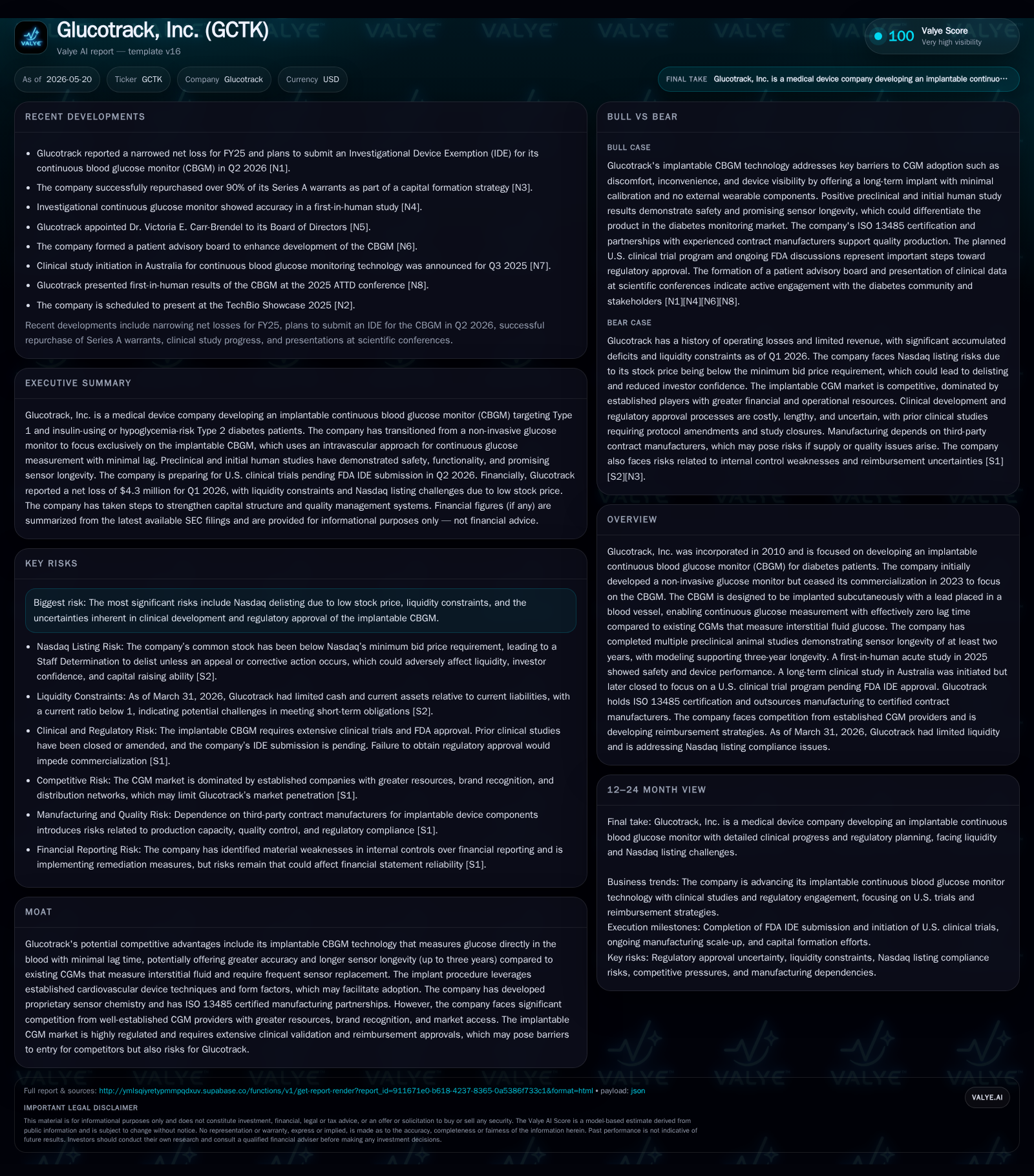
Glucotrack, Inc., a medical device company focused on an implantable continuous blood glucose monitor (CBGM), reported no material change in risk factors but disclosed receipt of a Nasdaq Staff Determination to delist its stock due to sustained low bid price. The company is accelerating discussions with the FDA to initiate a U.S. clinical trial program for the CBGM, aiming for regulatory approval in a market dominated by established CGM providers. Despite promising preclinical data showing sensor longevity up to three years, Glucotrack faces significant operational risks related to clinical trials, regulatory uncertainty, and liquidity constraints. The company holds ISO 13485 certification and has strategic manufacturing partnerships but must resolve key regulatory milestones and financial hurdles for sustained growth.
Recent Operating Update
Glucotrack's most recent quarterly filing dated May 14, 2026 [S2] confirmed that there have been no material changes in previously disclosed risk factors but revealed the critical development that the Nasdaq Stock Market LLC has determined to delist Glucotrack’s common stock. This decision arises from a sustained closing bid price below $1.00 over the prior 30 consecutive trading days as defined by Nasdaq Listing Rule 5550(a)(2). Importantly, Glucotrack is barred from the customary 180-day compliance period typically afforded under this rule due to having effected cumulative reverse stock splits exceeding a ratio of 250:1 within the last two years. The delisting would be effective post-May 20, 2026 unless Glucotrack requests an appeal before the Nasdaq Hearings Panel—a step the company intends to pursue along with presenting a plan to regain compliance [S2][S3].
This latest event marks a significant near-term catalyst reflecting challenges in investor sentiment amid operational headwinds.
Alongside this structural market disclosure, Glucotrack indicated it issued a press release simultaneously reporting operating results for Q1 ended March 31, 2026 without notable deviation from previous guidance or operational outlooks [S16][S20]
Business Model
Glucotrack operates as a medical device developer focused exclusively on creating an implantable continuous blood glucose monitor (CBGM) designed for patients with Type 1 diabetes and those with insulin-dependent Type 2 diabetes or at risk of hypoglycemia [S1]. The company's revenue model will ultimately center around selling implantable sensors coupled with required implantation procedures and possible follow-up services including device removal or replacement due to sensor lifespan expiration.
The business' unique value proposition lies in leveraging intravascular sensing technology—implanting the sensor subcutaneously with a lead inserted directly into a blood vessel—to continuously measure glucose concentration in blood rather than interstitial fluid where existing CGMs operate. This approach aims to overcome known limitations such as physiological time lag inherent in interstitial measurements and improves accuracy with essentially zero delay relative to blood glucose fluctuations [S1][S25].
Currently pre-commercial with no substantial product sales since the initial non-invasive Glucotrack device was withdrawn from commercial markets after retracting CE Mark authorization in 2023 due to insufficient accuracy and evolving market trends towards continuous monitoring [S1], Glucotrack’s path forward depends heavily on successful regulatory clearance of its implantable CBGM.
The company outsources manufacture of core CBGM components—both electronic assemblies and sensor leads—to contract manufacturing organizations certified under ISO13485 standards specialized in active implantables. These partnerships ensure quality management system compliance aligned with global regulatory expectations such as FDA and EMA requirements [S7].
Industry Structure and Competitive Position
Glucose monitoring technologies operate within highly regulated medical device sectors characterized by stringent clinical validation imperatives and reimbursement challenges. The CGM market is dominated today by large-cap players such as Dexcom (a recognized pioneer in transcutaneous CGMs) and Medtronic Diabetes with deeply entrenched customer relationships among patients, healthcare providers, and payors.
Within this ecosystem, implantable CGMs remain nascent but potentially transformative given their promise for improved patient convenience through longer wearable life span—targeting up to three years versus roughly one week for many existing sensors—and possibly enhanced measurement accuracy by sampling blood directly rather than interstitial fluid.
While this strategic positioning offers clear differentiation theoretically anchored by novel sensor chemistry innovations and familiar cardiovascular device implantation techniques enabling ease of adoption among implanting physicians [S1][S25], Glucotrack faces formidable barriers:
- Regulatory uncertainty typical for novel invasive devices necessitating multi-phase extensive clinical trials.
- Competitive pressure from established CGM vendors rapidly innovating their product portfolios.
- Market access complexity including securing adequate third-party reimbursement which can be fragmented across geographies.
- Financial resource constraints that may limit marketing penetration or scale deployment.
Growth Drivers
Advancement Toward U.S. Clinical Trials
The foremost near-term growth driver remains regulatory progress within the United States where Glucotrack is expediting preparations for launching its IDE-approved feasibility study scheduled for second half of 2026 following submission expected in Q2 2026 [S5][S7]. Gaining FDA IDE approval will unlock access to pivotal human data necessary for eventual marketing authorization enabling commercial launch
Sensor Longevity & Accuracy Demonstrations
The company's R&D progression evidences promising technical advances: laboratory feasibility studies confirmed at least two-year sensor viability; subsequent animal studies demonstrated safe operation up to six months post-implant; modeling combined with bench testing suggest three-year sensor lifetime feasible; preliminary human acute trials established safety profile without substantive adverse events [S1][S25]. This longevity contrasts favorably against competitors’ shorter-duration sensors potentially reducing patient burden from frequent replacements.
Manufacturing Quality Assurance & Scale Readiness
ISO13485 certification obtained through British Standards Institute affirms production quality control compliant with global standards enhancing readiness for scaling production upon regulatory approvals [S7]. Multiple contract manufacturers provide supply redundancy critical for risk mitigation as commercial activities unfold
Reimbursement Planning Early Engagements
Anticipating cost pressures within healthcare systems globally, Glucotrack has initiated early-stage reimbursement strategy planning engaging leading consultants focused on CGM landscapes plus cardiovascular device reimbursement parallels relevant given procedural similarities. Although coding applications hinge upon FDA regulatory clearance timing, proactivity here could smooth payer acceptance pathways crucial for market uptake economics [S13].
Risks and Constraints
Nascent Clinical & Regulatory Pathway Risks
Despite positive early preclinical results, there is inherent uncertainty around device efficacy/safety as larger-scale clinical trials progress—a common challenge that has derailed peer medical devices even after promising starts. Delay or negative outcome in these trials may significantly impact prospects.
Financial Liquidity Constraints & Stock Market Delisting Risk
As of March 31, 2026, Glucotrack held approximately $3.9 million in cash and equivalents with total debt negligible at about $12 thousand, resulting in a net cash position [F1]. However, current liabilities of approximately $5 million exceed current assets of about $4.2 million, yielding a current ratio near 0.85, which indicates potential short-term liquidity constraints amid ongoing R&D and administrative expenditures [F1]. Historically, operating losses have been significant, with a net loss of approximately $19 million in FY2025 contributing to accumulated deficits exceeding $150 million [F1][S4]. The Nasdaq delisting risk further complicates access to capital markets.
Competitive Pressures From Established Players
Incumbent CGM providers possess substantial brand recognition and deeper financial resources allowing multidimensional investment across R&D pipelines, marketing distribution networks, user ecosystem integrations—which could constrain rapid customer adoption if Glucotrack’s approvals come late or perceived incremental benefits are modest.
Reimbursement Challenges Post Approval
Fragmented insurance coverage environments particularly outside major markets like the U.S., complex healthcare payer negotiations ahead along with evolving legislative scrutiny over medical device pricing present material obstacles affecting ultimate patient accessibility.
What To Watch Next
- Approval or feedback timing on IDE submission anticipated mid-2026 signaling potential study commencement milestones.
- Outcome of hearing panel appeal regarding Nasdaq delisting decision potentially impacting capital markets access.
- Updates on patient enrollment progression or protocol amendments during U.S.-based trials providing signal on clinical development pace.
- Advances in manufacturing scale-up readiness or further enhancements validating sensor longevity beyond three years.
- Emerging reimbursement insights following initial engagements detailing potential coverage pathways or coding strategies.
Financial Profile Summary
Cash reserves as of March 31, 2026 were approximately $3.9 million while total debt remained negligible (~$12 thousand), resulting in net cash position but limited absolute liquidity given near-term payables slightly exceeding current assets (current liabilities ~ $5 million) indicating tight working capital situation ([F1]). Historically operating losses have been significant totaling nearly $20 million in net loss during FY2025 reflecting ongoing R&D investment without product revenue yet realized [F1].[S4]
This financial footing underscores ongoing capital needs which must be met through equity issuance or other financing methods amid challenging market conditions exacerbated by potential delisting [S15].
This analysis is based solely on public SEC disclosures through May 20, 2026 without any forward-looking projections beyond what is documented. It aims to provide a fact-based operational view without investment research views or speculative commentary.
Disclaimer: This is research-only, informational analysis and not investment advice. It may include AI-generated interpretation and general industry context. Always verify important details using primary sources.

Comments